

Published on: June 9, 2026 | Time to read: 22 min
What Is LLM Prompting and Why Is It a Critical Skill?
LLM prompting is the process of crafting inputs to guide a large language model toward a specific, useful output. It's not just asking a question. It's a form of communication and instruction that shapes how an AI understands and responds to your needs.
Think of it like giving directions. Vague directions lead to wrong turns. Clear, detailed directions get you exactly where you want to go. The same logic applies here.
The Quality of Your Input Shapes Everything
The gap between a bad AI response and a great one usually comes down to how the prompt was written. Generic prompts produce generic results. Specific, well-structured prompts unlock outputs that are actually useful.
The numbers back this up. Research shows that structured prompts outperform casual prompts by 15% to 94% depending on the task. That's a huge range, and it shows just how much the craft of prompting matters.
And it's not just output quality. Teams using smart prompting strategies have seen up to 30% faster turnaround times on writing and editing work. That's real time saved, every single day.
Who Needs to Know This?
LLM prompting isn't just for AI researchers or engineers. It's a skill that crosses nearly every role.
- Marketers use it to generate campaign copy, brainstorm ideas, and draft social content faster
- Developers rely on it to write, debug, and document code with AI assistance
- Analysts apply it to summarize reports, extract patterns, and simplify complex data
- Business leaders use it for strategic planning, drafting memos, and synthesizing research
No matter your job, the better you are at prompting, the more value you get from any AI tool you use. It's quickly becoming one of the most practical skills in the modern workplace.
The Core Principles of Effective Prompt Design
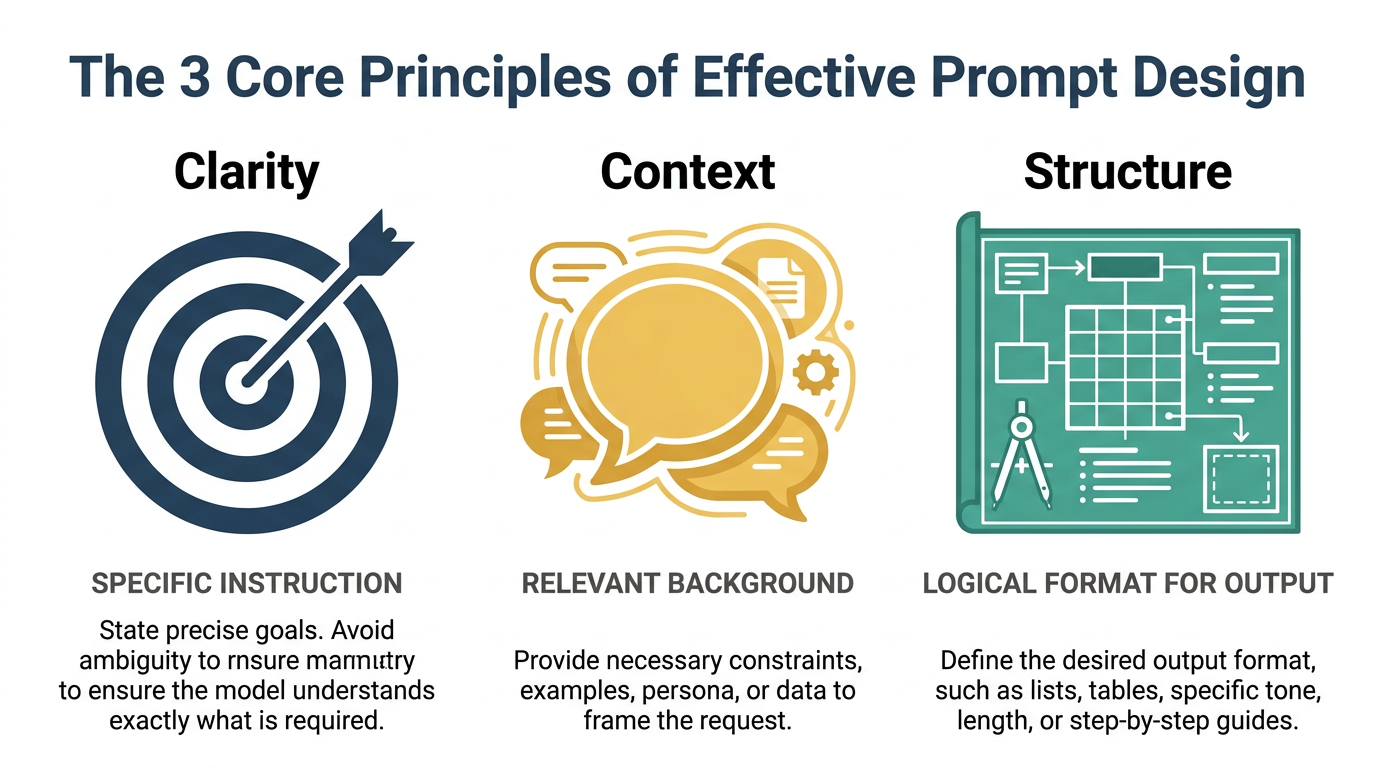
Effective prompt design comes down to three things: clarity, context, and structure. When you give an AI clear instructions with enough background and a defined format, you get much better results. Skip any one of these, and the output usually falls flat.
Principle 1: Be Specific and Clear
Vague prompts are the number one reason people get unhelpful AI responses. If your prompt is broad, the AI fills in the gaps with guesses. And those guesses rarely match what you actually wanted.
Being specific means stating exactly what you want. It also means telling the AI what you don't want. Negative constraints like "don't use bullet points" or "avoid technical jargon" are just as useful as positive ones.
For example, instead of asking "write something about productivity," try "write a 150-word paragraph about time-blocking for remote workers, avoid using statistics, and keep the tone casual." The second version leaves no room for confusion.
Research from arXiv's 2025 prompting study found that 83.7% of respondents agreed clearer, more specific prompts consistently lead to better AI outputs.
Principle 2: Provide Sufficient Context
An AI model only knows what you tell it. It has no idea about your industry, your audience, your goals, or your preferences unless you spell it out.
Good context answers questions the AI might have. Who is this for? What problem are we solving? What has already been tried? What matters most here?
Think of it like onboarding a new teammate. You wouldn't hand them a task with zero background and expect great results. The same logic applies to prompting.
Principle 3: Define the Persona, Format, and Tone
This is where many prompts go from decent to excellent. Telling the AI who to be, how to format the output, and what tone to use creates a very tight frame for the response.
For persona, try something like "Act as an experienced marketing strategist" or "Respond as a patient teacher explaining to a beginner." This shifts how the model approaches the task.
For format, be direct: "Give me a numbered list," "Write this as a short paragraph," or "Use headers for each section." For tone, say "keep it conversational" or "write formally for a corporate audience."
Combining all three elements in a single prompt puts you in full control of the output. It's the difference between getting something usable and getting something you actually want to publish or use.
Fundamental LLM Prompting Techniques Everyone Should Know
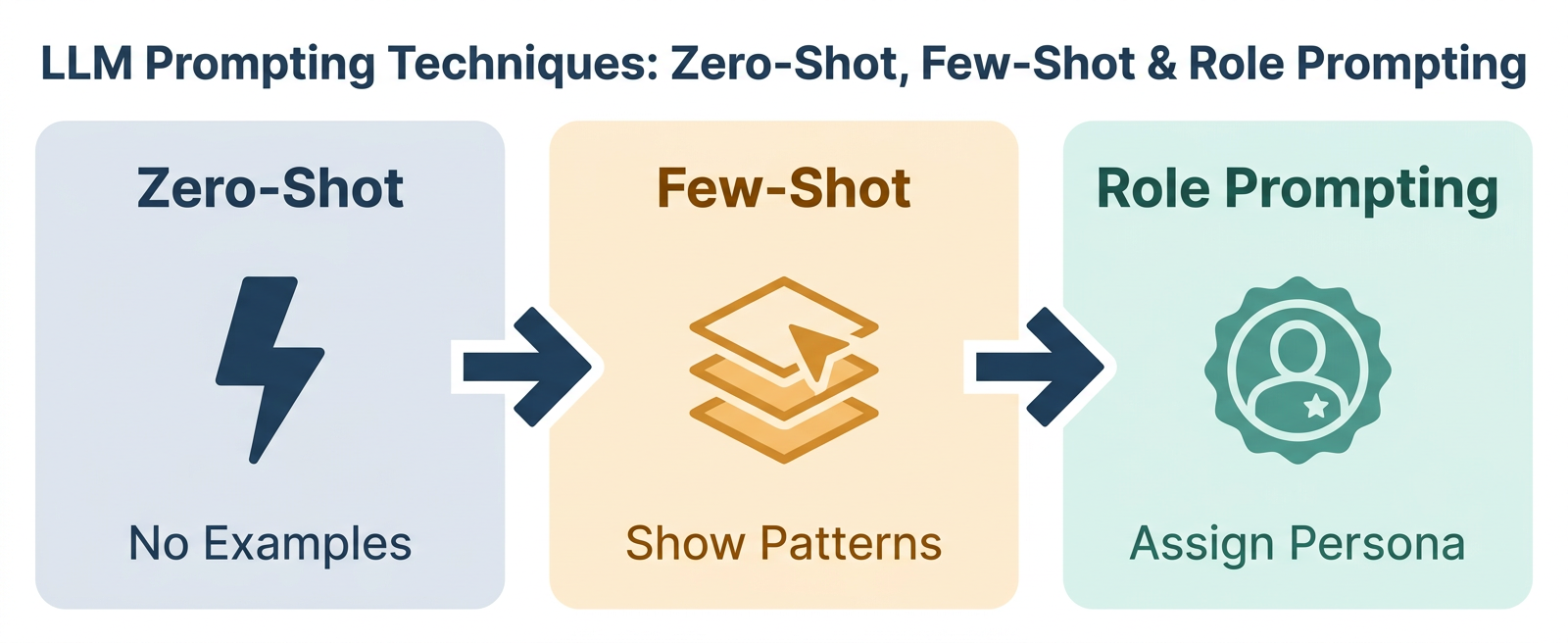
There are three core LLM prompting techniques that form the foundation of effective AI communication: zero-shot, few-shot, and role prompting. Each one gives you a different level of control over how the model responds, and knowing when to use each one makes a real difference in your results.
Zero-Shot Prompting: No Examples Needed
Zero-shot prompting is the simplest approach. You give the model a task and it answers based entirely on what it already knows. No examples, no demonstrations, just a clear instruction.
This works well for straightforward tasks. Ask the AI to summarize a paragraph, translate a sentence, or answer a factual question, and it handles it without any hand-holding. Zero-shot prompting tests the model's built-in understanding of your task.
But it has limits. For complex or format-specific tasks, the model's guess about what you want may not match what you actually need. That's where few-shot prompting comes in.
Few-Shot Prompting: Show, Don't Just Tell
Few-shot prompting means including two or three examples of the input and output pattern you want before making your actual request. You're showing the model exactly what a good response looks like.
This approach dramatically improves accuracy for tasks that need a specific format, tone, or structure. According to Prompting Guide's breakdown of few-shot techniques, adding examples helps the model infer the right label mapping or output style when the task is ambiguous.
For instance, if you want product descriptions written in a punchy, two-sentence style, show two examples first. The model picks up the pattern and applies it to your actual request. It's one of the fastest ways to close the gap between what you imagined and what the AI produces.
Research consistently backs this up. Few-shot examples improve pattern matching by roughly 20 to 35 percent compared to zero-shot prompts on the same task, particularly for classification and structured output work.
Role Prompting: Give the AI a Job Title
Role prompting means telling the model who to be before you make your request. Phrases like "Act as an experienced data analyst" or "You are a friendly customer support agent" shift the tone, vocabulary, and perspective of every response that follows.
This technique is especially useful when you need a specific voice or level of expertise. A prompt starting with "You are a senior copywriter" will produce very different output than one with no role assigned at all. The model adjusts its approach based on the persona you define.
Role prompting pairs well with both zero-shot and few-shot techniques. You can set the role first, then provide examples, then make your request. Layering these methods gives you tight control over the final output.
These three techniques are your starting point. They're simple to learn, easy to apply, and they cover the majority of everyday prompting needs across almost any use case.
Advanced LLM Prompting Techniques for Complex Tasks
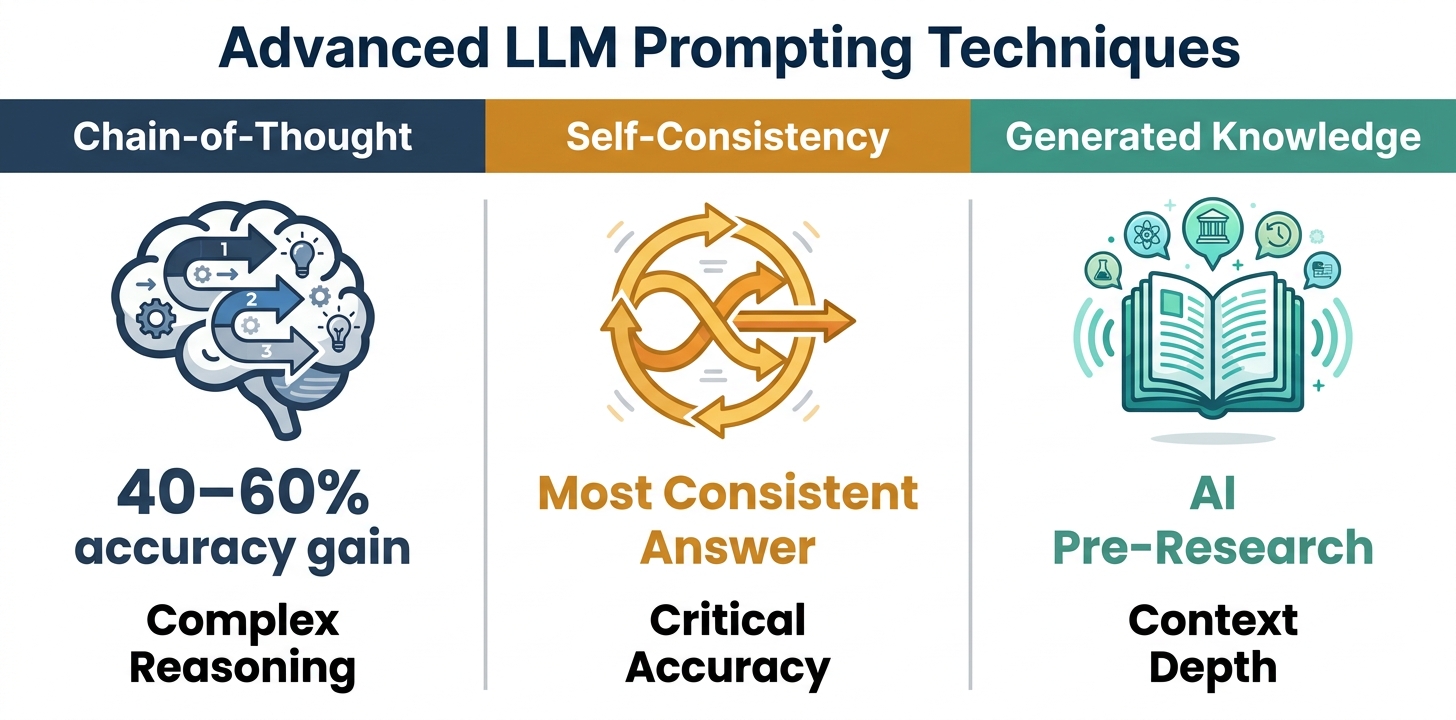
Once you've got the basics down, advanced LLM prompting techniques help you tackle harder problems. Chain-of-thought prompting, self-consistency, and generated knowledge prompting give you more control over complex reasoning tasks. These methods push AI outputs from decent to genuinely impressive.
Chain-of-Thought Prompting: Think It Through Step by Step
Chain-of-thought (CoT) prompting is a technique where you ask the model to reason through a problem before giving a final answer. Instead of jumping straight to a conclusion, the AI walks through its thinking one step at a time.
The idea is simple. You include a phrase like "think step by step" or show the model an example where the reasoning is written out in stages. This small shift produces dramatically better results on complex tasks.
CoT prompting was introduced in a landmark 2022 paper showing that guiding models through intermediate reasoning steps significantly improves accuracy on arithmetic, commonsense, and symbolic tasks. According to AWS's overview of chain-of-thought prompting, this approach works especially well in large models and is most useful when the task requires multi-step logic.
Research shows CoT prompting can improve reasoning accuracy by 40% to 60% compared to standard prompts on the same tasks. That's a significant jump for anyone working with data analysis, planning problems, or complex decision support.
Here's a quick comparison of what this looks like in practice:
| Prompt Type | Example | What Happens |
|---|---|---|
| Standard prompt | "What is 17 x 8?" | Model answers directly, may skip steps |
| CoT prompt | "What is 17 x 8? Think step by step." | Model shows working: 17 x 8 = 10x8 + 7x8 = 80 + 56 = 136 |
Self-Consistency: Run It Multiple Times, Pick the Best Answer
Self-consistency takes chain-of-thought one step further. Instead of running a prompt once, you run the same prompt several times with slight variation in how the model generates responses. Then you compare the outputs and select the answer that shows up most often.
This works because language models don't always produce the same answer twice. Sampling multiple reasoning paths and choosing the most common result filters out flukes and reduces error on tricky problems.
According to PromptHub's guide on self-consistency prompting, this method is particularly effective for tasks like math word problems, logical reasoning, and any situation where one wrong step can throw off the whole answer.
The process looks like this:
- Write your CoT prompt
- Run it multiple times
- Compare the final answers across each run
- Pick the answer that appears most consistently
You don't need to do this manually. Tools like LangChain and LlamaIndex can automate multi-sample generation and apply majority voting logic to find the most consistent answer at scale.
Generated Knowledge Prompting: Let the AI Build Its Own Context
Generated knowledge prompting flips the usual process. Instead of jumping straight to your question, you first ask the model to generate relevant facts or background information. Then you use that self-generated knowledge as context for the actual question.
It's a two-step approach. Step one: "Tell me five key facts about X." Step two: "Using those facts, now answer Y."
This matters because AI models sometimes skip important background when answering directly. By forcing the model to surface its own knowledge first, you reduce the chance of shallow or incomplete answers.
This technique works especially well for topics where accuracy matters. Think research summaries, policy analysis, or any task where missing context leads to weak output. You're essentially asking the AI to do its own pre-work before writing the final response.
All three of these advanced techniques build on each other. Start with chain-of-thought to improve reasoning. Add self-consistency when accuracy is critical. Use generated knowledge when context depth is the main challenge. Together, they give you a practical toolkit for getting reliable, high-quality results from even the most complex tasks.
The C.R.A.F.T. Framework: A New Model for Exceptional AI Prompts
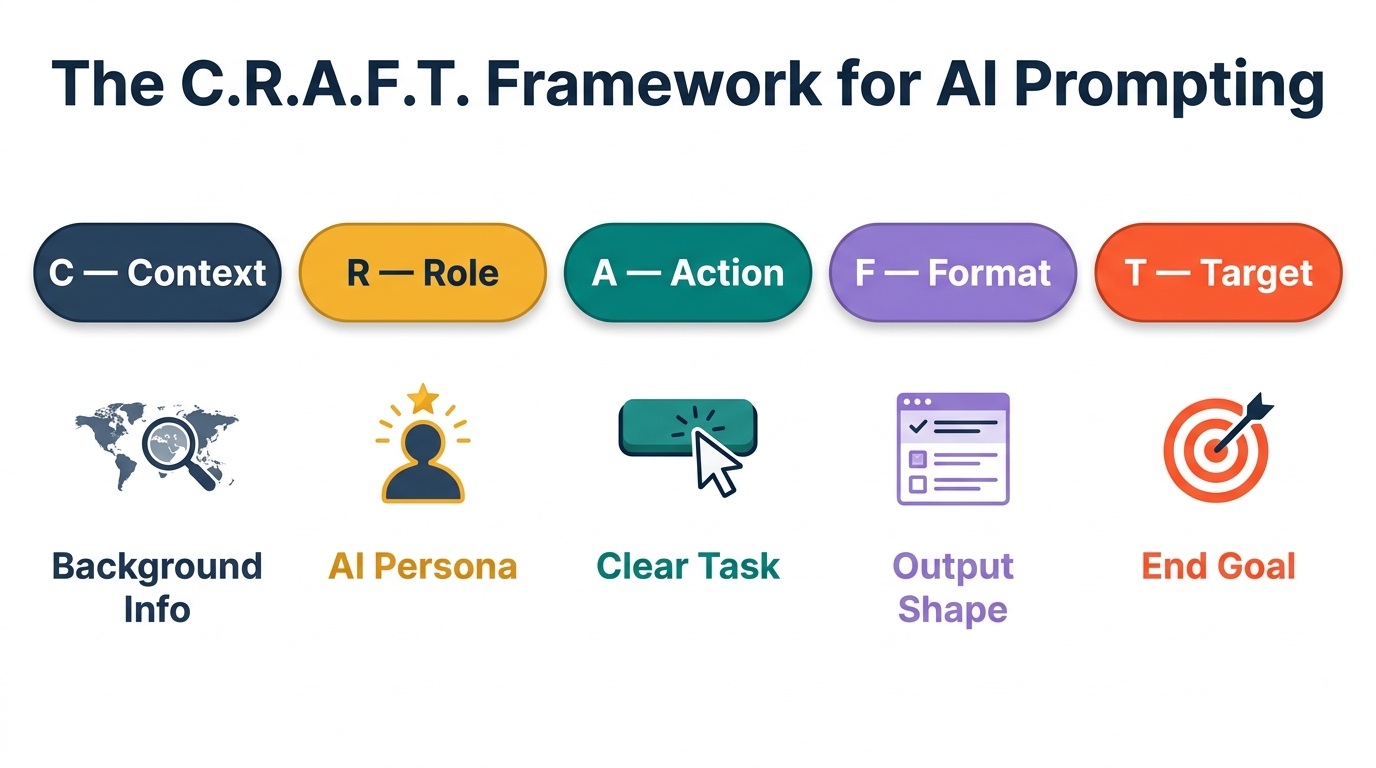
The C.R.A.F.T. framework is a five-part structure for building better AI prompts. Each letter stands for a key ingredient: Context, Role, Action, Format, and Target. Together, they turn vague requests into precise instructions that consistently produce high-quality outputs.
Breaking Down Each Component
Context means giving the AI background information before making your request. Who is the audience? What situation does this apply to? What constraints exist? Without context, the model fills in the blanks with guesses.Role means assigning the AI a persona. "Act as a senior content strategist" or "You are a technical writer for a SaaS company" shifts how the model approaches every word. It changes tone, vocabulary, and assumed expertise.
Action is the verb at the heart of your prompt. Write, summarize, analyze, compare, rewrite. Be direct. A clear action removes ambiguity and tells the model exactly what job it's doing.
Format defines what the output should look like. Should it be a bulleted list? A two-paragraph summary? A table? A numbered sequence of steps? Spelling this out prevents the model from choosing a format you didn't want.
Target specifies the goal or objective behind the request. What outcome does this output serve? Who will use it, and why? This final layer helps the model calibrate the depth, length, and emphasis of its response.
A C.R.A.F.T. Prompt vs. a Simple Query
Here's what the difference looks like in practice. Imagine you need help writing marketing copy for a new project management tool.
Simple query: "Write marketing copy for a project management tool."This works, but the output will be generic. The model doesn't know your audience, your tone, or your goal.
C.R.A.F.T. version:- Context: The audience is small business owners who feel overwhelmed by complex software
- Role: Act as an experienced B2B copywriter who specializes in simple, benefit-driven messaging
- Action: Write a short homepage headline and sub-headline
- Format: Two lines, headline under 10 words, sub-headline under 20 words
- Target: The goal is to get a visitor to click the free trial button
The second version gives the model everything it needs. The output is tighter, more relevant, and far more usable without heavy editing.
According to Stanford's 2025 AI Index Report, 78% of organizations used AI in 2024, up from 55% the year before. As more teams rely on AI tools daily, having a repeatable framework for prompt construction becomes a real competitive advantage.
Your Copy-and-Paste C.R.A.F.T. Template
Use this blank template any time you need to build a prompt from scratch:
| Component | Your Input |
|---|---|
| Context | [Background info, audience, situation, constraints] |
| Role | [Who should the AI be? What expertise or voice?] |
| Action | [What specific task should the AI perform?] |
| Format | [How should the output be structured or presented?] |
| Target | [What goal does this output serve? What outcome matters?] |
Fill in each row before you write your actual prompt. Then combine all five elements into a single, flowing instruction. You'll notice right away how much more specific and useful your prompts become.
The C.R.A.F.T. framework doesn't require any technical knowledge. It's a thinking tool. It forces you to answer the questions the AI would ask if it could, before it even has to guess.
Real-World Example: Before & After Using C.R.A.F.T.
Simple query (generic output):"Write marketing copy for a project management tool. "C.R.A.F.T. version (precise, usable output):
Context: The audience is small business owners who feel overwhelmed by complex software
Role: Act as an experienced B2B copywriter who specializes in simple, benefit-driven messaging
Action: Write a short homepage headline and subheadline
Format: Two lines, headline under 10 words, subheadline under 20 words
Target: The goal is to get a visitor to click the free trial button
Result: The second version gives the model everything it needs. The output is tighter, more relevant, and far more usable without heavy editing, demonstrating how structured prompts eliminate ambiguity and produce outputs ready to publish.
LLM Prompting for Business: Real-World Applications
LLM prompting isn't just a technical skill. It's a business tool that saves time, reduces costs, and helps teams do more with less. Across sales, operations, and strategy, the way you prompt an AI model directly shapes the value you get from it.
Sales and Marketing: Move Faster, Test More
Marketing teams are using LLM prompting to cut the time it takes to produce content without cutting quality. One of the most common use cases is personalized outreach at scale.Instead of writing individual emails from scratch, a sales rep can prompt the AI with customer context, a target outcome, and a preferred tone. The result is a tailored message ready to review in seconds, not minutes.
A/B testing is another area where prompting shines. Teams can generate multiple headline or subject line variations in a single session. You get five options in the time it used to take to write one.
Content briefs are also faster. A prompt that includes the target keyword, audience, and word count goal can produce a detailed brief that a writer can actually use, skipping the blank-page problem entirely.
According to McKinsey's report on the economic potential of generative AI, generative AI tools can raise productivity in customer-facing and marketing functions by 30 to 45 percent of current function costs. That's not a small number.
Operations and HR: Cut the Admin Work
Long reports and meeting transcripts are a constant time sink for operations teams. LLM prompting makes summarization fast.
A well-structured prompt can turn a 30-page report into a one-page summary with key findings, action items, and open questions. The same applies to meeting notes. Paste in the transcript, ask for a structured summary, and you're done.
HR teams use prompting to draft job descriptions, create onboarding materials, and write internal policy documents. These tasks used to require significant writing time. Now they take a prompt and a quick review.
The key in all of these cases is specificity. A prompt that defines the audience, format, and goal produces something usable. A vague prompt produces something generic that still needs heavy editing.
Strategy and Analysis: Sharper Thinking, Faster
Strategic work benefits from LLM prompting in less obvious but equally valuable ways. Analysts can run a full SWOT analysis by providing the AI with company data, market context, and competitive information, then asking for a structured breakdown.
Brainstorming growth initiatives is another strong use case. A prompt like "Given these three market trends and our current customer base, suggest five growth opportunities ranked by feasibility" produces focused ideas faster than a whiteboard session.
Scenario planning is also possible. You can ask the AI to simulate how a market shift might affect pricing, demand, or competitive position, using data you provide as the foundation. It won't replace a strategist, but it sharpens the thinking and speeds up the first draft.
Research from PMC's 2025 study on AI-assisted knowledge work found that workers using AI tools for analytical tasks completed them with measurably higher accuracy and in less time than those working without AI support. Better prompts drove most of that improvement.
The pattern is the same across every department. More specific prompts produce more useful outputs. And useful outputs mean less rework, faster delivery, and more time spent on the work that actually matters.
Ethical LLM Prompting: Navigating Bias and Misinformation
LLM prompting comes with real responsibility. AI models learn from massive amounts of internet text, which means they can pick up and repeat human biases around gender, race, age, and more. Knowing this helps you prompt more carefully and use AI outputs more thoughtfully.
AI Bias Is a Real Problem
When a model is trained on biased data, it can reproduce those biases in its outputs. Sometimes it amplifies them. A prompt asking for examples of "a successful executive" might default to certain demographics unless you actively push against that tendency.
This isn't a flaw you can fully fix through prompting alone. But you can reduce its impact with deliberate choices.
Counter-Prompting Strategies for Fairer Outputs
A few simple prompting habits help reduce bias in AI responses:
- Ask explicitly for diverse perspectives: "Consider this from multiple cultural viewpoints"
- Request neutral analysis: "Provide a balanced view without favoring any group"
- Call out assumptions directly: "Avoid gender assumptions in your examples"
- Ask the model to steelman multiple sides before drawing conclusions
According to Anthropic's Constitutional AI approach, their models are guided by explicit principles designed to steer outputs away from discriminatory or toxic content. But no system is perfect, and the prompter still plays a key role.
Your Responsibility to Fact-Check
AI models can sound confident while being completely wrong. This is sometimes called "hallucination," and it's a known limitation across all major models.
For anything important, verify the output. Cross-check facts with original sources. Don't publish AI-generated statistics without confirming them independently. And never use prompting to intentionally create misleading content or manipulate readers.
The tool is only as ethical as the person using it.
Critical Questions to Ask Before Prompting
- Am I being specific enough about what I want, or am I leaving room for the AI to guess?
- Have I provided enough context for the AI to understand my audience, goals, and constraints?
- Have I defined the persona (who should the AI be?), format (how should it be structured?), and tone (what voice should it use)?
- Am I asking for a task that requires step-by-step reasoning (chain-of-thought), or is a direct answer sufficient?
- For complex or important outputs, should I run this prompt multiple times and compare results (self-consistency)?
- Have I factored in potential bias or made explicit requests for diverse perspectives where relevant?
- Is this output factual or opinion-based, and do I need to fact-check it against original sources?
- Could I save this prompt in my library for future use, or should I refine it first?
Your Next Steps in the LLM Prompting Journey
Effective LLM prompting is what separates people who get mediocre AI results from those who get genuinely useful ones. The techniques and frameworks covered in this article aren't complicated. They just require practice and intention.
You don't need to master everything at once. Start small.
Start With One Real Task Today
Pick something you do regularly, a weekly report, a draft email, a brainstorm session, and run it through the C.R.A.F.T. framework. Define the context, assign a role, state the action, set the format, and name the target outcome.
Do this a few times and the structure becomes second nature. You'll notice right away how much better the outputs are compared to casual, off-the-cuff prompts.
Build a Personal Prompt Library
One of the most practical habits you can develop is saving prompts that work. When a prompt produces a great output, keep it. Label it by task type and store it somewhere easy to find.
Over time, this library becomes one of your most useful work assets. You stop reinventing the wheel for recurring tasks and start getting great results faster every time.
According to IBM's overview of zero-shot prompting, the way you structure a prompt directly shapes what the model understands about your task. A saved, well-tested prompt removes that uncertainty completely.
The skill of LLM prompting compounds. Every good prompt you write teaches you something. And the better you get, the more value you unlock from every AI tool you use.

A: A prompt is the text input given to a large language model—more than just a question, it's a set of instructions, context, and data that guides the AI's response. Think of it like a director giving detailed instructions to an actor; the clearer and more specific your directions, the better the performance.
Q: How do you write a good LLM prompt?A: Summarize the core principles: be specific and clear about what you want, provide sufficient context about your audience and goals, and define the persona, format, and tone. Use the C.R.A.F.T. framework as a simple checklist—define Context, Role, Action, Format, and Target before writing your prompt.
Q: What is the difference between prompting and prompt engineering?A: Prompting is the act of writing a single prompt to get an AI response. Prompt engineering is the broader discipline of designing, refining, and optimizing prompts through systematic and iterative processes to achieve the best possible performance from an LLM for specific, repeatable tasks.
Q: Can you show an example of a good prompt?A: Simple version: "Write about sales." Improved version using C.R.A.F.T.: "Act as a senior sales enablement manager. Write a 5-bullet point list for a new sales hire outlining the top 3 most common customer objections and a brief, effective response for each. The tone should be encouraging and professional."
Q: How does prompt length affect the AI's response?A: Longer prompts with more context and clear constraints generally lead to better, more detailed responses—up to a point. Be mindful of the model's context window (maximum text it can consider); overly long, unfocused prompts can confuse the model. Brevity with high-density information is the goal.
Q: What is 'jailbreaking' an LLM prompt?A: Jailbreaking is crafting special prompts designed to bypass the safety features and content restrictions of an LLM. This often violates usage policies and is used to generate content the AI is built to avoid. This practice is strongly discouraged and ethically problematic.