
Published on: May 01, 2026 | Time to read: 20 min
AI paid advertising uses smart algorithms to automatically manage and optimize ad campaigns, shifting from reactive to predictive marketing. This growing technology, expected to reach $36.34 billion by 2030, helps businesses stretch budgets, find more customers, and free up valuable time through real-time data analysis and automated optimization.
Key Takeaways
- AI paid advertising uses machine learning to automatically optimize ad campaigns, making real-time bidding decisions and audience targeting without constant human intervention.
- The technology boosts campaign performance by analyzing countless data points to improve ROAS, with some businesses seeing increases from 2.8x to 4.5x ROAS in just months.
- AI tools free up significant time by automating tedious tasks like bid management and budget allocation, allowing marketers to focus on strategy and creative work.
- Dynamic Creative Optimization (DCO) enables personalized ads at scale by automatically testing different ad elements to find the perfect combination for each viewer.
- Major platforms like Google (Performance Max) and Meta (Advantage+) offer comprehensive AI solutions with complementary strengths for different marketing goals.
- Setting up effective AI campaigns requires clear goals, high-quality creative assets, and patience during the 1-3 week learning phase to allow the system to gather sufficient data.
- Privacy concerns and algorithmic bias present ethical challenges that marketers must address through transparency, data minimization, and regular audits of AI targeting.
Table of Contents
- The Core Benefits: How AI Supercharges Your Ad Campaigns
- The Landscape of AI Advertising Platforms
- Your Step-by-Step Guide to Launching an AI-Powered Campaign
- The Ethical Compass: Navigating Privacy and Bias
- Beyond the Giants: Niche AI Tools for an Unfair Advantage
- Conclusion: Your Next Steps in AI Advertising
What Is AI Paid Advertising (And Why It Matters Now)
AI paid advertising uses smart computer programs to automatically manage and improve your ad campaigns. These algorithms learn from data to make better decisions about where to spend money, who to target, and which ads to show, all without constant manual effort.
It's easy to mix up AI with simple automation. While automation follows set rules, like posting an ad at a specific time, AI goes further. AI uses machine learning to analyze performance, find patterns, and make its own decisions to improve results over time.
In the past, advertisers had to constantly check their campaigns and make changes based on what already happened. AI shifts this process from being reactive to predictive. It looks ahead to find opportunities, adjusting your ads in real time to reach the right people at the right moment.
This new approach is why so many businesses are adopting these tools. The market is growing incredibly fast. In fact, a report from The Business Research Company projects the AI advertising market will reach $36.34 billion by 2030. This growth shows it’s becoming a standard part of modern marketing.
The Core Benefits: How AI Supercharges Your Ad Campaigns

Using AI in advertising delivers better results and smarter decisions. These tools work to stretch your budget, find more customers, and free up your time. The market is growing fast, with data from Precedence Research showing it was valued at $25.83 billion in 2025, as businesses see these powerful benefits.
One of the biggest wins is a serious boost in campaign performance. AI algorithms analyze countless data points in real time to find optimal ad placements and audiences. This means your ads are shown to people much more likely to buy, directly improving your return on ad spend (ROAS).
For example, an e-commerce fashion boutique used AI tools to manage its budget and targeting. A case study from Madgicx shows this helped lift their average ROAS from 2.8x to 4.5x in just two months. It's a clear example of how AI can directly boost company profits.
AI also handles tedious tasks that eat up hours. Instead of manually tweaking bids or pausing losing ads, the system does it automatically. The same boutique saved 10 hours of work each week. This allows marketers to focus more on strategy and developing new creative ideas for campaigns.
Beyond just optimizing current efforts, AI can find brand new opportunities you might miss. It can identify surprising new audiences or discover a certain ad works best on an unexpected platform. For example, an analysis by Microsoft Advertising found its AI campaigns increased conversion rates by an incredible 97%.
This all leads to a shift in the marketing role. With machines handling number-crunching, your team can focus on what humans do best: strategy and creativity. Gartner's strategic roadmap for marketing highlights this change, moving teams from just being efficient to being more effective at hitting business goals.
Enhanced Bidding and Budget Allocation
One of the biggest jobs AI handles is managing your ad bids. Instead of setting bids by hand, you give the AI a goal, like target cost per acquisition (tCPA). The AI then looks at thousands of signals to guess how likely a person is to convert. It sets a perfect bid for that specific moment.
AI also automatically moves your budget in real time. If one campaign starts doing well, the system sends more money its way instantly. A market analysis from SNS Insider found 40% of programmatic campaigns already use AI for this kind of optimization, showing how quickly it's being adopted.
These quick, smart decisions help you get the most from every dollar. It's a major shift from older methods. Learning about traditional PPC bidding strategies shows just how powerful this is. It lets you focus on the big picture while the AI handles the daily work.
Hyper-Targeted Audience Segmentation
AI creates incredibly detailed audience groups for your ads. As more businesses use these tools, with a BCG report noting a 35% growth in generative AI use, the technology gets smarter. It studies thousands of data points like browsing history and purchase habits to predict who is most likely to become a customer.
In the past, marketers grouped people using broad categories like age or location. AI is much more specific and powerful. It can also create "lookalike" audiences. This means it finds new people who act just like your best existing customers, expanding your reach with impressive accuracy.
Major ad platforms rely on these automated systems. They analyze countless user activities to find ideal audiences for your products. This real time process ensures your ads are shown to relevant people automatically. You can learn more by reading how Google explains their use of audience signals to improve campaign results.
Dynamic Creative Optimization (DCO)
Dynamic Creative Optimization, or DCO, is another powerful AI feature. It lets the system automatically test different parts of your ad. It mixes and matches headlines, images, descriptions, and call-to-action buttons. The goal is to build the perfect ad combination for each individual viewer in real time.
This makes personalization possible on a massive scale. Instead of showing the same ad to thousands of people, DCO creates unique versions for different segments. The AI learns which images resonate with certain shoppers or which headlines drive clicks for others. This boosts relevance and engagement.
For an online store, DCO could pair a running shoe image with a "Shop Now" button for an athlete. For a fashion-focused user, it might show a stylish sneaker with a "See New Collection" button. Using AI for creative generation can significantly improve results, with a case study from Adamigo.ai showing it led to an 80% higher click-through rate for one e-commerce brand.
Real-World Example: Fashion Boutique
An e-commerce fashion boutique integrated Madgicx AI tools to manage its ad budget and targeting automatically. This implementation lifted their average ROAS from 2.8x to 4.5x in just two months while scaling ad spend by 50%. Beyond the financial gains, the boutique saved approximately 10 hours of manual optimization work each week, allowing their team to focus on developing new creative ideas and strategic initiatives.
The Landscape of AI Advertising Platforms
Many platforms now offer powerful AI tools for advertising. The biggest names are Google and Meta, with their own all-in-one solutions. But a whole ecosystem of specialized tools also exists. These platforms help automate everything from finding customers to creating the ads they see. This market is a big deal and continues to expand rapidly.
To show how big this is, a study by Grand View Research found the AI marketing market was worth over $27 billion in 2023. This explosive growth signals a major shift in how businesses reach customers online. It's not just a trend; it's becoming the standard way to advertise effectively and get a competitive edge.
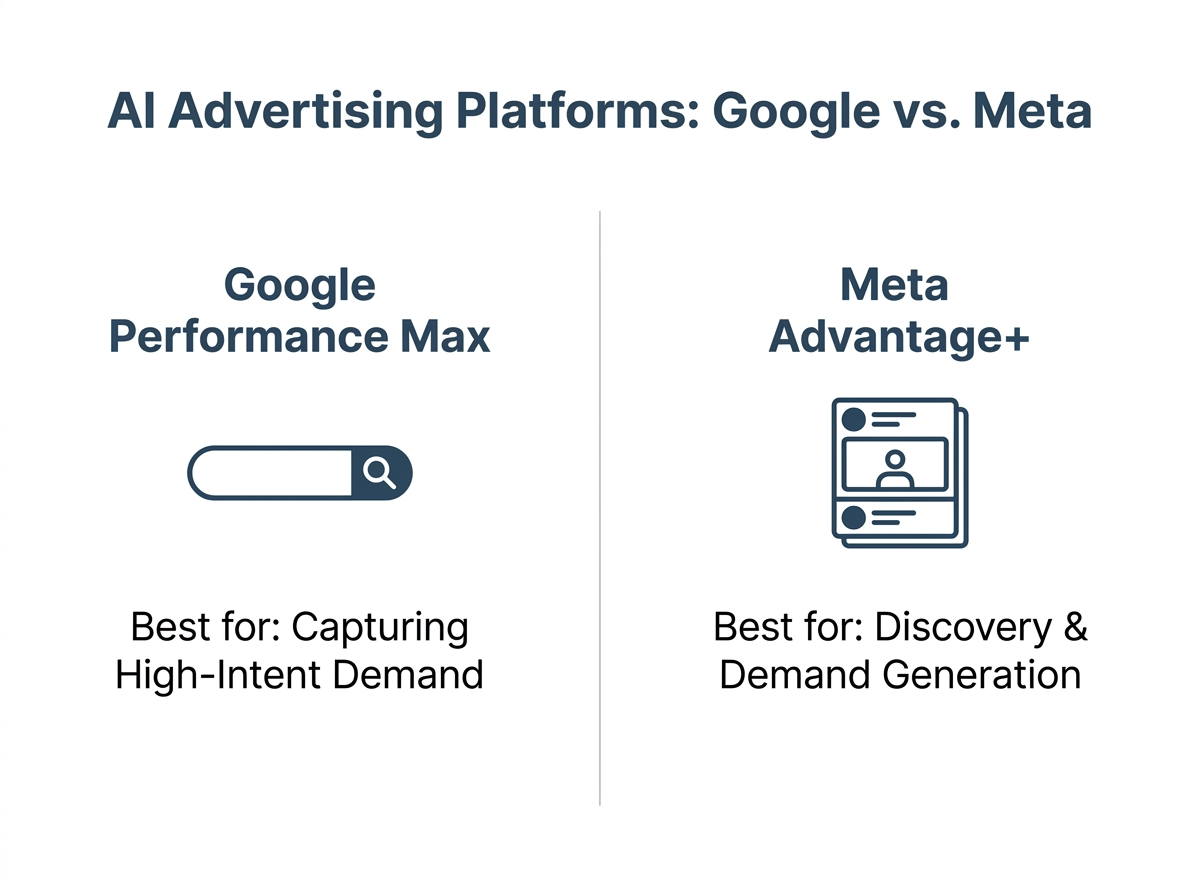
Google Ads uses Performance Max (PMax) to manage campaigns across all its properties. This includes Search, YouTube, a Display network, and more. PMax is great for finding customers who are already looking for what you sell. It uses your website data and product details to automatically find high-intent buyers and show them relevant ads at the perfect time.
Meta's platform, which includes Facebook and Instagram, uses Advantage+. This system is excellent for discovery and demand generation. Instead of just targeting people actively searching, it finds users likely to be interested in your product based on their behaviors. It's perfect for visual products and impulse buys, sparking interest where it did not exist before.
While both platforms are powerful, they often serve different goals. As one industry analysis points out, they are often more complementary than competitive. Many businesses use PMax for capturing immediate demand and Advantage+ for building brand awareness. Choosing between Google Ads vs. Facebook Ads depends on your specific product and goals.
Beyond the big platforms, specialized AI tools handle specific jobs. For example, some tools focus only on creating ad visuals and text. Platforms like AdCreative.ai, which is trained on millions of ads, can generate hundreds of ad variations in minutes. This helps you test ideas much faster than a human team could, finding winning combinations quickly and efficiently.
Other tools give you a peek at what your competitors are doing. AI platforms analyze ad strategies, showing you what keywords they target. As an overview of competitive analysis tools from Klue explains, systems like Semrush and SpyFu are popular for this. These insights help find market gaps and make smarter decisions about your own budget and messaging.
Google Ads: Performance Max & Broad Match
Performance Max, or PMax, is Google’s main AI-driven campaign type. It runs your ads across all of Google’s channels, including YouTube, Display, Search, and Gmail. You give it goals, creative assets like images and text, and audience ideas. The AI then works to find the best way to reach your customers automatically.
AI has also made keyword targeting much smarter with Broad Match. This setting lets Google’s system understand the true meaning behind a search, not just the exact words used. It helps you find customers who are searching in new or unexpected ways. This connects your product with wider user intent, growing your reach.
PMax uses this enhanced Broad Match to find new opportunities. The system then takes your inputs to show the most useful ad mix to the right person. Following a clear process is key to getting great results. As DataFeedWatch explains in their PMax best practices guide, providing high-quality assets and clear audience signals is the foundation for a successful campaign.
Meta Ads: The Advantage+ Suite
Meta's answer to AI advertising is the Advantage+ suite. It's a collection of tools designed to automate different parts of your campaigns on Facebook and Instagram. The suite helps find the right audiences and show them the best ads, making it powerful for demand generation. It focuses on helping people discover products they might love.
For an almost completely automated experience, there are Advantage+ Shopping Campaigns. With this option, you give Meta your creative assets and budget, and the AI handles the rest. It finds high-value customers, selects the best placements, and optimizes for sales. This is ideal for businesses that want an efficient, hands-off approach.
If you want more control, you can use specific features like Advantage+ Creative or Advantage+ Audience. These tools add AI to parts of a manual campaign. As Meta's Business Help Center explains, Advantage+ tools use machine learning to improve campaign results. This lets you get the benefits of AI while keeping control over your strategy.
Your Step-by-Step Guide to Launching an AI-Powered Campaign
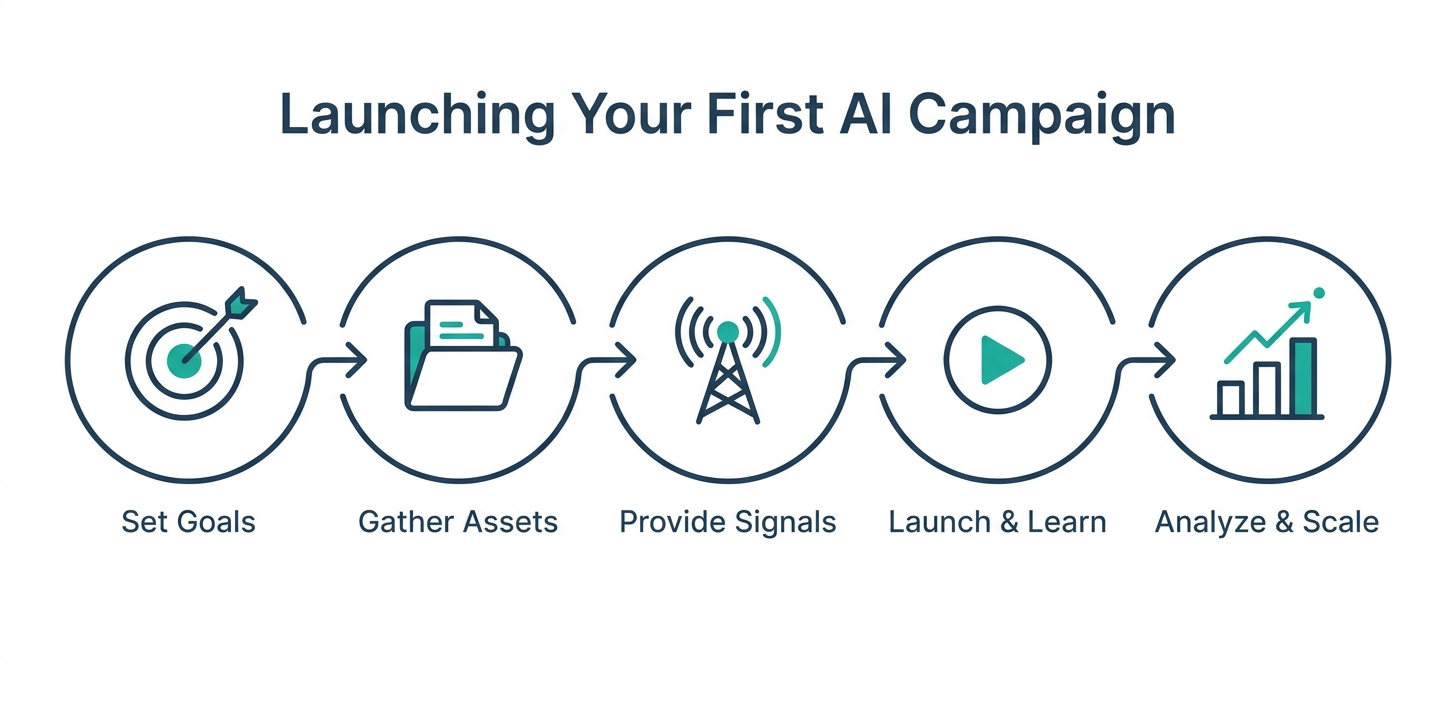
Launching an AI advertising campaign is like giving a super-smart assistant a project. The quality of your instructions and materials directly impacts the final result. If you give the AI clear goals and high-quality creative assets, it has everything it needs to succeed. This framework will guide you through the process.
1. Set Clear and Measurable Goals
First, decide what you want to achieve. Are you looking for more online sales, lead form submissions, or to hit a specific return on ad spend (ROAS)? You need to give the AI a single, clear objective. Without a specific goal, the system will not know how to optimize your budget effectively. This simple first step is the most important one.
2. Gather High-Quality Creative Assets
AI is powerful, but it doesn't create your brand's look and feel from scratch. You need to supply it with strong ingredients. This includes a variety of high-resolution images, compelling video clips, and engaging ad copy like headlines and descriptions. The more options you provide, the more combinations the AI can test to find what works best.
3. Provide Strong Audience Signals
Next, you give the AI hints about who to target. This is not about building a narrow audience list yourself. Instead, you provide "signals" like data from your website visitors, customer email lists, or themes related to what people search for. The AI uses these signals as a starting point to find new customers that look and act like your best ones.
4. Launch and Respect the Learning Phase
Once you launch your campaign, the AI enters a "learning phase." During this time, which experts at North Country Growth say can last from one to three weeks, the system gathers data to understand what works. It is important to be patient and avoid making major changes, as this can reset the learning process and hurt performance.
5. Analyze, Refine, and Scale
After the learning period ends, you can start refining your campaign. Review which assets perform best and replace those that do not. This new process allows you to make decisions based on real-time data. AI helps you "shift gears before it wastes time or money," building on what is working right now, as explained in a Kuno Creative blog post on AI workflows.
Questions to Ask Before Launching AI Advertising
- What specific, measurable goal am I trying to achieve with this campaign?
- Do I have enough conversion data to properly train the AI system?
- Have I prepared diverse, high-quality creative assets for the AI to test?
- What audience signals can I provide to give the AI a strong starting point?
- Am I prepared to be patient through the 1-3 week learning phase?
- How will I measure success beyond just ROAS or CPA metrics?
- What processes do I need to change to take advantage of the time AI saves?
- How will I ensure my AI campaigns respect user privacy and avoid bias?
- What complementary channels or platforms should I test alongside this AI campaign?
- How will I use the insights from AI to improve my broader marketing strategy?
The Ethical Compass: Navigating Privacy and Bias

As AI advertising becomes more common, it raises important ethical questions. People are understandably concerned about how their data is used and whether algorithms are fair. Addressing these concerns is not just about following rules. It helps you build a stronger, more trusting relationship with your customers, turning ethics into a real advantage.
Privacy is a top concern for many consumers. AI systems use personal data to make ads relevant, but this can make people uneasy. Being transparent about what data you collect is a start. But as a Snowflake blog post on privacy-first strategies explains, giving customers real control can turn privacy from a hurdle into a loyalty driver.
Another major issue is algorithmic bias. AI learns from the data it's given. If that data reflects historical inequalities, the AI can accidentally learn those same unfair patterns. This could lead to some groups being excluded from important offers. As the Brookings Institution highlights, this can cause real consumer harm if left unchecked.
To fight bias, you must actively review your AI's work. Audit your audience segments to ensure they are fair and use a diverse range of ad creative. By following best practices for ethical AI marketing, you can build campaigns that are more inclusive. This is an ongoing process of refinement.
Ultimately, an ethical approach to AI is simply good business. When customers feel respected and know their information is safe, they are more likely to stick with your brand. Building this trust is vital for long-term success, a point reinforced by a PwC analysis on responsible AI. It shows you value people, not just their data.
Beyond the Giants: Niche AI Tools for an Unfair Advantage
Relying only on the AI from Google and Meta is a missed opportunity. The smartest advertisers build an "AI stack" by combining these platforms with specialized tools. This makes a custom system that outperforms any single solution. With the digital ad market hitting new records according to the Interactive Advertising Bureau, many innovative tools are now available.
One popular category is AI creative generation. These tools focus entirely on producing ad visuals and copy quickly. You can test hundreds of images and headlines in minutes to find winning combinations. As Adweek highlights in a review of helpful apps, this technology speeds up one of advertising's most time-consuming tasks and improves performance.
Another key area is competitive intelligence. Specialized AI can give you a look at what your rivals are doing. These platforms analyze data to show which keywords competitors are bidding on and what their ad copy says. This information helps uncover market gaps and find audiences your competition has overlooked, providing a clear advantage.
Using these tools helps you make better strategic choices. Instead of guesswork, you can base decisions on real market data from day one. You can build a more effective ad strategy when using AI for competitive benchmarking, helping you outmaneuver rivals and get more from your budget.
Integrating these tools helps create a smarter marketing workflow. It lets you automate processes from brainstorming to analysis. As Jasper CEO Timothy Young explains, AI gives marketers an "opportunity to rewrite our marketing playbooks." This means building a more efficient and impactful system by using AI to transform team workflows.
Conclusion: Your Next Steps in AI Advertising
AI advertising is a partnership between you and the machine. It amplifies your strategy, but it cannot replace it. With your expertise guiding its power, you can achieve incredible growth. Here are your next steps to get started right away.
First, start with one clear goal. Do not try to do everything at once. Choose a single objective, like sales or leads, and pick one platform to focus on. This gives the AI a clean target to aim for and helps it learn much faster.
Next, provide top-notch ingredients for the system to use. The AI builds ads from the materials you give it. Supply a diverse mix of your best images, videos, headlines, and descriptions. Better inputs always lead to smarter, more effective ads.
Finally, trust the learning process. Be patient during the initial weeks of a campaign. Avoid making big changes, as this can reset the algorithm. Let the system gather data, then use the insights to refine your next steps for even better results.
Getting started now gives you a significant advantage. A majority of experts surveyed by the Pew Research Center believe AI will be even more integrated into our lives by 2030. By embracing these tools today, you are not just keeping up. You are building a more competitive brand for the future.
AI Advertising Frequently Asked Questions
How does AI actually improve ad targeting?
AI analyzes thousands of user signals including demographics, interests, and on-site behavior in real-time to predict which users are most likely to convert. It then prioritizes showing ads to these high-value prospects, going far beyond traditional manual targeting methods based on simple interests or demographics. This data-driven approach ensures your ads reach users with the highest purchase intent.
Can AI in advertising work for small businesses with limited budgets?
Yes, AI advertising is particularly beneficial for small businesses with limited budgets. Automated bidding and budget allocation ensure that even modest ad spend is used as efficiently as possible, minimizing waste and maximizing return on investment. Major platforms like Google and Meta have integrated these AI tools without additional cost, making powerful optimization accessible to businesses of all sizes.
Will AI replace paid advertising managers?
No, AI won't replace paid advertising managers but will transform their role. AI automates repetitive tasks like bid adjustments and budget allocation, allowing managers to focus on more valuable activities like strategy development, creative direction, and interpreting AI-driven insights. The role is evolving from tactical campaign management to strategic business guidance and creative leadership.
How much data do I need for the AI to work effectively?
While more data generally improves AI performance, you can start with what you have. At minimum, you need a properly configured tracking pixel on your website. For optimal results during the AI learning phase, platforms recommend achieving at least 30-50 conversions within a 30-day period. You can supplement this by uploading first-party data like customer email lists to provide additional signals for the AI system.
How can I ensure my AI-powered ads are ethical and not biased?
To ensure ethical AI advertising, regularly audit the audience segments the AI is targeting to check for unfair exclusion of certain groups. Use diverse and inclusive ad creative that represents various demographics. Be transparent in your privacy policy about data usage practices. Most importantly, review campaign performance beyond just ROAS metrics to identify any potential negative impacts on specific demographics and make necessary adjustments.