
Published on: April 23, 2026 | Time to read: 20 min
Event Return on Investment (ROI) measures an event's success by comparing earned revenue against costs, helping justify budgets and prove value to stakeholders. With 83% of marketing leaders prioritizing ROI demonstration, understanding both tangible financial gains and intangible benefits is crucial for event planners seeking to quantify their event's true business impact.
Key Takeaways
- The standard Event ROI formula is [(Total Event Revenue - Total Event Costs) / Total Event Costs] x 100, expressing return as a percentage.
- Event gains should include both direct revenue (ticket sales, sponsorships) and indirect value (qualified leads, customer lifetime value).
- Hidden costs like service charges, AV equipment, and staffing frequently derail event budgets and must be meticulously tracked.
- Intangible returns such as brand awareness and relationship building create long-term value that can be measured through metrics like Net Promoter Score.
- 44% of marketers achieve a 3:1 ROI from events, with in-person events typically yielding higher lead-to-customer conversion rates than virtual formats.
- Integration between event technology and CRM systems is critical for tracking lead attribution and demonstrating true ROI.
Table of Contents
- The Core Event ROI Formula
- Key Metrics: What to Measure for Accurate ROI
- Interactive Event ROI Calculator
- Going Beyond the Basics: Measuring Intangible Returns
- How to Calculate ROI for Different Event Types
- 5 Actionable Strategies to Improve Your Event ROI
What is Event ROI and Why Does It Matter?
Event Return on Investment, or ROI, is a simple way to measure if your event was a success. It’s a key performance indicator that compares the money you earned or saved from an event against the money you spent. This calculation helps show the true business impact of your gathering.
Calculating ROI is critical for event planners. It helps justify budgets for future projects and proves your work’s value to company leaders. Showing this value is now a major focus. In fact, a 2024 analysis on event marketing finds 83% of marketing leaders prioritize demonstrating ROI.
When you measure success, it’s helpful to think about two types of returns. The first is tangible ROI. These are the direct financial gains you can count easily. Think of things like revenue from ticket sales, new customer contracts, or sponsorship deals that came directly from your event.
These financial wins can be significant. Many companies see a strong profit from their events. For instance, event marketing statistics compiled by Certain show that 44% of marketers achieve an impressive 3:1 ROI. This means they make three dollars for every one dollar spent.
The second type is intangible ROI. These benefits are harder to measure with a number, like increased brand awareness or stronger customer relationships. But as Cvent highlights in a discussion on event value, stakeholders demand proof. This makes it important to connect even these softer goals to business outcomes.
The Core Event ROI Formula

To measure success consistently, you need a standard formula. This turns guesswork into a number you can use to show an event's financial performance. It’s a simple way to calculate your return.
Here is the standard formula: [(Total Event Revenue - Total Event Costs) / Total Event Costs] x 100. The final result is a percentage. This number shows your profit relative to your investment.
Total Event Revenue is all the money an event made from ticket sales, sponsorships, or merchandise. Total Event Costs are all expenses, like the venue, marketing, and staff pay. Be sure to track everything.
Let's use an example. Say your event brought in $50,000 and cost $20,000. Your calculation is [($50,000 - $20,000) / $20,000] x 100. That gives you a 150% ROI. You earned $1.50 for every dollar you spent.
Calculating ROI helps prove an event’s value to decision makers. With 83% of marketing leaders now prioritizing ROI, according to 2024 event marketing statistics from NextGen Event Co., this basic formula is a great place to start.
Questions to Ask Before Planning Your Next Event
- What specific business goals will this event support?
- How will we define and measure success beyond attendance numbers?
- Which metrics will demonstrate direct financial impact to stakeholders?
- What technology do we need to accurately capture and attribute leads?
- How will we track attendees from initial registration through to sale?
- What will be our follow-up process to convert event leads?
- How can we measure intangible benefits like brand awareness?
- What were the hidden costs that surprised us last time?
- How quickly do we need to see a return to consider this event successful?
- What benchmarks from past events should we aim to improve upon?
Key Metrics: What to Measure for Accurate ROI
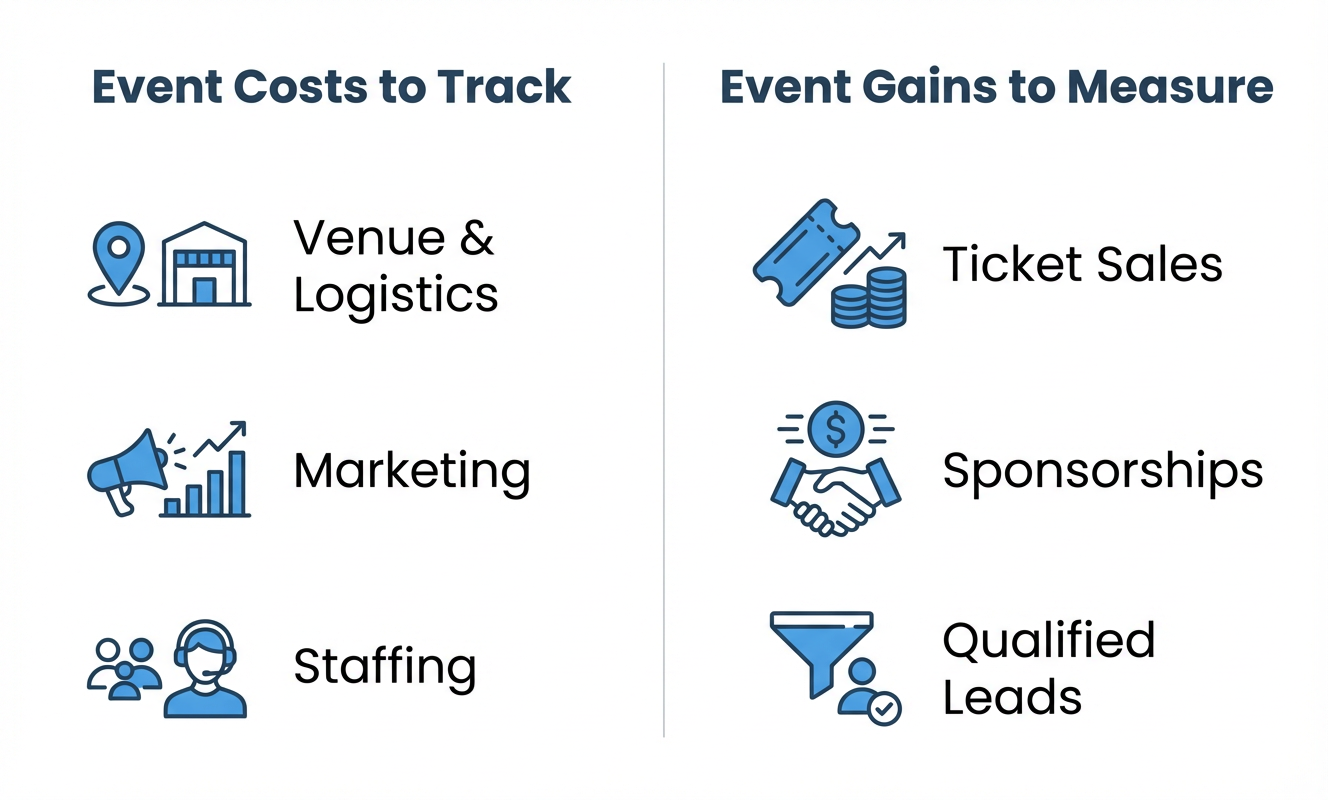
To get a true picture of your event's success, you need to track more than just ticket sales. An accurate ROI calculation depends on a complete understanding of all your expenses and all the money you brought in. It’s a detailed approach that many marketers are still working to perfect.
Getting this right can be a big hurdle. In fact, 32% of marketers admit they are not happy with their ability to measure an event's return. But don't worry. Breaking down your numbers into specific costs and gains makes the process much more manageable.
Tallying Up the Total Event Cost
First, let's look at the money going out. Some costs are obvious, like the venue rental and marketing campaigns. But many budgets get derailed by unexpected expenses. These are often small details that add up quickly if you are not prepared for them.
Things like service charges, credit card fees, and extra AV equipment can surprise you. An analysis from Social Tables points out that these hidden fees are common in vendor contracts. Tracking every single expense, no matter how small, is the only way to know your true total cost.
Use this checklist to make sure you account for all potential costs.
| Cost Category | Example Expenses |
|---|---|
| Venue & Logistics | Rental fees, insurance, permits, security |
| Food & Beverage | Catering per person, bartending services, gratuity |
| Marketing & Promotion | Ad spend, printed materials, PR, signage |
| Staffing & Talent | Speaker fees, on-site staff, photographers, travel |
| Technology & AV | Wi-Fi, presentation gear, lighting, event apps |
| Miscellaneous | Taxes, service charges, credit card fees, decorations |
Measuring Your Event's Financial Gains
Now for the fun part: adding up the money your event generated. This side of the equation includes both direct income and the long-term value created from new relationships. Immediate revenue is easy to spot, like ticket sales and sponsorships.
But the real value often comes later. For example, tracking which event leads turn into paying customers is a powerful metric. One company used this strategy to achieve a 5X ROI from leads captured at a single conference, showing the direct link between event interactions and sales.
It can also be useful to estimate the value of new leads. One way to do this is by looking at your normal sales process. Industry guides on post-event analysis suggest calculating the average value of a customer and multiplying it by your lead-to-customer conversion rate.
Here are some of the most important gains to track:
- Total ticket sales revenue
- Sponsorship and exhibitor fees
- Sales made directly at the event
- Value of qualified leads generated
- Post-event sales from event leads
- Customer upsells or cross-sells
- Media value from press coverage
Thinking about both costs and gains gives you a complete financial story. Using event technology can help you automate data collection and create detailed reports, as this guide on measuring event ROI explains. This clarity proves the value of your work and helps you plan even better events in the future.
Event Costs to Track
To get a true picture of your event's ROI, you must track all your expenses. Separating them into \"hard\" and \"soft\" costs can make this easier. It helps you see exactly where your money is going and find places you might be overspending.
Hard costs are the direct expenses you pay for. These are the bills you receive from vendors and suppliers. Think of them as the tangible items you purchase for your event to happen.
Here are some common hard costs to include in your budget:
- Venue rental
- Audio and visual (A/V) equipment
- Speaker fees and travel
- Food and beverage (F&B)
- Marketing and promotion
- Temporary staffing
Next are the soft costs. These are indirect expenses that are just as real but sometimes harder to pin down. They often involve internal resources. The biggest soft cost is usually your team's time spent planning, coordinating, and managing the event. Don't forget software subscriptions, either.
But watch out for hidden expenses. These can quickly blow your budget if you aren't careful. Things like service fees, taxes, and last minute AV needs can add up. Industry surveys show costs for AV and labor are rising. For example, a 2026 trends survey from Meetings Today highlights sharp increases in F&B and AV.
Careful planning helps you avoid these surprises. For a deeper look at creating a solid budget, check out our complete guide to event budgeting.
Event Gains & Revenue to Measure
To find your event's return, you need to look at the gains. The most obvious gains come from direct revenue. This includes clear income sources like ticket sales, sponsorship deals, and fees from exhibitors. These are the easiest numbers to track and add to your event's balance sheet.
Don't forget other direct income, like on-site merchandise sales or paid workshops. Every dollar that comes in during the event adds to this side of the equation. Summing up all these sources gives you a clear picture of your total direct revenue.
But the gains don't stop there. Indirect revenue often holds the most value. This includes the potential income from new sales leads or upsells to existing customers. Tracking this is harder, but it's key for understanding your event's true impact on business growth.
To measure this, you can put a dollar value on new leads. Use this simple formula. Multiply your new leads by your average lead to customer conversion rate. Then, multiply that number by the average lifetime value of a customer. This shows your potential future income.
Adding this potential income to your direct revenue gives you a complete picture of your event's gains. This is the number you'll use to calculate your final ROI. And recent event marketing statistics from Nextgen Event Co. show that 44% of marketers get at least a 3:1 return from their events.
Interactive Event ROI Calculator
Want to see your return on investment without the guesswork? This simple tool helps you plug in your numbers and see the results instantly. Just fill in your event costs and the money you brought in to find your ROI percentage.
Use the fields below to get started. Don't worry if your numbers aren't perfect. This tool is designed to give you a strong estimate of your event's financial success.
| Event Costs | Enter Amount ($) | Event Revenue & Gains | Enter Amount ($) |
|---|---|---|---|
| Venue & Catering | Ticket Sales | ||
| Marketing & Promotion | Sponsorships | ||
| Speakers & Entertainment | Value of New Leads | ||
| AV & Technology | Other Revenue | ||
| Total Costs | Total Revenue & Gains |
Once you have your totals, the calculator provides a clear result. It shows your ROI as a percentage and explains it in simple terms. For example, it might say, “For every $1 you invested, you earned $2.50 in return.”
Keeping track of these numbers is much easier with event technology. And it works. Information from Certain highlights that 78% of businesses using event apps report positive outcomes. Using the right tools can make tracking much clearer.
Going Beyond the Basics: Measuring Intangible Returns
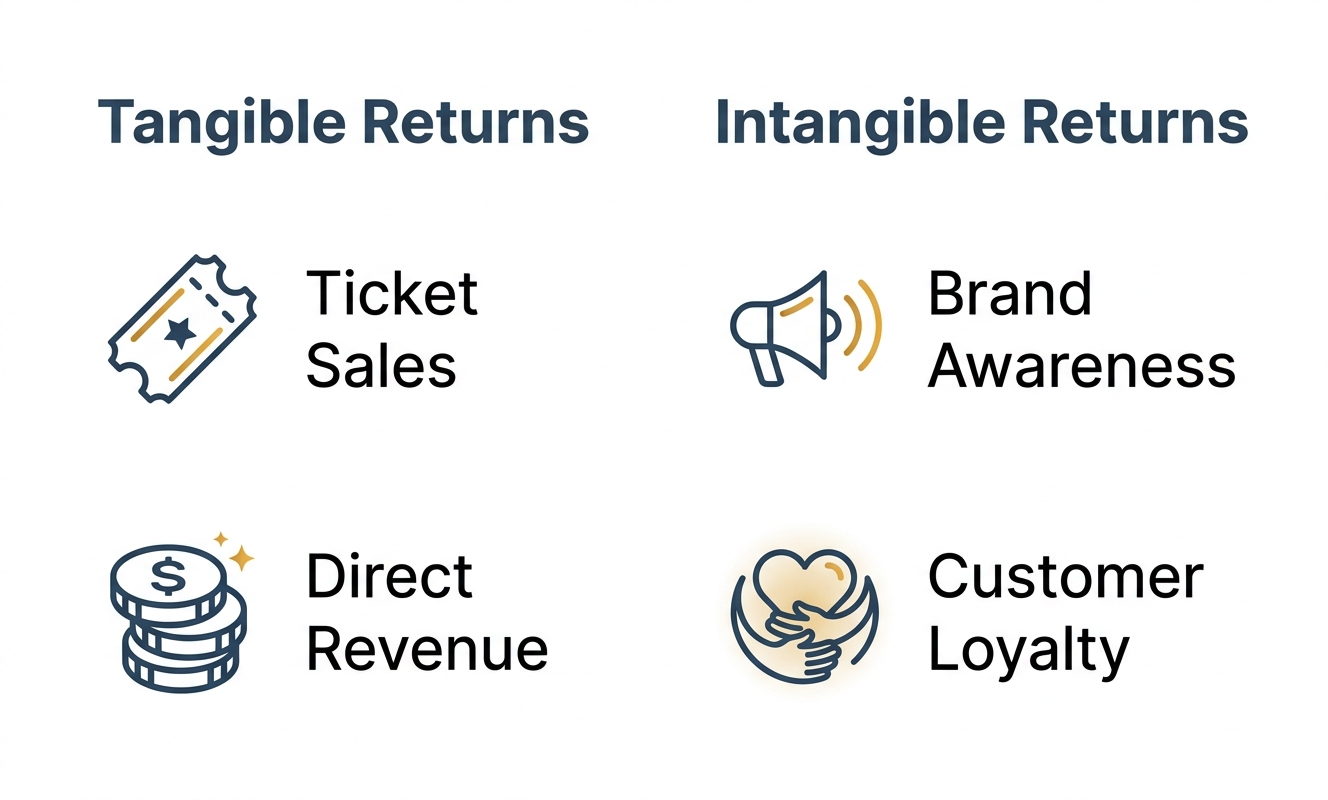
While financial numbers are important, the true success of an event often lies in value that doesn’t show up on a balance sheet. These intangible returns, like brand building and stronger relationships, create long-term growth. Measuring them helps you understand the full impact of your event strategy.
Brand awareness is a powerful, yet hard to measure, outcome. You can track this by monitoring social media mentions, press clippings, and spikes in your website traffic around the event date. In fact, NextGen Event Co.'s 2024 analysis shows that 70% of marketers use media exposure as a primary way to gauge success. This focus shows just how valuable awareness is considered.
To put a number on this, you can use a metric called Advertising Value Equivalency (AVE). This method estimates what your earned media coverage would have cost if you had paid for it as advertising. While not a perfect science, it helps assign a dollar value to your brand’s visibility.
Events are also incredible for building stronger customer and partner connections. These relationships foster loyalty and can lead to future business. But how can you measure something like goodwill or trust? You can track this through specific, targeted feedback after your event concludes.
Post-event surveys are a great tool for this. Ask attendees about their experience and use tools for sentiment analysis to see how people are talking about your event online. As Cvent's guide on proving event ROI suggests, tracking metrics like Net Promoter Score (NPS) provides concrete data on attendee satisfaction and loyalty.
Finally, consider your position as a thought leader. Did your event establish your company as an expert in the field? You can measure this by tracking session attendance for your key speakers, content downloads after the event, or an increase in demo requests for a product that was showcased.
How to Calculate ROI for Different Event Types
Calculating your event's return isn't a one-size-fits-all process. The formula and key metrics change based on the event's format. With 83% of marketing leaders prioritizing ROI, knowing which numbers matter for your specific event is more important than ever. Let's break down how to approach ROI for different types of events.
Virtual Events
For online events, you should focus on digital engagement metrics. Track things like how many people attended live sessions versus watching recordings. Also, monitor how many times resources like slides or white papers were downloaded. These actions show who is most interested in your content.
This digital trail helps you see an attendee's journey. You can connect their activity directly to your sales pipeline. But be patient. For many B2B companies, it can take time to see a return. Markletic's research on virtual events shows that 74% of organizers see a positive ROI around six months after the event.
Hybrid Events
Hybrid events add a layer of complexity because you have two audiences. The key is to measure the in-person and virtual groups separately first. You'll track booth visits and physical networking for one group, and clicks and chat messages for the other.
Once you have data for both, you can combine it for a complete picture. This holistic view shows which parts of your event were most effective overall. It also helps you understand if one format delivered a better return than the other, guiding future event strategy.
Trade Shows and In-Person Conferences
At trade shows, lead generation is often the main goal. But quality is more important than quantity. Use badge scanners to capture contact info and add notes about your conversations. This helps your sales team prioritize who to follow up with first.
Calculate your cost-per-lead by dividing your total event cost by the number of qualified leads you generated. This tells you how efficient your spending was. According to an in-depth guide to marketing analysis by Umbrex, trade shows can have lead conversion rates between 20-30%, showing their power for creating real opportunities.
5 Actionable Strategies to Improve Your Event ROI
Improving your return on investment is more than just hoping for the best. It requires a clear plan. While only 34% of marketers use comprehensive metrics to calculate ROI, a few focused strategies can make a huge difference. These steps will help you track success and prove your event's value.
1. Set Clear Goals from the Start
Before doing anything, define what success looks like. Vague goals like “brand awareness” are impossible to measure. Instead, set a specific, measurable target. For example, aim to “generate 100 marketing qualified leads (MQLs)” or “book 20 sales demos” from the event.
2. Define Your Key Performance Indicators (KPIs)
Your goals tell you where you are going, and your KPIs tell you if you are on track. These are the specific numbers you will measure against. It could be cost per lead, lead quality score, or on-site meeting bookings. This focus is critical, as 83% of marketing leaders now prioritize demonstrating ROI.
3. Leverage Event Technology
Use modern tools to work smarter. Event apps, QR code scanners, and other digital platforms automate data collection. This frees your team from manual data entry and allows for more meaningful conversations. It also ensures the lead information you collect is accurate and easy to use later on.
4. Integrate Tech with Your CRM
The real magic happens when your event tech talks directly to your Customer Relationship Management (CRM) system. Automating this sync sends leads straight to your sales team. This speed is powerful. In fact, a case study from Popl shows this process helped a company achieve a 5x ROI on their conference spending.
5. Create a Strong Post-Event Nurture Plan
The event isn’t over when you pack up your booth. A prompt and personalized follow up turns conversations into paying customers. Waiting too long allows leads to go cold. Plan your email sequences and sales call scripts before the event even starts so you can act fast.
Remember to use the notes you gathered to make your follow up personal. Reference a specific conversation you had or a problem they mentioned. It shows you were listening and helps you rebuild the connection. This thoughtful approach can dramatically improve your conversion rates and overall event ROI.
Real-World Example: Paul Smith PR
Paul Smith's PR team transformed their event strategy by implementing Launchmetrics Events platform to track ROI. Moving from a fragmented approach to a unified system focused on real-time data capture and performance measurement, they successfully managed diverse events from large fashion shows to exclusive VIP gatherings. By automating tasks like RSVP tracking and attendance data collection, they gained actionable insights on guest engagement and demographics that quantified event impact and demonstrated clear ROI to stakeholders.
Conclusion: Making Event ROI Your Strategic Advantage
Thinking about event ROI is your secret weapon. It is more than just a math problem to solve after the fun is over. It is a full game plan. This approach helps you prove your event’s value and make smarter decisions for your next one.
True success goes beyond just the money you make. To get the whole story, you must look at everything. This includes tangible goals like sales and leads. And don't forget intangible wins like stronger brand recognition and happy, loyal customers.
The pressure to justify spending is higher than ever. Tracking your return is no longer a nice-to-have. As Cvent's industry analysis explains, providing solid data to prove event value is now a core part of any corporate event strategy. Leaders want to see the numbers behind the success.
Now you have the tools to make your events more powerful. Start by applying these measurement strategies to your planning process. You can turn your next event from a simple expense into a clear strategic investment that delivers impressive results.
Frequently Asked Questions
What is the formula for event ROI?
The standard formula for calculating event ROI is [(Total Event Revenue - Total Event Costs) / Total Event Costs] x 100. This formula expresses your return as a percentage, showing how much profit you generated relative to your investment in the event.
What is a good ROI for an event?
While a 5:1 ratio (500% ROI) is often considered a strong benchmark across industries, any positive ROI indicates success. The most important practice is improving upon your past performance and meeting your company's specific goals, as good ROI varies by industry, event type, and business objectives.
How do you calculate ROI for a virtual event?
Virtual event ROI uses the same basic formula as in-person events, but with different inputs. Costs typically include platform fees and digital marketing expenses, while revenue comes from virtual ticket sales and digital sponsorships. Additionally, tracking engagement metrics like content downloads and session attendance provides valuable data for a complete ROI picture.
How do you measure event success without direct sales?
When direct sales aren't the primary goal, focus on intangible metrics and leading indicators of future business impact. Measure qualified leads generated, social media engagement growth, press mentions, increased website traffic, and attendee satisfaction scores from post-event surveys to demonstrate value.
How can I forecast event ROI before the event?
To forecast ROI before your event, analyze data from past events to project costs and potential revenue. Estimate leads based on expected attendance and your historical conversion rates. This data-driven approach creates a solid business case for budget approval and helps set realistic targets for success.
What tools can help automate event ROI tracking?
Look for event management platforms that integrate directly with your CRM system, such as Salesforce or HubSpot. These integrations automatically track a lead's journey from event registration through to closed sale, providing accurate attribution and eliminating manual data entry that can lead to errors.
What's the difference between ROI and ROO (Return on Objectives)?
ROI is strictly financial, measuring monetary returns against costs. In contrast, ROO (Return on Objectives) measures success against non-financial goals like achieving specific press coverage, improving brand sentiment, or training a target number of employees. Both metrics are important for a complete view of event success.
How long after an event should I measure ROI?
ROI measurement should follow a multi-stage approach. Calculate initial ROI immediately after the event based on direct revenue, then reassess at 3, 6, and 12 months to account for longer sales cycles and track revenue from converted leads. This timeline approach provides both immediate feedback and long-term performance insights.