
Published on: April 28, 2026 | Time to read: 18 min
AI demand generation leverages machine learning and smart technology to automate and improve how businesses find new customers. By analyzing data to pinpoint genuinely interested prospects, AI brings precision to marketing efforts that traditional manual processes lack, with the global AI marketing field projected to grow from $19.5 billion to nearly $180 billion by 2034.
Key Takeaways
- AI demand generation uses predictive analytics to identify high-quality leads, boosting conversion rates by 25% and shortening sales cycles by 30%.
- Personalized content driven by AI can deliver a 10-15% revenue lift according to McKinsey research.
- Modern AI chatbots convert leads at rates of 10-15%, significantly outperforming traditional contact forms (1.7-5%).
- Programmatic AI optimizes ad targeting and creative, improving ROAS by 17-45% on average.
- Purchase intent data helps identify in-market buyers before they reach out, with 97% of marketers citing this as a competitive advantage.
- A well-structured AI demand gen tech stack consists of three layers: data foundation, intelligence layer, and activation layer.
- The AI in marketing industry is projected to grow from $19.5 billion in 2024 to nearly $180 billion by 2034.
Table of Contents
- Leverage Predictive Analytics for Hyper-Targeted Lead Scoring
- Scale Content Personalization with AI Engines
- Automate & Optimize SEO with AI-Powered Content Creation
- Engage Prospects 24/7 with Intelligent Chatbots
- Refine Ad Targeting & Creative with Programmatic AI
- Uncover Purchase Intent Data to Reach In-Market Buyers
- Personalize the Sales Cadence with AI-Powered Insights
- Building Your AI Demand Gen Tech Stack: A Practical Framework
- Measuring the True ROI of Your AI Demand Generation Efforts
The New Era of Marketing: What is AI Demand Generation?
AI demand generation uses smart technology, like machine learning, to find new customers for your business. It works by automating and improving the ways you create interest in your products or services. This technology represents a major shift in how modern marketing gets done, moving teams toward smarter, data-driven decisions.
In the past, marketing was very manual. Teams would spend hours trying to guess who their best customers were. They ran broad campaigns hoping their message would reach the right person. This process involved a lot of guesswork and was often inefficient, leading to wasted time and resources on uninterested audiences.
AI changes the game by adding incredible precision. Instead of blasting messages to everyone, AI analyzes data to pinpoint people who are genuinely interested in what you offer. It helps understand customer behavior and predict who is most likely to buy, making every marketing dollar work harder.
This isn't just a small trend. It's a massive industry movement. According to projections from Zion Market Research, the global AI in marketing field is expected to grow from $19.5 billion in 2024 to nearly $180 billion by 2034. This boom shows just how many businesses are turning to AI.
Questions to Ask Before Implementing AI Demand Generation
- What specific business problems am I trying to solve with AI?
- Which of our current marketing processes are most repetitive and time-consuming?
- How clean and accessible is our customer data?
- Do we have clear metrics to measure AI implementation success?
- What level of personalization would provide the most value to our customers?
- How will we maintain brand voice and quality when using AI for content?
- Which team members need training to effectively use new AI tools?
- How will we ensure compliance with data privacy regulations?
- What is our plan for human oversight of AI-generated outputs?
- How will we test and validate AI recommendations before full implementation?
1. Leverage Predictive Analytics for Hyper-Targeted Lead Scoring
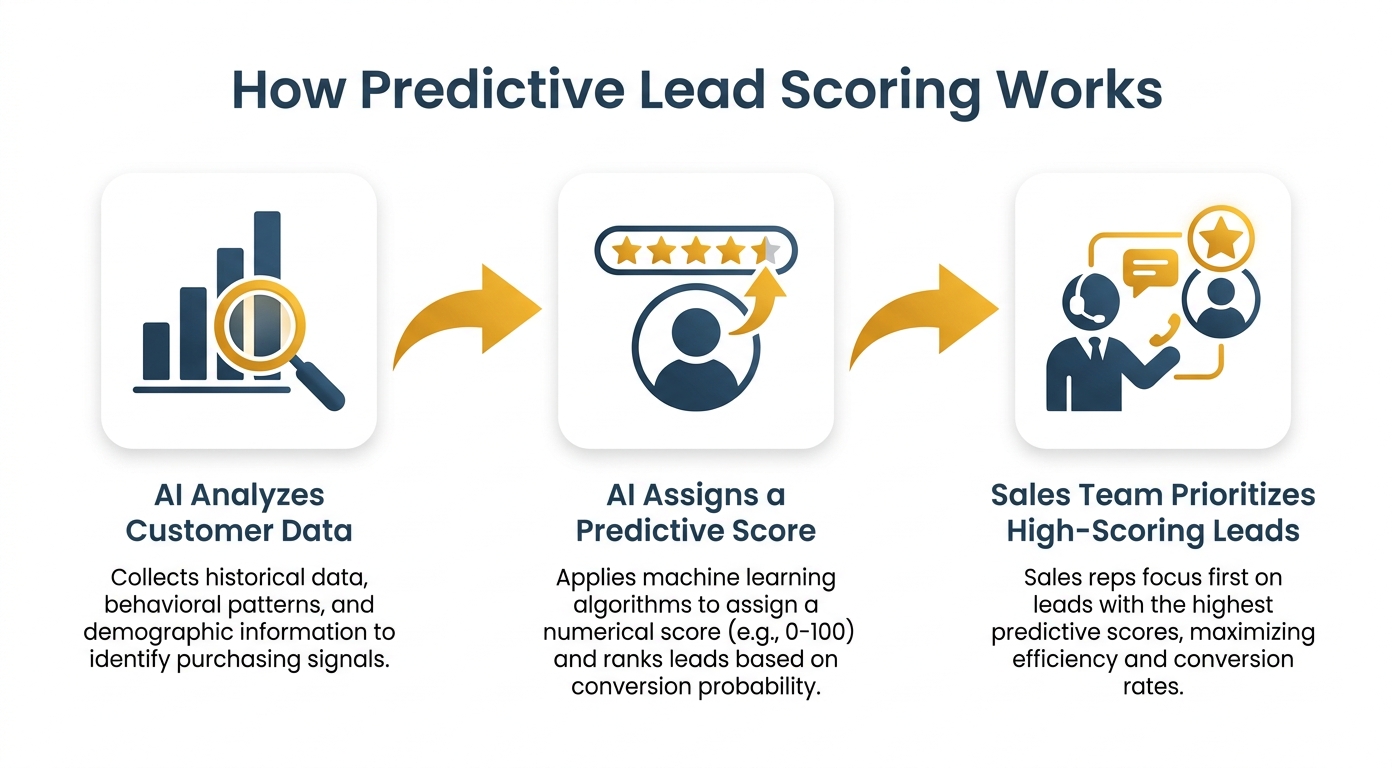
Imagine knowing which leads are ready to buy before you even call them. That’s what predictive lead scoring does. AI models look at your past successes and failures. They analyze data from customers who bought from you and those who didn't. This helps the AI learn what a perfect customer looks like.
The AI studies everything from basic details like location to online behavior like pages visited. By combining this information, the system gives each new lead a score. A high score means a lead is very likely to become a customer. A low score suggests they may need more nurturing.
This powerful scoring lets your sales team prioritize their time effectively. Instead of chasing every lead, they focus on the ones with the highest scores. This means more meaningful conversations. Research from Kinex Technologies shows AI lead scoring can boost conversion rates by 25% and shorten sales cycles by 30%.
For businesses using Account-Based Marketing (ABM), this works on a bigger scale. It's called predictive account scoring. Instead of ranking individuals, the AI ranks entire companies. This helps teams align their efforts to win over high-value accounts, a strategy central to modern B2B growth programs.
2. Scale Content Personalization with AI Engines
AI personalization changes your website for each visitor. It's more than just adding a name to a welcome message. AI engines can swap out content, images, and calls-to-action based on a person's profile and real-time actions. This makes the experience feel unique and highly relevant to their needs.
This is also a great way to guide leads. As someone browses, an AI can suggest the perfect blog post or case study to look at next. For example, a SaaS pricing page might show a healthcare visitor compliance features, while a visitor from finance would see security details highlighted instead.
This personal touch leads to real business growth. In fact, McKinsey reports that marketing personalization can drive a 10-15% revenue lift. It's a powerful way to show customers you understand their problems, which directly impacts your bottom line and helps you stand out.
The market for these tools is exploding. Adopting this tech now gives B2B companies a strong competitive edge in a crowded marketplace.
3. Automate & Optimize SEO with AI-Powered Content Creation
AI tools are changing how companies approach search engine optimization (SEO). They can quickly perform keyword research and analyze competitors to find content gaps. This means you can build a data-backed content plan in a fraction of the time. It helps you focus on topics your audience is actually searching for, giving you a clear path to follow.
Generative AI takes this a step further by drafting the actual content. It can write initial blog posts, social media updates, or even ad copy. In fact, a SurveyMonkey report shows that 51% of marketers use AI to optimize content, and 50% use it for content creation. This lets you scale up your output dramatically.
But AI-generated content isn't ready to publish right away. It's simply a starting point. A human writer must review everything to check for accuracy, refine the tone to match your brand’s voice, and add unique insights. This human oversight is what turns a generic draft into something valuable for your readers.
The combination of AI speed and human expertise is the key to success. While AI handles the heavy lifting of research and drafting, your team can focus on strategy and quality. Getting this balance right is what our Content Marketing services are all about, guaranteeing your brand’s message stands out.
4. Engage Prospects 24/7 with Intelligent Chatbots

Forget the clunky chatbots of the past. Today’s AI tools are smart, helpful, and available 24/7. They understand what your visitors are looking for and give instant answers. This tech is a big reason the AI in marketing industry is growing so fast.
These intelligent chatbots do more than just answer basic questions. They can understand a user's goal, handle complex issues, and qualify leads in real time. The chatbot can determine if a visitor is a good fit, automating the top of your sales funnel. This frees up your team to focus on closing deals instead of screening contacts.
This immediate and personal interaction makes a huge difference for your website visitors. Instead of making them fill out a boring form and wait, you give them instant help. The results are clear. While forms convert poorly, some reports show AI chatbots can convert leads at rates of 10-15% or higher.
For the best results, place these chatbots on your most important pages, like your pricing or demo request page. A chatbot here can capture a warm lead’s information and book a meeting directly on your sales team’s calendar. It’s an effortless way to connect with buyers right when they are most interested in your brand.
5. Refine Ad Targeting & Creative with Programmatic AI
Go beyond guessing where to place your ads. Programmatic AI uses algorithms to automate ad buying in real-time. It bids on placements most likely to be seen by your ideal customers. This means your budget is spent more efficiently, reaching the right people at the right moment without wasted spend on irrelevant audiences.
AI also uncovers new opportunities by analyzing huge datasets. It can identify hidden customer segments and build powerful lookalike audiences that manual efforts often miss. This level of precision is why AI-driven ad campaigns report ROAS improvements of 17-45% on average, making every dollar work harder for your business.
The technology even customizes the ads themselves. With Dynamic Creative Optimization (DCO), AI assembles the best ad for each person by mixing headlines, images, and calls to action.
6. Uncover Purchase Intent Data to Reach In-Market Buyers
What if you could know who is ready to buy before they even reach out? That's the power of purchase intent data. These are behavioral signals left across the web, like when someone researches a topic or views competitor pricing. These digital footprints show that a company is actively looking for a solution like the one you offer.
AI platforms are built to find these signals for you. They automatically scan articles, forums, and company websites to gather these clues. The technology then connects the dots to build a list of companies showing strong buying intent. This turns a massive amount of online noise into a clear list of hot prospects for your team.
This information gives your team a major head start. You can proactively contact these in-market buyers before your competitors do. It's no wonder that B2B intent data statistics compiled by Landbase reveal that 97% of marketers feel this data gives them a competitive advantage. This approach helps get your message in front of the right people at the perfect time.
Using this data is a cornerstone of a modern account-based marketing (ABM) strategy. It allows you to focus your budget and efforts on accounts that are already likely to convert, making your entire demand generation program more efficient. You stop guessing and start engaging with interested buyers.
7. Personalize the Sales Cadence with AI-Powered Insights
Gone are the days of generic sales emails. AI now lets you personalize your sales cadence for each prospect. Smart tools analyze past interactions to suggest the best communication channel, whether it's an email, a call, or a LinkedIn message. It even recommends the best time of day to reach out.
Generative AI takes it a step further by helping you craft the perfect message. These tools can review a prospect's LinkedIn activity, recent company announcements, or known industry pain points. Then, the AI can draft a unique outreach email that speaks directly to their situation.
This focused approach gets results. When every touchpoint is relevant, prospects are far more likely to respond. Companies using these strategies often see a major increase in meeting booking rates. And McKinsey's research on personalization shows it can drive a 10 to 15% revenue lift.
The market for these tools is growing fast. As more companies see the value, adoption is skyrocketing.
8. Building Your AI Demand Gen Tech Stack: A Practical Framework
Building a new tech stack from scratch can feel like a huge job. But you don't have to start over. A better way is to begin with the systems you already use, like your CRM. Then, you can carefully add AI tools on top in a smart, phased approach. This ensures everything works together smoothly from day one.
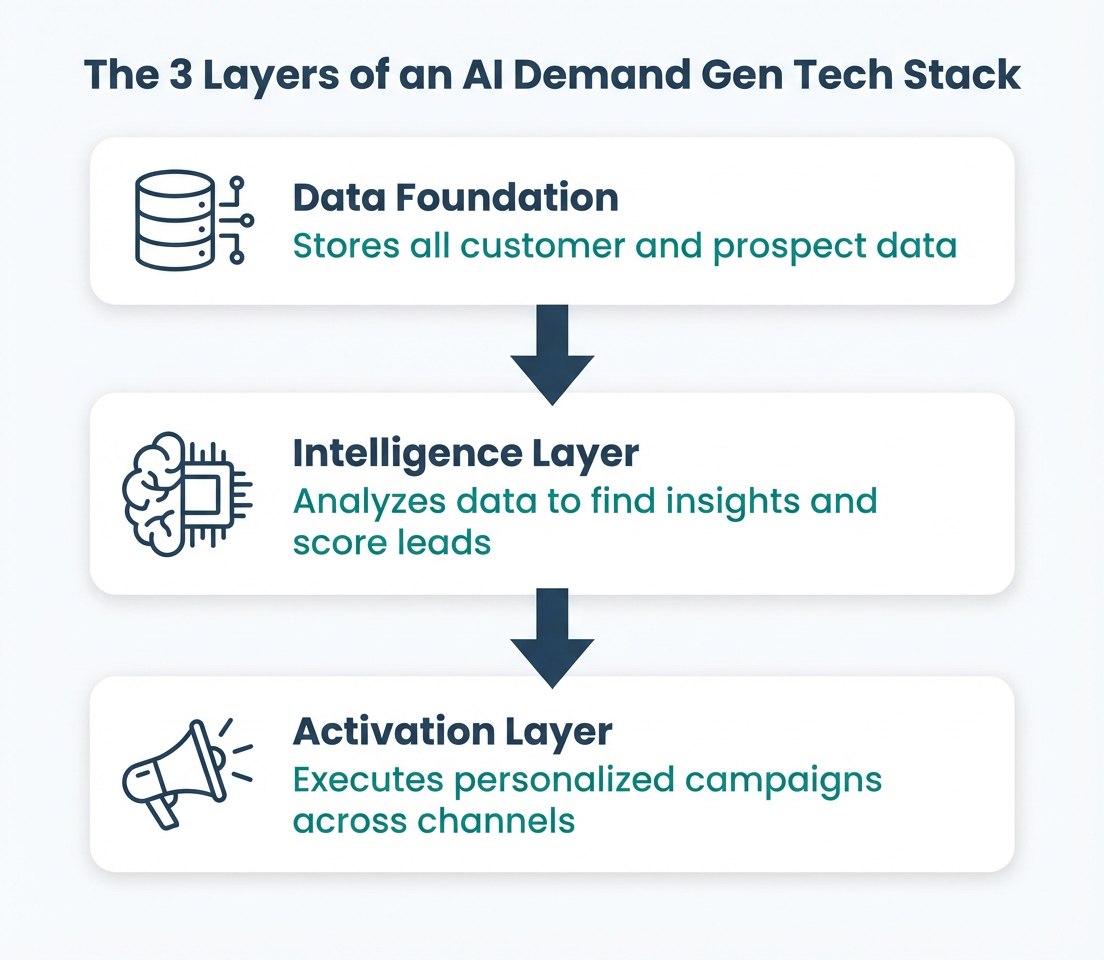
Think of your stack in three main parts. This structure makes it easy to understand where each tool fits and what it does. Most modern setups, like those used in The Zulu Method, are built around a data foundation, an intelligence layer, and an activation layer.
Each layer has a specific job. Your data foundation holds all your customer information. The intelligence layer analyzes that data to find patterns. Finally, the activation layer uses those insights to create personalized marketing campaigns that get results.
| Layer | Purpose | Example Tools |
|---|---|---|
| Data Foundation | Stores all customer and prospect data. Your source of truth. | CRM (Salesforce, HubSpot), Marketing Automation Platforms |
| Intelligence Layer | Analyzes data to find insights, score leads, and identify intent. | Predictive Scoring, Intent Data Platforms, Analytics |
| Activation Layer | Uses insights to execute personalized campaigns across channels. | Email Marketing, Ad Platforms, AI Content Generators |
The most important part is making sure these layers are connected. When your AI intelligence tools can seamlessly pull data from your CRM and push instructions to your ad platforms, you get a powerful, automated system. This integration stops data from getting trapped in separate silos, which is a common problem.
A well-integrated stack turns raw data into revenue. It makes sure the right message gets to the right person at the right time. The B2B Playbook's guide to tech stacks shows how this structure helps you make better decisions and scale your marketing efforts without adding more manual work.
9. Measuring the True ROI of Your AI Demand Generation Efforts
So you're investing in AI. But how do you prove it is actually working? To get your share, you must measure what truly matters and look beyond vanity metrics like social media likes or clicks.
The real value of AI demand generation appears in core business numbers. Focus on metrics like your Customer Acquisition Cost (CAC) going down. Also track your Marketing Qualified Lead (MQL) to Sales Qualified Lead (SQL) conversion rate to see if it's climbing. These numbers connect your marketing spend directly to revenue, which is what leadership wants to see.
Traditional attribution is often just guesswork. AI-powered attribution modeling changes that completely. It analyzes every single touchpoint a customer has with your brand, from the first ad they saw to the email they opened right before buying. This gives you a much clearer picture of what is actually working in your campaigns.
To really understand the impact, you need a scorecard. Track your key performance indicators (KPIs) before and after implementing an AI strategy to see the difference. To make this easier, you can use a dedicated AI Demand Gen ROI calculator to build your business case.
Here are a few essential KPIs to watch closely:
- Customer Acquisition Cost (CAC): Is it getting cheaper to bring in new customers?
- MQL-to-SQL Conversion Rate: Are more of your marketing leads becoming sales opportunities?
- Sales Cycle Length: Are you closing deals faster than before?
- Return on Ad Spend (ROAS): Are your ad dollars working harder and smarter for you?
Tracking these numbers does more than just justify a budget. It helps you refine your strategy over time. It’s how modern teams, like those working with The Zulu Method, turn marketing from a cost center into a predictable revenue engine. By doing this, they can prove their AI demand generation efforts are paying off.
Conclusion: Your Next Steps in Building an AI-Powered Future
Artificial intelligence isn't a far-off concept for demand generation. It is a practical set of tools you can use today to find more customers. The market is growing at an incredible pace. A detailed analysis from Zion Market Research projects the industry will soar from $19.5 billion to nearly $180 billion by 2034. This rapid expansion signals that early adopters will gain a strong advantage.
But you don't need to rebuild your entire marketing department overnight. The best approach is to start small. Look back at the strategies we discussed, from predictive scoring to personalized content. Choose one that aligns with your biggest challenges. Then, run a small pilot project to test its impact. This allows you to learn and build momentum without a huge upfront investment.
Your next step is to audit your team's current processes. Where do you see bottlenecks or repetitive work that slows everyone down? Identifying these friction points will show you the perfect place to begin integrating AI. This is exactly how forward-thinking teams, like those partnering with The Zulu Method, start their journey toward a more efficient, AI-powered future and predictable growth.
Frequently Asked Questions
What is AI demand generation?
AI demand generation is the use of artificial intelligence, machine learning, and data analysis to create, nurture, and capture demand for products or services more effectively than traditional methods. It automates marketing processes while providing deeper insights into customer behavior, allowing for more targeted and efficient campaigns.
How does AI help in lead generation?
AI helps lead generation by identifying ideal customer profiles through data analysis, scoring leads to prioritize sales efforts, enabling personalization of content at scale, and automating engagement through tools like intelligent chatbots. These capabilities allow marketing teams to focus on high-potential prospects and create more relevant experiences.
What are some examples of AI in B2B marketing?
Common examples of AI in B2B marketing include predictive lead scoring that prioritizes sales opportunities in your CRM, AI-powered chatbots that engage website visitors 24/7, personalized content recommendations in email nurture campaigns, and AI-optimized advertising campaigns on platforms like LinkedIn that target the most receptive audiences.
Is AI expensive to implement for demand generation?
The cost of implementing AI for demand generation varies widely. While enterprise-level AI platforms can require significant investment, many existing marketing tools like CRMs and email platforms now include AI features at no additional cost. There are also many affordable AI solutions designed specifically for SMBs that offer strong ROI through efficiency gains and improved targeting.
What skills does my marketing team need for AI demand generation?
Your marketing team needs data literacy to interpret dashboards and results, strategic thinking to identify which problems AI can best solve, and adaptability to embrace new workflows. Contrary to popular belief, coding skills aren't essential for most marketing AI applications, though familiarity with MarTech operations is increasingly valuable as teams integrate more AI-powered tools.
How do you ensure the ethical use of AI and data privacy?
Ensuring ethical AI use in marketing requires transparency about what customer data you collect and why, strict compliance with regulations like GDPR and CCPA regarding data handling and consent, and regular auditing of AI models to prevent unintentional bias. Building customer trust through responsible data practices is essential for long-term marketing success with AI tools.