
Published on: May 15, 2026 | Time to read: 29 min
Humanizing AI content means transforming robotic machine-generated text into authentic articles with personality, emotion, and unique insights. While AI tools enable rapid content production, raw output lacks the human touch needed to build trust and engage readers. This guide reveals how to blend AI's speed with genuine human voice through a practical five-step process.
Key Takeaways
- Raw AI-generated content feels lifeless and generic because it lacks personality, emotional connection, and real experience—elements only humans can authentically add.
- Google prioritizes quality and helpfulness over production method; low-quality AI content ranks poorly not because it's AI, but because it fails to demonstrate E-E-A-T (Experience, Expertise, Authoritativeness, Trustworthiness).
- Humanized AI content drives 5-10x more engagement than raw output through emotional storytelling, personal anecdotes, and a distinct brand voice that readers remember and share.
- The humanization process takes 30-50% of the time it would take to write from scratch, making it an efficient way to scale high-quality content without sacrificing authenticity.
- A structured "human-in-the-loop" workflow with clear roles (AI operator, human editor, SEO strategist, final reviewer) ensures consistent quality while scaling AI content production across teams.
- Human editors are irreplaceable because they provide deep thinking, nuanced judgment, fact-checking, and strategic context that AI cannot deliver—these are what build credibility and trust.
Table of Contents
- What Is Raw AI Content? The Unedited Output
- What Is Humanized AI Content? The Gold Standard
- The Showdown: Humanized AI vs. Raw Output
- How to Humanize AI Content: A 5-Step Action Plan
- Unique Differentiator: The Psychology of Connection, Why Robotic Text Fails
- Unique Differentiator: Building a Scalable 'Human-in-the-Loop' AI Content Workflow
- Conclusion: The Future is AI-Assisted, Not AI-Replaced
Humanizing AI content means editing machine-generated text to add personality, emotion, and unique insights. This process turns robotic drafts into authentic articles that build trust with readers. It's the key to balancing the speed of AI with the need for a genuine human voice.
The Rise of AI and the Risk of Robotic Content
AI content tools are everywhere now. Platforms like ChatGPT help create drafts and articles in minutes, which is great for busy teams. In fact, a 2024 SurveyMonkey report finds that half of all marketers use AI to produce content. This speed allows for more publishing, but it comes with a cost.
The biggest issue is that raw AI writing can feel lifeless and generic. The tone is often flat, and the text lacks the unique voice that makes a brand stand out. It reads like a machine wrote it because one did. Readers can spot this robotic content and quickly lose interest, hurting your connection with them.
This problem goes beyond just style. According to Google's official guidance on AI content, the main thing that matters for ranking is quality and helpfulness. Low-quality, unhelpful text will perform poorly, whether it was written by a human or a machine. It's the value that counts.
So how do we use these powerful tools without losing that essential human touch? This article will show you exactly how to humanize your AI content. We'll cover practical steps to get the efficiency of AI while building the trust that creates a loyal audience.
What Is Raw AI Content? The Unedited Output
Raw AI content is the first draft a language model gives you. When you type a prompt into an AI writer and hit "generate," the text it produces is the raw output. This version has not been reviewed, edited, or improved by a person. It's the machine's initial attempt at your request.
This unedited text often shares common traits. The language can feel very general and lack a clear point of view. Sentences might sound similar or repeat the same ideas. And because the AI doesn't have personal feelings or experiences, the writing can come across as flat and uninspired.
More importantly, raw AI content can contain factual errors, sometimes called "hallucinations." The AI can invent facts, sources, or events that sound real but are not. For instance, reporting from The Stanford Daily covered a case where a professor submitted a court filing with fake citations created by an AI. This shows how risky unverified AI output can be.
Imagine you ask for a paragraph about drinking water. The raw AI version might look like this:
Water is important for health. It aids in bodily functions. Sufficient hydration is key for maintaining energy and good skin. Drinking enough water every day is recommended for overall wellness.
This is technically correct, but it's boring and lacks any real flavor. It doesn't connect with the reader on a human level. Experts agree, noting that AI-driven content often lacks personality and the creative spark that a human editor provides. Using AI writing tools is a great start, but the real magic happens in the editing process.
What Is Humanized AI Content? The Gold Standard

Humanized AI content combines a machine's speed with a human's touch. An AI generates the draft, and an expert editor refines it. They add personality, restructure sentences, and enrich the text with unique insights. This turns a robotic draft into something valuable.
This gold standard content has a clear brand voice. It uses storytelling to connect emotionally with readers. But it's not all style. It's also factually accurate and focused on answering a person's real questions, making it genuinely helpful and trustworthy.
Remember the robotic paragraph about water? It was dull:
Water is important for health. It aids in bodily functions. Sufficient hydration is key for maintaining energy and good skin. Drinking enough water every day is recommended for overall wellness.
Now, here's the humanized version. Notice how much more personal it feels:
Ever feel that afternoon slump at your desk? I used to think I was just tired, but it was really dehydration! A simple glass of water can help your brain stay sharp and keep your energy up. It's a small change that makes a huge difference.
This is originality that only a person can add. As professional editors at Inkbot Editing note, human experts provide "deep thinking, nuanced judgment, and strategic work" that AI cannot. This is what creates a real connection with your audience.
That connection drives real results. For example, an analysis highlighted by The Ocean Marketing showed that authentic posts received up to 10 times more comments than generic AI content. Readers reward content that feels genuine and relatable.
Real-World Example: Sarah's 'Ghost Latte' Coffee Shop Story
A coffee shop compared a polished, generic AI post about unique latte art experiences with a barista's authentic story: "Spilled a latte all over the floor today—created a 'ghost latte' stain that looked spooky. Customer laughed so hard they took a pic." The humanized post with its vulnerability and personal touch generated 5-10x more comments and shares, drove customers to visit asking about the "ghost latte," and built genuine brand loyalty. This demonstrates how messy, authentic human moments outperform perfectly optimized generic content in engagement and trust.
The Showdown: Humanized AI vs. Raw Output
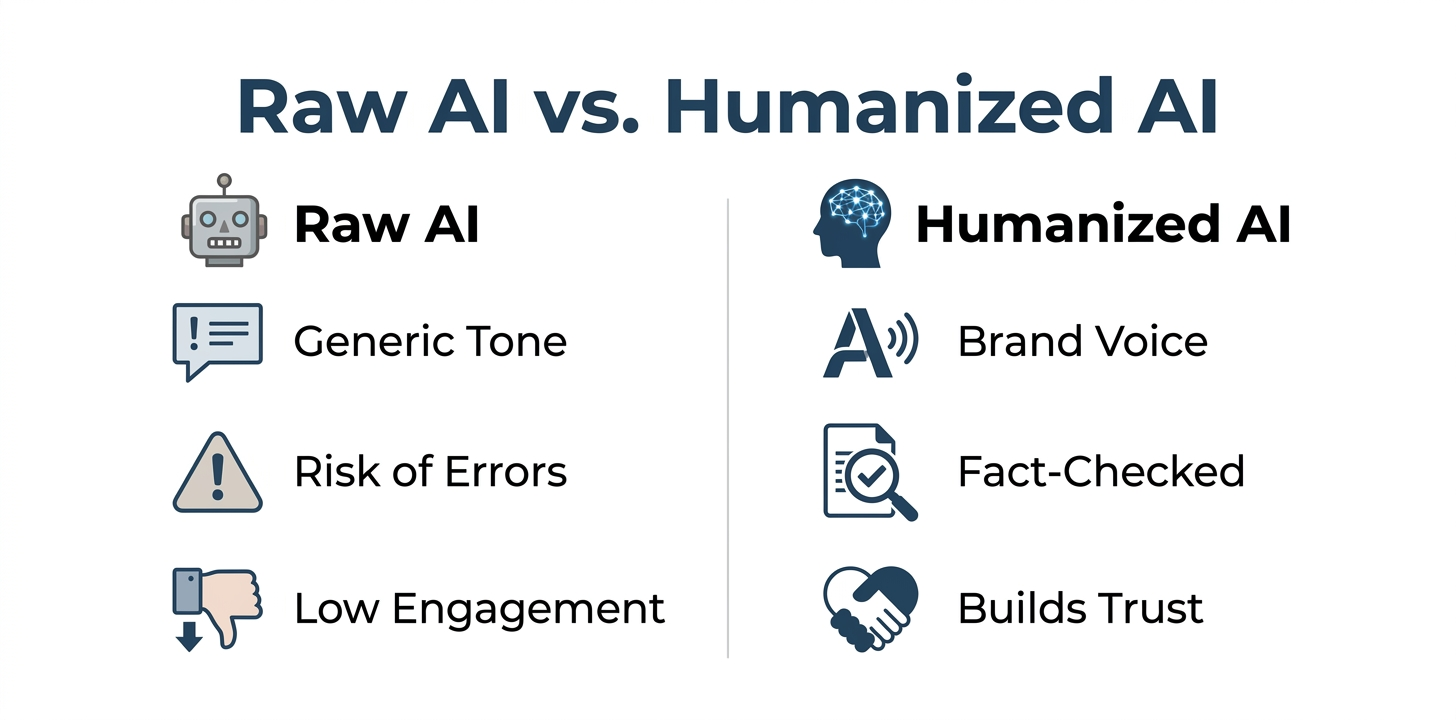
Let's move beyond theory and see a direct comparison. It's not just about which one reads better. It's about which one delivers better business results like engagement, ranking, and trust. Here is a breakdown of how a raw draft stacks up against polished, humanized content.
Reading Experience and Scannability
Raw AI often produces dense walls of text. The sentences might be grammatically correct, but they lack flow and variety. This makes the content hard to scan, forcing readers to work too hard to find the information they need. Most people will just click away when faced with a huge block of text.
Humanized content is designed for how people actually read online. Editors break up long paragraphs, use headings, and add bullet points. This makes the text easy to digest. Long-standing research from the Nielsen Norman Group confirms that 79% of users scan web pages instead of reading word-for-word. A scannable structure respects their time.
Emotional Connection and Trust
AI cannot feel emotions, so its writing is often cold and impersonal. It presents facts without the stories or empathy that build real connections. This lack of personality makes it hard for a brand to establish trust or stand out from the crowd of other generic articles online.
A human editor weaves in personal anecdotes, storytelling, and a relatable tone. This creates an emotional bond with the reader. Tapping into this is powerful. In fact, cognitive psychology shows that many consumer decisions are made subconsciously, driven by emotion rather than pure logic. Stories make content memorable and trustworthy.
Accuracy and Originality
One of the biggest dangers of raw AI is its tendency to "hallucinate." This means it can confidently invent facts, statistics, and even sources that are completely false. Publishing unverified AI output is a huge risk to your brand's credibility. It's a shortcut that can seriously backfire.
For example, Capella University's blog points to several high-profile AI errors, including a law firm that was fined for citing fake legal cases made up by an AI. A human editor's job is to ruthlessly fact-check every claim. This ensures the content is accurate and builds authority, protecting your reputation.
Business Results and ROI
At the end of the day, content needs to achieve business goals. Generic, raw AI content typically gets low engagement. Readers don't share, comment on, or trust it. This leads to poor search rankings, low conversion rates, and a weak return on your time investment.
Humanized content, on the other hand, delivers real value. It builds a loyal audience that trusts your brand. This leads to more shares, better engagement, and higher conversions. The effort pays off significantly. Investing in quality content is one of the smartest marketing decisions you can make.
The numbers prove it. While a specific ROI can vary, analysis compiled by Genesys Growth shows that content marketing can generate an average return of $3 for every $1 spent. Authentic, high-quality content marketing is not just an expense; it is a powerful investment that compounds over time.
Comparison 1: Engagement & Readability
Raw AI content often creates long, dense paragraphs. The sentences can sound robotic and use a passive voice, making the text feel heavy and hard to follow. This creates a poor reading experience for your audience. When faced with a wall of text, most people will simply leave the page, which increases your bounce rate and hurts your goals.
Humanized content is different because it's built for how people read online. It uses short paragraphs, clear headings, and even bullet points to break up the text. An editor will also use an active voice, ask questions, and weave in small stories. This structure makes the content much easier to scan and a lot more enjoyable to read.
These small changes make a big difference in keeping readers interested. And with so much AI content out there, standing out is more important than ever. In fact, the 2024 AI Marketing Benchmark Report reveals that over a third of marketers are already using AI to produce posts and articles. Simple human touches make your content memorable.
Ultimately, better readability leads to higher engagement. When readers find your content easy to digest and relatable, they are more likely to stay on the page longer. They might also share it with others or leave a comment. This is how you build a real connection that passive, robotic text just can't achieve.
Comparison 2: SEO & E-E-A-T
Raw AI content can struggle to rank well in search engines like Google. Search engines want to show users helpful articles made for people, not just for bots. Unedited AI text often rephrases what's already out there. It doesn't provide the unique value that makes content truly helpful, which can cause it to be seen as low quality.
This is where Google's quality signals, known as E-E-A-T, come in. This stands for Experience, Expertise, Authoritativeness, and Trust. Raw AI trips up on the very first letter: Experience. Since a machine has no personal life or firsthand knowledge, its content can't show real experience. This is a huge miss for creating people-first content that search engines reward.
Humanizing your content is the perfect fix. An editor adds stories, opinions, and firsthand insights that demonstrate experience. They also cite credible sources to build trust. According to digital marketing analysts at Absolute Digital, showing these qualities helps signal to Google that your content is valuable and made for humans. It is about showing, not just telling.
By adding a human touch, you directly address what search algorithms look for in top-tier content. This helps your articles perform better and builds a stronger connection with your audience. Human-edited content isn't just a reader preference; it's a smart SEO strategy. You can learn more in our guide to Google's E-E-A-T guidelines.
Comparison 3: Brand Voice & Trust
Raw AI content often sounds generic because it has no real personality. It pulls from a huge mix of online information, so it struggles to capture your brand's unique humor, tone, or values. This makes your message blend in with all the other robotic content. Your brand becomes forgettable and fails to stand out from the noise.
When your content has no distinct voice, it makes it hard for people to trust you. A generic tone feels impersonal and can even seem lazy to a reader. They might wonder if your brand truly stands behind the information it publishes. This lack of authenticity can slowly chip away at the trust you are trying to build with your audience.
Humanizing the text is how you reclaim your brand's identity. A person can add the stories, opinions, and specific language that make your brand unique. They ensure the content aligns with your core values and speaks directly to your ideal customer. This process turns a bland draft into something that truly sounds like you.
This effort builds a real relationship with your audience. As content marketing experts at Skyword highlight, humans are needed to add the emotional resonance that creates impactful connections. When readers feel that authentic personality, they connect on a deeper level. This emotional bond is what turns casual readers into loyal fans of your brand.
Comparison 4: Accuracy & Credibility
Raw AI output isn't just generic; it can be completely wrong. These tools are known to invent facts, statistics, or sources that sound real but are fake. This is often called an AI "hallucination." Publishing this unverified information is a huge risk. It can quickly destroy the trust you've built with your audience and damage your brand's reputation.
This is a well-known issue with current AI models. For example, a detailed analysis from Originality.ai highlights several cases where AI has spread misinformation. One instance involved a teacher who wrongly accused an entire class of cheating based on a faulty AI detector's output. These mistakes can have real consequences.
This is exactly why humanizing your content is so important. A human editor acts as a crucial fact-checker. Their job is to be skeptical of every claim the AI makes. They carefully review all the data, verify sources, and confirm every piece of information is accurate and current before anything gets published.
This careful process is what builds true credibility. When your audience knows your content is reliable and trustworthy, they see your brand as an authority. This turns your content from a potential risk into a valuable asset that strengthens your relationship with readers. It's a non-negotiable step for any serious brand.
How to Humanize AI Content: A 5-Step Action Plan
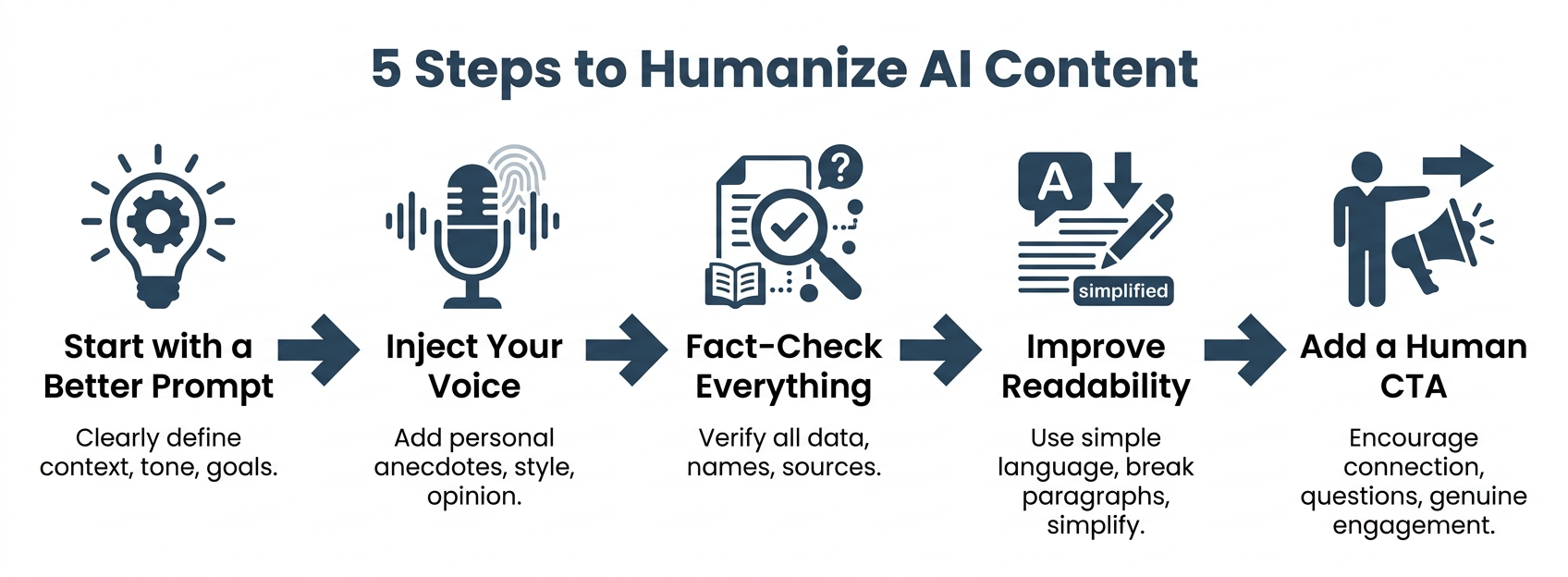
We've seen why robotic content fails to connect with readers. Now, let's get practical. How do you take a raw AI draft and turn it into something great? It's not about magic; it's about a simple, repeatable process. Following these five steps will help you blend AI's speed with your unique human touch every time.
Step 1: Start with a Better Prompt
The quality of your AI draft depends heavily on your initial instructions. Giving a vague request like \"write a blog post about marketing\" will get you a generic article. A detailed prompt is the foundation for better content. It guides the AI to produce a more structured and relevant first draft, saving you a lot of editing time later.
Think of it as creating a recipe for the AI to follow. Your prompt should define the target audience, desired tone of voice, and format. Guidance from marketing experts at Serpstat suggests including secondary keywords, a word count, and even a rough outline with H2s. A strong prompt is the first step to a strong article.
The Zulu Method uses humanizer prompts upstream in many of their automations to start the process of writing more human AI content from step one.
Here's the full Zulu Humanizer prompt library augmented for more general use: https://tinyurl.com/zuluaiprompts
16 prompts. 8 categories. A Claude & ChatGPT version for each. Customize and use these to create more human AI content in your stack.
Step 2: Inject Your Unique Voice and Stories
Raw AI content has no personality. Your next job is to give it one. Go through the draft and replace generic phrases with your brand's specific language. Add your opinions, humor, and unique perspective. This is where you make the content truly yours and stand out from the competition.
The most powerful way to do this is with storytelling. Add a short, personal anecdote, a client success story, or a specific example that only you could provide. According to brand psychology specialists at The MTM Agency, stories help move marketing messages from the rational mind to the emotional heart. This creates a much stronger and more memorable connection.
Step 3: Fact-Check Everything and Add Authority
Never trust an AI's facts without checking them yourself. AI models can confidently state things that are completely false, an issue known as hallucination. Even major tech companies have been embarrassed by this. For instance, IBM points out that Google's Bard AI made a factual error about a new telescope in its very first public demo.
Your credibility is on the line. Take the time to verify every statistic, name, date, and quote in the AI draft. Look for the original source of the information. Then, add links to credible websites to back up your claims. This not only proves your content is accurate but also boosts your authority and trustworthiness in the eyes of your readers.
Step 4: Improve Flow and Readability
AI writers often create long sentences and dense paragraphs. This is hard for people to read online. Your next step is to break up these walls of text to make the article easy to scan. No one wants to read a text that feels like a chore. People appreciate content that respects their time.
Go through the article and shorten long paragraphs. Aim for just one main idea per paragraph. Use headings, subheadings, and bullet points to organize the information. As UX design publication UX Planet explains, readers scan pages for keywords and headings. Making your content scannable helps them find what they need quickly and keeps them on your page longer.
Step 5: Add a Human-Driven Conclusion and CTA
An AI-generated conclusion is often weak. It might just repeat what was already said in a robotic way. Your article deserves a stronger ending. A human-written conclusion is your chance to leave a lasting impression on the reader and guide them toward what to do next.
Summarize the most important points in your own words. End with a final thought or a question that encourages the reader to think. And don't forget a clear call-to-action (CTA). Instead of a vague \"learn more,\" tell them exactly what to do. Maybe that's downloading a template, signing up for a newsletter, or leaving a comment with their own experience.
Step 1: Fact-Check and Deepen Research
Your first draft from an AI is just a starting point. You must treat every claim with a healthy dose of skepticism. Think of the AI as a helpful intern, not an expert. Its goal is to generate text that sounds convincing, which is very different from generating text that is factually correct. Always assume verification is needed.
This step is critical because AI tools can "hallucinate" or invent information. These mistakes can be very damaging to your credibility. For example, legal analysis from Esquire Solutions highlights a court case where a professor's expert report was thrown out. The professor had used AI to find sources and included fake citations it made up. Publishing unverified claims is a huge risk.
Don't just verify; go deeper. Use the AI's draft as clues for your own research. If it mentions a "recent study," find the original report and pull out a more specific data point. Look for newer information or a more authoritative source to replace the AI's generic statements. This process is what adds real value and authority to the content.
Step 2: Inject Your Unique Brand Voice & Tone
An AI-generated draft has no personality. It pulls from a huge mix of information online, so it can't capture the unique tone that makes your brand special. Your next job is to rewrite the text to sound like you. This step is about transforming a generic script into a message that feels authentic to your audience.
Go through the article line by line. Swap out formal, robotic phrases for the words you would actually use. Are you witty? Authoritative? Empathetic? Make sure the sentences reflect that personality. This isn't just about word choice; it's about the rhythm and feel of the writing. It should sound like a person, not a machine.
This is also where you add brand-specific analogies or points of view. These unique touches help readers remember you. According to an article on the cognitive psychology of advertising, personalized messaging and emotional storytelling are key to capturing an audience's attention. A unique voice makes your content feel personal and stand out.
Finally, make sure the tone matches who you're talking to and what you want to achieve. A playful tone might work for social media, but a more serious topic may need an authoritative voice. Matching the tone to your audience's expectations shows that you understand them, which is a big part of building trust.
Step 3: Weave in Stories, Examples, and Anecdotes
An AI doesn't have lived experiences. It can't share a funny mistake or a personal success story. This is where you, the human editor, come in. Your job is to find places in the raw draft to add these real-life touches. Go beyond just listing facts and start adding feeling to the words.
Stories turn abstract ideas into something concrete and easy to understand. Instead of just saying your service saves people time, tell a short story about what a client did with that extra time. This makes your point much more memorable and believable for the reader. It sticks in their mind.
People connect with emotion, not just logic. A story about a real person's success or struggle creates that emotional bond. In fact, a study in the Social and Economic Management Review suggests that emotionally connected customers can be 52% more valuable over their lifetime. Stories are how you build that connection.
This isn't just fluffy writing; it directly impacts your search rankings. This is what Google is looking for with its "Experience" signal in E-E-A-T. Adding real examples shows you have firsthand knowledge. As SEO best practices detailed on Hastewire highlight, solving user problems with unique insights is key, and that's precisely what stories do.
Step 4: Restructure for Flow and Readability
AI often writes in long, dense blocks of text. While the grammar might be perfect, the content can feel like a heavy textbook. This "wall of text" is intimidating for online readers who want answers quickly. Your job is to act as a sculptor, chipping away at the mass to reveal what's valuable inside.
The easiest way to fix this is to break up long paragraphs. Each paragraph should only contain one main idea. Aim for two or three sentences at most. This creates much-needed white space on the page. It makes the content feel more approachable and easier to digest for your readers.
Next, use formatting to guide the reader's eye. Bullet points and numbered lists are perfect for breaking down instructions or benefits. Use bold text to emphasize key terms or important takeaways. These elements act as visual signposts. They help people who are scanning find exactly what they need without reading every word.
Finally, check the overall flow of the article. Read the content aloud to make sure one idea smoothly transitions to the next. AI can sometimes jump between topics abruptly. Adding simple transition words or reordering sections can make the piece feel more logical. This final touch makes a huge difference in the reading experience.
Questions to Ask Before Humanizing Your AI Content
- Does this AI-generated draft tell a story or share a personal experience, or does it just list facts?
- How would I explain this topic to a friend in casual conversation—and does the AI text sound like that?
- What unique insight or firsthand knowledge could I add that no machine could produce?
- Are there long paragraphs or dense blocks of text that would make readers want to click away?
- Have I verified every statistic, name, date, and claim in this draft, or am I trusting AI accuracy?
- Does this content reflect my brand's voice and personality, or could it belong to any company?
- What emotional connection am I trying to create with my reader, and does the current text deliver that?
- Would my ideal customer find this article trustworthy and relatable, or does it feel like marketing copy?
Unique Differentiator: The Psychology of Connection, Why Robotic Text Fails
Have you ever read something and just felt... nothing? It's a common feeling with unedited AI writing. There's a reason for that, and it's rooted in how our brains work. We are not wired to connect with lifeless text. We are built for stories and emotion. This is the psychology that explains why flat, robotic content always falls short of its goals.
Our brains love things that are easy to process. This idea is called cognitive fluency. When text is smooth and flows well, it feels more believable and trustworthy. Raw AI content is often clunky and repetitive. This makes our brains work harder to understand it. As a result, we naturally distrust it or simply lose interest and click away in search of something better.
Real connection comes from emotion. Stories, personal examples, and a genuine voice trigger feelings that raw information cannot. This emotional link is powerful. It doesn't just make your content more enjoyable; it helps people remember your message. When readers feel something, they are far more likely to build a lasting bond with your brand and what you have to say.
AI is logical, not emotional. This is a major weakness in creative tasks. A study reported by ScienceDaily on the limits of AI creativity found that while AI can beat average humans on structured creative tests, it falls short on rich tasks like storytelling. It can mimic patterns, but it can't create the genuine feel that comes from human experience.
So when we talk about how to humanize AI content, we're really talking about bridging this psychological gap. It's about making the text flow naturally and adding the emotional sparks that create trust. This turns a forgettable article into a memorable experience that builds a loyal and engaged audience. Quality content connects with people on a deeper level.
Unique Differentiator: Building a Scalable 'Human-in-the-Loop' AI Content Workflow
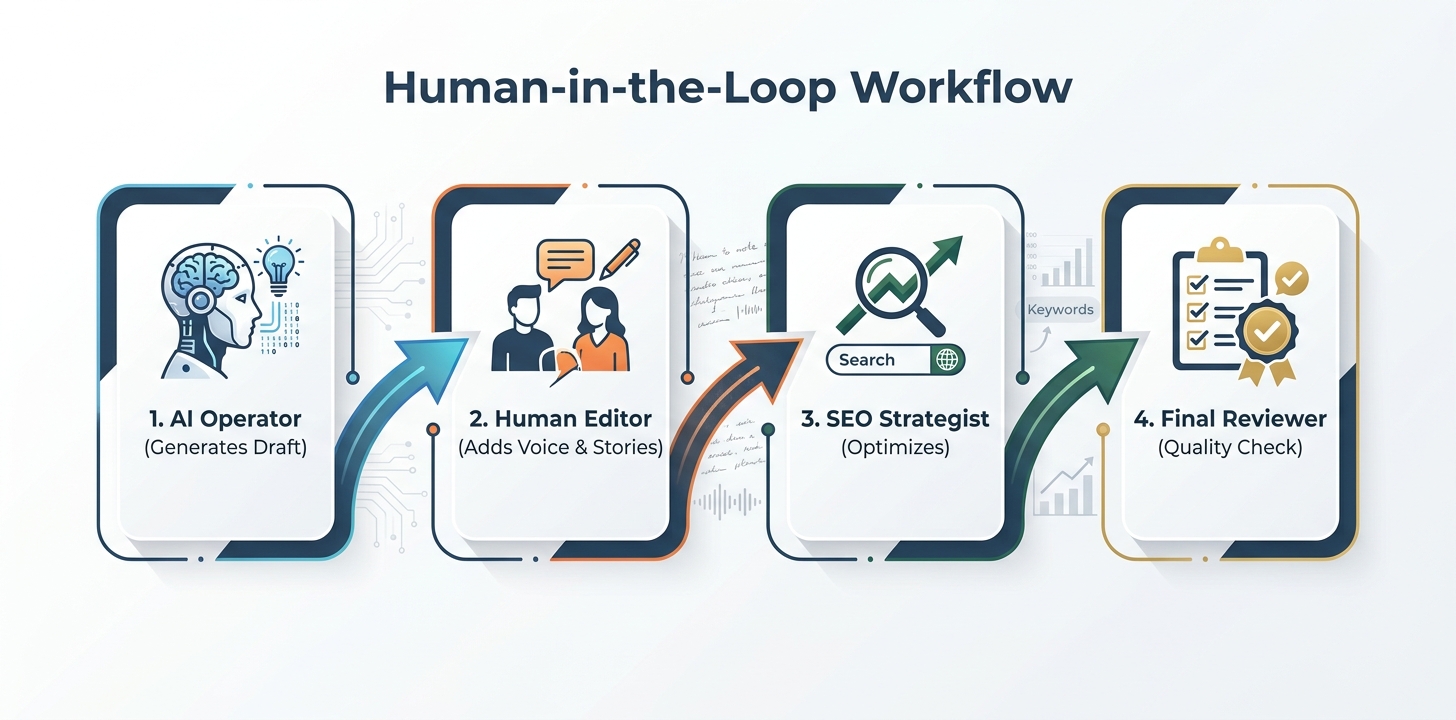
Humanizing AI content isn't a one-person job, especially for teams. To do it well and consistently, you need a structured workflow. This process ensures every piece of content gets the human touch it needs to connect with readers. It turns a chaotic task into an efficient and repeatable system for creating great articles.
With so many teams now using these tools, a smart process is a huge advantage. In fact, a 2024 global survey from Statista found that 42% of marketing leaders use AI for writing content multiple times a week. A good workflow helps manage this scale without letting quality slip.
A successful AI content system, often called a "human-in-the-loop" model, assigns clear roles. Each person has a specific job to do, which makes the whole process faster and more effective. Here is what a simple workflow can look like:
- AI Operator: This person takes a content brief and runs the prompts through an AI tool. They are responsible for generating the raw first draft and passing it along to the next person in line.
- Human Editor: This is where the real magic happens. This person takes the robotic draft and fully humanizes it. They add stories, fix the tone, check every fact, and dramatically improve the flow and readability.
- SEO Strategist: After the content feels human, this person optimizes it for search. They check for target keywords, add valuable internal links, and make sure the article meets all of Google's E-E-A-T guidelines.
- Final Reviewer: A fresh pair of eyes gives the article one last look. This person is the final quality check, catching any leftover mistakes before giving the green light to publish.
This structured approach ensures that every article is high-quality. By defining who does what, you can scale your content creation while maintaining a strong, authentic voice. If you want to dive deeper into building team systems, check out our guide on creating an effective project management workflow.
The Future is AI-Assisted, Not AI-Replaced
AI is a powerful assistant, but it can't replace human creativity. Relying on raw AI output is a risk that produces generic, untrustworthy content. The real advantage comes from humanizing that first draft. This turns a robotic article into something authentic that connects with people and builds a loyal audience.
Think of AI as your partner for the first part of the job. It drafts outlines and initial text, giving you a solid head start. But the most valuable part is the human touch you add at the end. This is where you inject personality, stories, and fact-checked authority into the piece.
The future of content is a true partnership between people and machines. It's more than a trend; it's a better way to work. Scientific studies in PMC even describe this as a new "co-creation paradigm," where AI amplifies human potential. This hybrid model is how leading brands will excel.
Take a hard look at your current content process. Are you leaning too heavily on automation? Use the steps in this guide to build a workflow that puts a human in the loop. Your audience will feel the difference, and your brand will be stronger for it. Understanding the broader context of AI marketing can help you implement these humanization techniques more effectively.

Frequently Asked Questions
Can Google detect AI content?
While Google has tools to understand content patterns and can identify some AI-generated text, their official stance is clear: they reward high-quality, helpful content regardless of how it was produced. Google's focus is on E-E-A-T (Experience, Expertise, Authoritativeness, and Trustworthiness), not punishing AI use itself. Poor, unedited AI content will rank poorly because it fails to be genuinely helpful to users, not simply because a machine wrote it.
Will I get an SEO penalty for using AI content?
No, you won't be penalized for using AI to create content. However, you will face poor rankings if your content is low-quality, unhelpful, or spammy—qualities that apply to poorly written content regardless of its source. If your AI-generated content is humanized to provide real value and aligns with user search intent, it meets Google's guidelines and will not be penalized. Quality and usefulness are what matter.
How do I make my AI writing sound natural?
To make AI writing sound natural, use active voice instead of passive construction, add personal stories or real-world anecdotes that only you could share, and break up long sentences into shorter, punchy ones. Read the content aloud to catch awkward phrasing that feels robotic. Finally, infuse it with your specific brand's tone, humor, and unique perspective so it sounds like a real person, not a machine.
What is the best AI humanizer tool?
The best "tool" for humanizing content is actually a skilled human editor, as true humanization requires adding unique insights, personal stories, and authentic brand voice—things that software cannot replicate. While tools like Grammarly and Hemingway App can help with grammar and readability, they're aids to the editing process, not replacements for human judgment and creativity.
How much time should I budget for humanizing an AI-generated article?
A good rule of thumb is to budget 30-50% of the time it would take to write the article from scratch for thorough humanization. For example, if an original 2,000-word article would take 6 hours to write, plan to spend at least 2-3 hours on a complete humanization pass that includes fact-checking, editing for voice, enriching with stories, and improving flow.
Can AI truly replicate human creativity and emotion?
Current AI can simulate emotional patterns and creative styles it learned from training data, but it doesn't possess genuine consciousness, lived experiences, or authentic feelings. This is why human-added stories and emotions feel real to readers—because they are. AI provides the initial canvas and structure; the human adds the soul that creates genuine emotional connection with your audience.