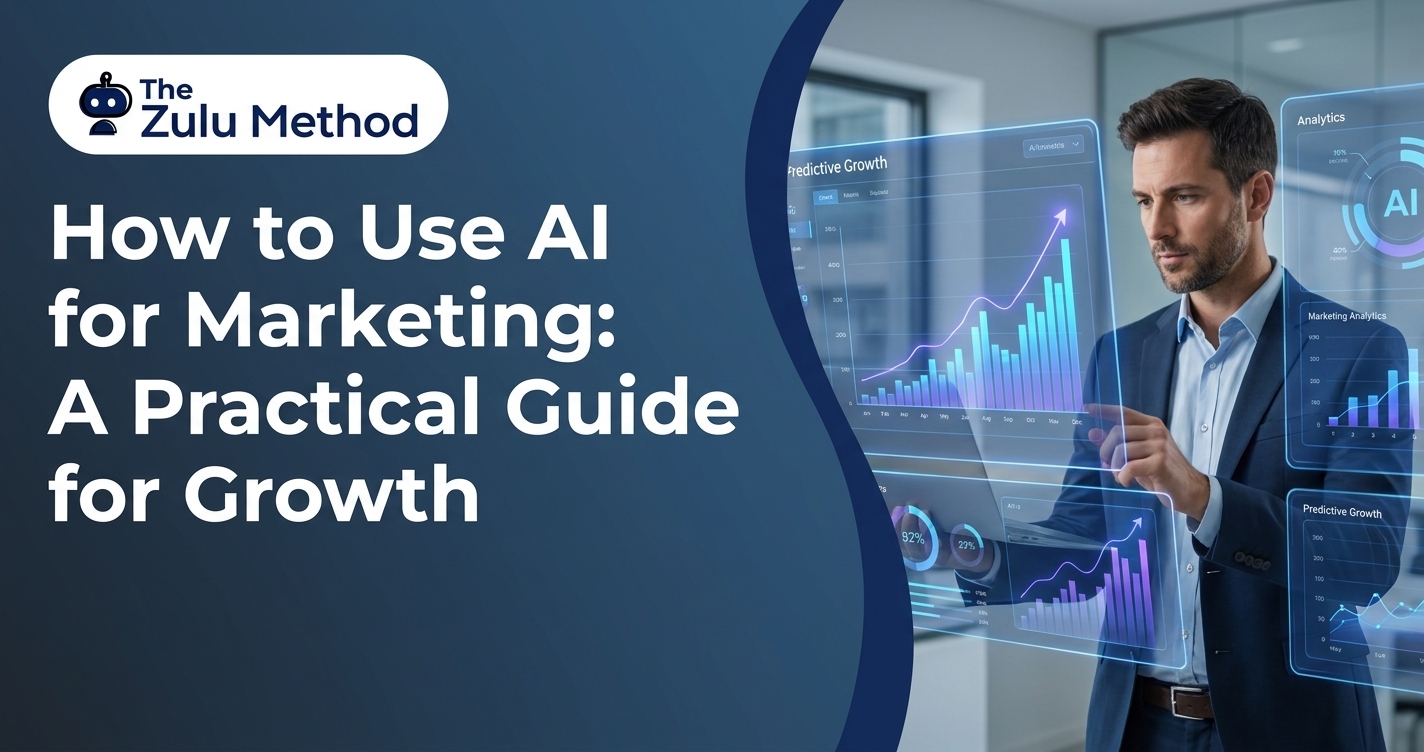
How to Use AI for Marketing: A Practical Guide for Growth

Published on: May 15, 2026 | Time to read: 6 min
Artificial intelligence (AI) has moved from a futuristic buzzword to a practical, powerful tool in the modern marketer's toolkit. But amidst all the hype, a crucial question remains: How do you actually use AI for marketing in a way that drives real growth? It’s not about replacing marketers; it's about empowering them to be more strategic, creative, and efficient.
This guide will walk you through the practical applications of AI across your marketing efforts and provide a clear, step-by-step framework to get started. Forget the jargon—let's focus on the results.
How AI is Reshaping the Marketing Landscape
At its core, AI in marketing involves using intelligent systems to analyze massive amounts of data, predict customer behavior, automate repetitive tasks, and personalize experiences at a scale never before possible. Here’s how you can apply it.
1. Uncover Deep Audience Insights
You have more customer data than ever before, but are you using it to its full potential? AI can sift through your CRM data, website analytics, and social media conversations to find patterns a human analyst might miss.
- Build Hyper-Detailed Personas: Move beyond basic demographics. AI can identify behavioral clusters, helping you understand your audience's motivations, pain points, and purchase triggers.
- Predictive Analytics: Use AI models to identify which leads are most likely to convert or which customers are at risk of churning. This allows you to focus your resources where they’ll have the biggest impact.
2. Supercharge Your Content Engine
Content creation is often a major bottleneck for marketing teams. AI can act as a tireless creative partner, helping you produce higher-quality content faster.
- Brainstorming and Outlining: Stuck for ideas? Ask an AI to generate blog topics, video scripts, or social media campaign concepts based on trending keywords or your core themes.
- Drafting Initial Copy: Use AI writing assistants to create first drafts of emails, ad copy, product descriptions, and even blog posts. The key is to treat it as a starting point—a human editor is still essential for refining the tone, ensuring accuracy, and adding a unique brand voice.
- SEO Optimization: AI tools can analyze top-ranking content and provide real-time suggestions to improve your on-page SEO, readability, and keyword density.
- Image and Video Generation: Create unique visuals for your ads, social posts, or blog articles simply by describing what you want in a text prompt.
3. Deliver Hyper-Personalization at Scale
Today's consumers expect experiences tailored to them. AI makes it possible to deliver one-to-one personalization to a one-to-many audience.
- Dynamic Website Content: AI can alter the text, images, and offers a visitor sees on your website based on their past behavior, location, or referral source.
- Smarter Email Marketing: Go beyond using a customer's first name. AI can power product recommendation engines, send emails at the optimal time for each individual, and even personalize subject lines to maximize open rates.
- AI-Powered Chatbots: Implement intelligent chatbots on your website to provide 24/7 customer support, answer common questions, and qualify leads in real-time, freeing up your sales and support teams for more complex issues.
4. Optimize Your Ad Spend and Targeting
Digital advertising is complex and competitive. AI helps you get the most out of every dollar you spend by automating and optimizing your campaigns.
- Automated Bidding: Let AI algorithms manage your bids in real time on platforms like Google and Facebook to achieve your goals, whether it’s maximizing conversions or lowering cost-per-click (CPC).
- Advanced Audience Segmentation: AI can analyze your existing customer data to build powerful lookalike audiences, finding new people who are highly likely to be interested in your product or service.
- Creative Optimization: Automatically test thousands of variations of ad copy, headlines, and images to identify the winning combinations without manual A/B testing.
A Practical 5-Step Framework to Get Started with AI in Marketing
Feeling overwhelmed? Don't be. You don't need to transform your entire department overnight. Here’s a simple process for integrating AI into your marketing strategy.
Step 1: Identify Your Primary GoalStart with a specific problem you want to solve or a metric you want to improve. Don't just "do AI." Instead, aim for a clear outcome. Examples include:
- "We need to increase our content output by 50% without hiring more writers."
- "We want to reduce our customer acquisition cost (CAC) by 15%."
- "We need to improve our email marketing click-through rate."
Choose one specific, low-risk area to experiment with first. This allows you to learn and demonstrate value before making a larger investment. For example:
- If your goal is content output, start by using an AI writing assistant to generate blog outlines and social media posts.
- If your goal is reducing CAC, experiment with an AI-powered bidding strategy on a single ad campaign.
Once you know your goal, look for the right type of tool. You don't need a single platform that does everything. There are countless specialized AI marketing tools available. Look for platforms that specialize in content generation, data analysis, ad optimization, or customer relationship management.
Step 4: Foster Human-AI CollaborationAI is a tool, not a replacement for human expertise. The most successful teams view AI as a collaborator. Invest in training your team on how to use these new tools effectively. Teach them prompt engineering for content creation, how to interpret AI-driven analytics, and when to trust their own strategic intuition over a machine's recommendation.
Step 5: Measure, Iterate, and ScaleTrack the performance of your initial test against the goal you set in Step 1. Did the AI-assisted content process save time? Did the AI-optimized ad campaign have a better ROI?
Use these findings to refine your approach. Once you've proven the value in one area, you'll have the business case to expand AI's role into other parts of your marketing strategy.
The Future is Collaborative
Learning how to use AI for marketing is no longer optional for growth-focused teams. It’s the key to unlocking new levels of efficiency, personalizing customer experiences, and gaining a competitive edge.
The marketers who will thrive in the coming years won't be replaced by AI. They will be the ones who master it, using it to amplify their creativity, strategy, and impact. Start small, stay curious, and begin your AI journey today.
Ready to Explore Agentic AI for Your Marketing Motion?
See how The Zulu Method combines expert human guidance with Agentic AI Execution to transform your entire GTM Motion.
Speak With An Expert!Hannon Brett
5x CMO/VP | 4x Founder | 20+ Years Building B2B Growth GTMs | AI-Native GTM Pioneer Proving AI Replaces 80% of Marketing Execution | B2B Events Growth Expert | Leadership, Superstar Team Building, & Successful Customers.