
Published on: June 01, 2026 | Time to read: 16 min
OpenAI paid ads represent an emerging advertising channel within ChatGPT, offering highly relevant contextual targeting to a massive, tech-savvy audience. While not yet publicly available, marketers should prepare now by understanding the unique benefits, early-mover advantages, and ethical considerations of this new advertising paradigm.
Key Takeaways
- OpenAI paid ads are not yet publicly available but are expected to feature contextual, conversational placements rather than disruptive banners
- The ChatGPT user base is highly educated, professionally driven, and tech-savvy—a valuable demographic for B2B and B2C companies
- High-intent contextual targeting could deliver dramatically higher engagement rates compared to traditional ad platforms by reaching users at their moment of need
- Early adopters will benefit from lower advertising costs and first-mover advantage before the market becomes saturated
- Success requires rethinking ad copy to be helpful and conversational, not promotional, with new measurement approaches focused on engagement and brand mentions
- Prepare now by building ad asset libraries, developing contextual ad strategies, and understanding privacy-centric advertising principles
Table of Contents
- The Core Benefits: Why Your Business Should Pay Attention
- Getting Started: A Step-by-Step Guide to Your First Campaign
- Beyond the Hype: Early Performance Benchmarks and Case Studies
- Advanced Strategy: Using AI to Create Your AI Ads
- Common Pitfalls and How to Avoid Them
- Conclusion: Your Next Steps in the New Age of AI Advertising
What Exactly Are OpenAI Paid Ads? A New Advertising Paradigm
OpenAI paid ads are an emerging concept centered on placing sponsored content within AI tools like ChatGPT. While a full-fledged ad platform is not yet public, the model is expected to feature contextual ads, like sponsored links appearing in response to a user's prompt. This creates a new channel for highly relevant advertising.
It is important to understand the difference between two concepts. The first is advertising on an OpenAI platform, which is still in an exploratory phase. The second is using OpenAI tools like ChatGPT to create ad copy and images for existing platforms like Google and Meta. The latter is already a common practice for many marketers.
So, who would these future ads target? The typical ChatGPT user is often tech-savvy, educated, and professionally driven. According to data from Statista on user demographics, a large portion of the audience is young adults seeking to improve productivity or learn new things. Understanding these marketing personas is key for any future campaigns.
This audience mindset shapes the conversation around potential ad formats. Instead of disruptive banners, the focus seems to be on native, helpful placements. Reports suggest OpenAI is exploring models like sponsored results that seamlessly integrate into the user's conversation. This approach would make ads feel more like useful suggestions than interruptions.
This idea is supported by tech industry analysis. For example, Semafor has reported on internal discussions at OpenAI about developing an advertising model as a new source of revenue. The goal appears to be creating a system that adds value to the user experience instead of taking away from it.
The Core Benefits: Why Your Business Should Pay Attention
Even though OpenAI paid ads are not widely available yet, the potential is huge. Getting in early on a new advertising channel could give businesses a major advantage. The unique environment of conversational AI offers benefits that traditional platforms can't match. It's a space every marketer should be watching closely.
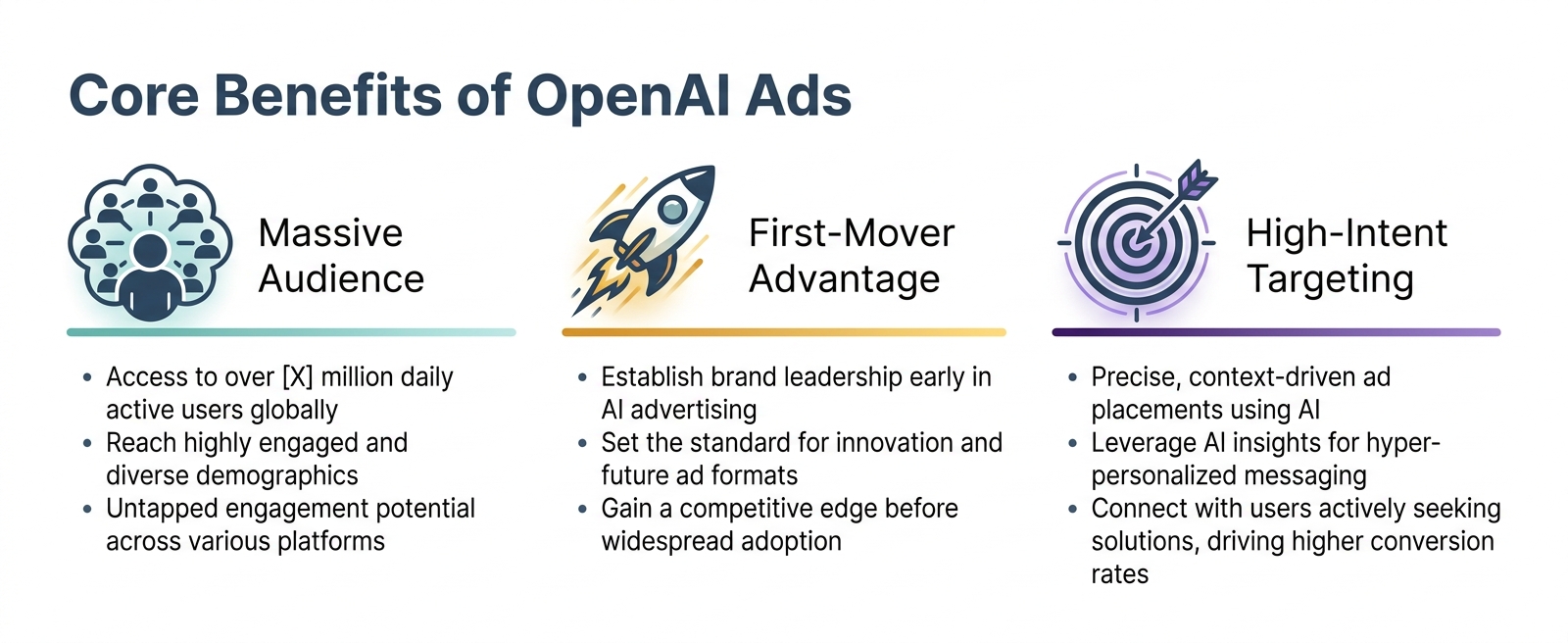
One of the biggest draws is access to a massive and highly engaged audience. ChatGPT serves hundreds of millions of users who are often educated, professionally driven, and actively seeking information. As demographic data from Similarweb shows, this user base is global and diverse, offering a direct line to a high-value audience that can be difficult to reach elsewhere.
Getting in early also means a first-mover advantage. New ad platforms usually have less competition. This can lead to lower advertising costs and a greater share of the audience's attention. As Gartner's analysis of marketing transformation suggests, early adopters get to learn what works before the space becomes crowded, providing a significant competitive lead for the future.
The most powerful benefit is high-intent targeting. Unlike ads based on past searches, ads on AI platforms could target users based on their live conversation. As Harvard Business Review explains, this means you can reach people at the exact moment they express a need or interest. This form of contextual advertising is incredibly precise.
This idea is supported by OpenAI's own technical explorations. For instance, a patent application filed by the company outlines a system for showing ads based on conversational topics. This approach presents a powerful alternative to traditional methods. It could make ads feel more like helpful suggestions than interruptions.
Getting Started: A Step-by-Step Guide to Your First Campaign

Since OpenAI paid ads are not yet available to the public, this guide is based on what we can expect. It combines insights from how current ad platforms work with the unique nature of conversational AI. Think of this as a look into the future of advertising and how you can prepare your business for it.
When an official platform launches, the first step will likely involve setting up an account and defining your budget. This process could look similar to creating a campaign on Google or Meta. You would probably set daily or lifetime budgets and establish your overall campaign goals, like driving traffic or generating leads.
Targeting is where things get interesting. Most experts believe OpenAI will focus on contextual targeting. This means ads would be shown based on the user's current conversation, not their past browsing history. As reporting from Axios suggests, this approach could align ads with a user's immediate needs, making them incredibly relevant.
Crafting your ad copy will require a completely new mindset. Traditional, loud calls to action will not work in a helpful, conversational space. Instead of shouting "Buy Now!", your ad copy will need to be subtle and useful. The goal is to feel like a natural part of the conversation, not an interruption.
The best ads will likely offer a solution to a problem the user just mentioned. For example, if a user asks ChatGPT for home workout ideas, a helpful ad might be "Here are some top-rated yoga mats for small spaces." This approach adds value while promoting your product. It becomes a suggestion, not an ad.
Measuring success will also be different. The conversational format may not support traditional tracking pixels due to a focus on privacy. And that means you cannot just rely on old methods. Instead, you'll need to think about new ways to track what is working with your campaigns and what is not.
Marketers might need to focus on metrics like engagement rates within the chat, brand mentions, or redemptions of unique coupon codes. The industry is already exploring new methods for privacy-safe advertising. Learning about algorithmic bias detection and mitigation is a great start for preparing for this new landscape.
By preparing now, you will be in a strong position to take advantage of this new channel when it arrives. Start thinking about what helpful, contextual ads would look like for your business. This forward-thinking approach will give you a significant edge over the competition.
Questions to Ask Before Launching Your OpenAI Ad Strategy
- Does your target audience align with ChatGPT's demographic profile of educated, professionally-driven, tech-savvy users?
- Can you articulate your product as a helpful solution to a specific problem rather than as a promotional message?
- Do you have the resources to create multiple contextual ad copy variations for different conversation topics?
- How will you measure success without relying on traditional tracking pixels, and what alternative metrics matter most to your business?
- Is your brand prepared to compete in a crowded marketplace once OpenAI ads become widely available?
- Have you considered the ethical implications and brand safety concerns of appearing alongside AI-generated content?
- What is your budget for experimentation in this emerging channel before proven ROI is established?
- Are you ready to invest time now in building an ad asset library and campaign roadmap before the platform launches?
Beyond the Hype: Early Performance Benchmarks and Case Studies
Since OpenAI paid ads are not yet public, there are no official performance benchmarks. No real-world data on click-through rates (CTR) or costs exists. But we can look at what experts predict based on how this new ad model is expected to work. This helps us set realistic expectations for the future.
Analysts believe these ads could perform very well. The main reason is their relevance. An ad that appears in a direct conversation about a problem is more likely to be clicked. This is because it is perfectly timed. This could lead to much higher engagement compared to traditional ads.
Early adopters could also benefit from lower costs. When a new ad platform launches, there is little competition, which often means lower prices for clicks or conversions. Projections in reports like Forrester's analysis of AI in marketing suggest that being early allows for learning and optimization that provides a strong advantage.
Let's imagine a hypothetical case study. Picture a small business that sells project management software. A user asks ChatGPT, "What are the best ways to keep my remote team organized on a big project?" The AI gives several helpful tips.
At the end of its answer, a sponsored link might appear. It could say, "You might also like this PM tool, designed for remote teams." This feels like a helpful suggestion, not a disruptive ad. Seeing this in action would show the power of contextual advertising, similar to what we explore in our own case studies.
This is different from ads on Google or Facebook. Those platforms target you based on past searches or demographic data. OpenAI paid ads would target your immediate, stated need. This in-the-moment relevance could lead to higher quality leads and better conversion rates because you are reaching someone at their exact point of need.
Of course, there are still unknowns. The final performance will depend on how well these ads are integrated and if users accept them. Marketers will also need new ways to measure success. But the potential for strong performance is clear, making this a channel worth watching closely.
Advanced Strategy: Using AI to Create Your AI Ads
While you wait for OpenAI paid ads to launch, you can use AI tools right now to prepare. This advanced strategy involves using AI like ChatGPT and DALL-E 3 to build your ad materials. It's a smart way to get ahead of the curve by using the technology to create ads for the technology.
Start by using ChatGPT to brainstorm your ad copy. Think of it as your creative partner. You can ask it to generate dozens of headlines, descriptions, and calls to action. The key is to provide very specific prompts. Tell the AI about your audience, their problems, and your product's solution. This helps you get truly useful ideas.
For example, you can ask for copy that is helpful and conversational, fitting the style of an AI chat. As guides from marketing tool SEMrush demonstrate, giving the AI a clear framework, like a problem and a solution, leads to better results. This process helps you build a library of ad copy ready to test when the platform goes live.
Next, use text-to-image models like DALL-E 3 to create your ad visuals. This allows you to generate completely unique, on-brand images at scale. Instead of relying on generic stock photos, you can create visuals that perfectly match your messaging. This saves time and money compared to traditional design methods.
You can also use AI for competitor analysis. Feed your competitor's ad copy or website text into ChatGPT. Then, ask it to identify their main selling points, tone of voice, and target audience. You can even ask it to point out gaps or weaknesses in their messaging that your own ads could target.
By following these steps, you build a complete portfolio of ad assets. When OpenAI paid ads become available, you will have a full set of tested copy and visuals ready to go. This preparation gives you a huge advantage, allowing you to launch and learn faster than your competition.
Common Pitfalls and How to Avoid Them
While OpenAI paid ads offer big opportunities, they also come with new risks. One of the main concerns is brand safety. Since the AI generates responses in real time, you will have less control over the content your ad appears next to. There is always a chance your brand could be associated with strange or inappropriate information generated by the AI.
Another issue is the risk of losing your unique brand voice. If you rely too much on generic AI outputs, your ads might sound just like everyone else's. To avoid this, always have a human in the loop. Use AI for ideas, but let a person refine the message to ensure it truly reflects your brand's personality and values.
The new ad model also brings up serious ethical questions. How will user data be used? And what about privacy? Because these ads are so new, the rules are still being written. Marketers need to be very careful and think about how their campaigns will affect users. Trust is easy to lose and hard to get back.
A major concern is the potential for biased ad delivery. AI systems learn from existing data, which can contain human biases. This could lead to ads being unfairly shown to or hidden from certain groups of people. This issue is a big topic, with a Pew Research Center report on AI concerns highlighting public worries over fairness.
Avoiding these pitfalls means staying engaged. Do not just "set it and forget it." Monitor where your ads appear. Put people in charge of your brand voice. And always prioritize being fair and transparent with your audience. A thoughtful approach will help you navigate this new advertising world successfully.
Your Next Steps in the New Age of AI Advertising
The landscape of AI advertising is unfolding rapidly. While OpenAI paid ads are still on the horizon, the opportunity to prepare is here today. By getting familiar with contextual, conversational advertising now, you gain a significant competitive edge. This is your chance to learn and adapt before the field becomes crowded and more expensive.
This new channel is not about replacing what already works. Instead, it is about adding a powerful tool to your marketing mix. A thoughtful and balanced approach is key. As Accenture's insights on ethical AI advertising highlight, a responsible strategy integrates new technologies while maintaining consumer trust. Think of it as diversifying your advertising portfolio for the future.
So, what is your immediate next step? Start planning now. Set aside a small test budget specifically for AI ad experiments. This does not need to be a huge amount. The goal is to have resources ready so you can move quickly and begin learning as soon as a platform becomes available to the public.
To guide your efforts, create a simple experimentation roadmap. This document should outline your goals, potential target conversations, and your ideas for ad copy. It acts as your playbook for launching your first campaign. You can get organized with our free marketing experiment template to help you get started.

Frequently Asked Questions
Can I advertise on ChatGPT right now?
OpenAI has not yet publicly launched a commercial advertising platform for third-party advertisers on ChatGPT or its other consumer products. While OpenAI is exploring advertising as a potential revenue stream and has discussed this internally, there is no official beta program or public signup available. Keep monitoring OpenAI's official channels and blog for any announcements about when an ad platform becomes available.
How much do OpenAI ads cost?
Official pricing models for OpenAI ads have not been publicly announced, so the exact cost per click (CPC), cost per thousand impressions (CPM), or cost per acquisition (CPA) remains unknown. However, industry analysts expect that early-stage platforms typically offer lower costs due to less competition, and as the market matures, prices will increase. The final pricing will likely depend on factors like targeting specificity, audience demand, and overall market competition.
Are OpenAI ads effective?
While no real-world performance data exists yet, the potential for high effectiveness is significant due to the contextual nature of AI-driven ads and high user intent. Ads appearing during relevant conversations are likely to achieve higher click-through rates and conversion rates than traditional advertising. However, this is still an emerging channel, so a "test and learn" approach is recommended. Early adopters should prepare to experiment, measure new metrics, and optimize based on results.
What kind of businesses should advertise on OpenAI?
Ideal candidates include B2B and B2C SaaS companies, tech-focused businesses, e-learning platforms, high-consideration consumer products, and any brand targeting educated, professionally-driven audiences. Businesses offering solutions to problems that users actively discuss in ChatGPT—such as productivity tools, courses, professional software, or specialized services—will likely see the strongest results from contextual ad placement.
How will OpenAI handle ad and user privacy?
OpenAI's current privacy-centric approach emphasizes that user conversations are not used for model training by default without explicit consent. While OpenAI has not yet detailed specific privacy policies for its future ad platform, their existing framework suggests ads will likely rely on real-time conversational context rather than deep historical profiling. The company's commitment to responsible AI and privacy suggests any advertising implementation will prioritize transparency, user control, and privacy-preserving technologies aligned with industry trends toward privacy-safe advertising.