
Published on: June 1, 2026 | Time to read: 21 min
Decoding the Definition: What Exactly is AI Slop?
AI slop meaning in plain terms: AI slop is low-quality, unoriginal content produced by generative AI tools with little or no human review. It's published in bulk, wastes the reader's time, and adds no real value. Think generic blog posts, nonsensical images, and copy-pasted text that floods the web.Where the Term Came From
The word "slop" has been around for a long time. It means messy, unappetizing waste. And that's exactly what the term captures when applied to AI content.
The phrase "AI slop" started appearing online as early as 2022, used on platforms like 4chan and YouTube to describe low-quality AI-generated images. By 2024, it had gone mainstream. Developer Simon Willison helped push the term into wider use through his blog post in May 2024, crediting an earlier post by @deepfates as his inspiration.
The timing wasn't random. It matched a surge in mass-produced AI content flooding Amazon, social media feeds, and search results.
What Makes Something "Slop" vs. Useful AI Content
Here's the key point: AI slop isn't about the tool. It's about the output and the intent behind it.
Useful AI-assisted content is guided by human expertise. A writer uses AI to draft ideas, then edits, fact-checks, and shapes the work with real knowledge. The result is relevant, accurate, and genuinely helpful.
AI slop is the opposite. It skips all that. It's the brazen publishing of content that clearly wasn't reviewed. As researchers at Northeastern University describe it, slop is text that lacks relevance, contains factual errors, or suffers from biased framing.
One expert quoted in a 2025 study on measuring AI slop put it well: "I wouldn't call it 'slop' if it was simply a first draft. It's the brazen publishing of content that wastes a reader's time that befits the term best."
The Slop Metaphor Explained
Think of it like food. A skilled chef can use a blender to make something delicious. But if someone just throws random ingredients in and serves the unblended mess straight to the table, that's slop.
The same logic applies here. AI is the blender. The problem isn't using it. The problem is skipping the part where a human steps in, tastes it, and makes it worth eating.
Low-quality AI content is verbose, off-topic, and often just wrong. It fills space without adding anything. And right now, it's spreading fast across the web.
The Origin Story Behind the Term 'AI Slop'
The phrase "AI slop" didn't come from a boardroom or a research lab. It bubbled up from everyday internet users who needed a word for something they kept running into online: content that was clearly machine-made, clearly low-effort, and clearly not worth their time.
From Niche Slang to Mainstream Label
The term was already floating around as early as 2022 on platforms like 4chan and YouTube. Back then, people used it mostly to describe weird, low-quality AI-generated images. But it stayed pretty niche for a while.
That started to change in late 2023 and into 2024. As tools like ChatGPT became easy for anyone to use, a flood of mass-produced content hit the web. Books, blog posts, product descriptions, and social media images all started showing up in huge volumes with very little human input behind them.
People needed a word that captured this specific problem. "Spam" was too old and too tied to email. "Fake news" was about deliberate political deception. Neither one quite fit. "AI slop" did.
According to Wikipedia's entry on AI slop, the term gained traction as users sought language to describe shoddy or unwanted AI content appearing across major platforms.
The Key Moment That Spread the Term
One specific moment helped push "AI slop" into wider use. In May 2024, developer Simon Willison wrote a blog post adopting the phrase and crediting a post by user @deepfates as his inspiration. Willison had a large audience in tech and developer circles, so the term spread quickly after that.
But Willison was clear: he wasn't inventing the term. He was helping amplify something that already existed. The real origin was community-driven, born from frustration on forums and feeds.
Why Amazon Books Became a Symbol of the Problem
One of the biggest trends that gave the term its footing was the rise of AI-generated books on Amazon. Reports described a "stratospheric" jump in new titles, many of them thin, repetitive, and clearly written without real expertise.
As Kenton Library's buyer guide on AI slop books explains, readers started noticing these titles popping up in search results, often mimicking the look of legitimate guides or manuals.
This wasn't just annoying. It was a real problem for people trying to find trustworthy information.
A Term That Fills a Gap
So why did "AI slop" stick when other terms didn't? Because it names something specific.
It's not about AI being bad in general. It's about content that skips the human step entirely and gets published anyway. The word "slop" carries a sense of carelessness, of serving something that wasn't ready. That feeling resonated with a lot of people.
And as the volume of this content kept growing through 2024, the term only became more useful.
How to Spot AI-Generated Slop: The Telltale Signs

AI slop meaning in practice comes down to recognizing specific patterns. Whether it's text or images, low-quality AI content leaves clues. Once you know what to look for, you'll start seeing them everywhere.
Red Flags in AI-Generated Text
The easiest signs show up in word choice and structure. Watch out for opening lines like "In today's fast-paced world" or closing phrases like "In conclusion, it's clear that." These are classic AI filler phrases that signal no real human shaped the content.
Repetitive sentence structure is another giveaway. If every paragraph feels like it follows the same rhythm, that's a pattern AI tools fall into naturally. Real writers vary their pace and flow without thinking about it.
Factual errors and logical gaps are also common. AI tools can confidently state things that are simply wrong. A Harrisburg County Public Library guide on AI slop points out that checking facts in AI-generated content is always a smart move, because errors often hide inside otherwise polished-looking text.
Signs in AI-Generated Images
Images are often easier to call out. The most famous tell is the hands: too many fingers, bent the wrong way, or fused together in odd ways. Eyes can look slightly off too, glassy or asymmetrical in a way that's hard to pin down but easy to feel.
Background text in AI images is almost always gibberish. Letters blur, words repeat, and signs say nothing meaningful. Objects near the edges of the frame tend to blend into each other in unnatural ways. Textures like fabric, hair, and wood often look smooth in the wrong places or detailed in areas that should be flat.
The 'Soulless Valley' Problem
This is the trickiest sign of all. Some AI content is grammatically perfect. No typos, no awkward phrasing. But it still feels empty.
Experts call this the "soulless valley." The text is technically fine but lacks any real point of view, personality, or fresh insight. It restates the obvious in clean language and stops there. There's no opinion, no story, no moment where a real human perspective comes through.
Researchers studying AI content have found that this kind of writing is "very generic and overly verbose," essentially marketing copy or rambling prose that should have been edited before publishing. It passes a quick glance but offers nothing worth reading twice.
If you finish a piece and can't say what you actually learned, there's a good chance you just read slop.
Examples of AI Slop Flooding the Internet
AI slop doesn't just exist in theory. It's showing up in places people visit every day: online bookstores, search engines, and social media feeds. Here are some of the clearest real-world examples of what low-quality AI content actually looks like in the wild.
AI-Generated Books and T-Shirts on Amazon
Amazon became one of the most talked-about battlegrounds for AI slop. Reports described a "stratospheric" rise in new book listings, many of them thin, repetitive, and clearly produced without real expertise or human review.
Some of these books cover topics like foraging, medical advice, or survival skills. The problem is that they can be dangerously wrong. And readers often can't tell until they've already bought them.
AI-generated t-shirt designs followed a similar pattern. Strange text, warped images, and nonsensical slogans flooded print-on-demand storefronts. Many designs featured twisted fonts, extra limbs, or images that made no visual sense.
The 'Glue on Pizza' Search Result
Perhaps the most famous single example of AI slop in search results came from Google's AI Overview feature. When users searched for pizza-making tips, the AI reportedly suggested adding non-toxic glue to keep the cheese from sliding off.
The likely origin of this bizarre tip was a satirical Reddit post from years earlier. Google's AI pulled it in without understanding context, and served it as real advice. As covered by BGR's analysis of Google AI Overviews, the feature continued surfacing misleading answers even after public backlash.
This became a symbol of what happens when AI content skips the human review step entirely.
Social Media Slop: Bots, Bait, and 'Shrimp Jesus'
Social media is where AI slop gets truly strange. Facebook saw a wave of AI-generated images designed purely to grab attention and farm engagement, not to share anything real.
One of the most widely shared examples was "Shrimp Jesus," an AI-generated image of a shrimp-human hybrid that went viral across Facebook pages. Researchers studying this trend found that scam pages used floods of AI images to build audiences and then push fake products or misleading links.
According to research published in the Harvard Misinformation Review on AI images and Facebook spam, spammers leaned heavily on AI-generated visuals because they were cheap, fast, and generated high engagement before platforms could respond.
And it wasn't just Facebook. X (formerly Twitter) bots posted endless streams of AI-generated images with generic captions, designed to accumulate followers and appear legitimate.
These examples aren't rare edge cases. They're part of a pattern that's become one of the defining features of the modern web.
Real World Example: The 'Glue on Pizza' Incident
When users searched for pizza-making tips on Google's AI Overview feature, the AI reportedly suggested adding non-toxic glue to keep cheese from sliding off. This bizarre recommendation likely originated from a satirical Reddit post the AI misinterpreted as legitimate advice. Despite public backlash, the feature continued surfacing misleading answers—a perfect symbol of what happens when AI content skips human review entirely and confidently states false information without citations.
The Economic and Ethical Impact of This AI Content Problem
AI slop meaning goes beyond bad writing. It's a real-world problem with financial consequences, ethical dangers, and a slow drain on human creativity. The effects ripple out far beyond any single bad article or weird image.
The Economic Damage to Writers and Artists
For freelance writers, copywriters, and illustrators, the flood of cheap AI content has made an already tough market worse. Companies that once paid for quality human writing can now generate thousands of words for pennies. That changes what they're willing to pay for.
The Authors Guild has called AI text generators a serious threat to the writing profession, warning that market dilution from AI-generated works makes it harder for human authors to earn a living. When slop fills shelves and feeds, original work gets buried.
Artists face the same squeeze. AI image tools can produce dozens of visuals in the time it takes a professional to sketch one. That speed difference directly affects who gets hired and at what rate.
Gaming the Ad-Revenue System
Slop also distorts how ad revenue flows online. Spam sites and content farms publish thousands of AI-generated articles not because they help anyone but because each page can earn ad impressions.
This creates a system where low-effort content competes for the same ad dollars as carefully researched journalism. Publishers who invest in real reporting, fact-checking, and expert sources get undercut by sites that churn out AI text for next to nothing.
Google's March 2024 core update tried to address this directly. The policy targets scaled content abuse, meaning pages created at scale with little or no value, regardless of whether they're AI-generated or not. The intent matters as much as the method.
The Spread of Misinformation and Eroded Trust
The ethical stakes are just as serious. AI slop doesn't stay harmless. When it spreads false information confidently, it can change what people believe.
The glue-on-pizza moment was funny. But the same dynamic applies to medical advice, legal questions, and news events. AI tools can state incorrect things with total confidence and no citations. That's a problem when people can't tell the difference.
Researchers warn that trust in online information is already fraying. AI slop is also being used deliberately. Propagandists and bad actors can flood platforms with AI-generated content to push narratives, drown out real voices, or make fake stories look credible through sheer volume.
What It Does to Human Creativity
There's a subtler problem too. When the internet fills up with generic, machine-made content, it changes what creativity looks like and what it's worth.
Human writers and artists create in response to the world around them. They read things, get inspired, react, and make something original. But if most of what's available to read and view is AI slop, that feedback loop breaks down.
The economic pressures of AI don't just reduce jobs. They reduce the incentive to develop creative skills at all. Why invest years in learning a craft if the market won't reward it?
A web flooded with AI content doesn't just waste readers' time. It slowly hollows out the creative culture that made the internet worth visiting in the first place.
Google's War on Slop Content: Algorithmic Updates and Penalties
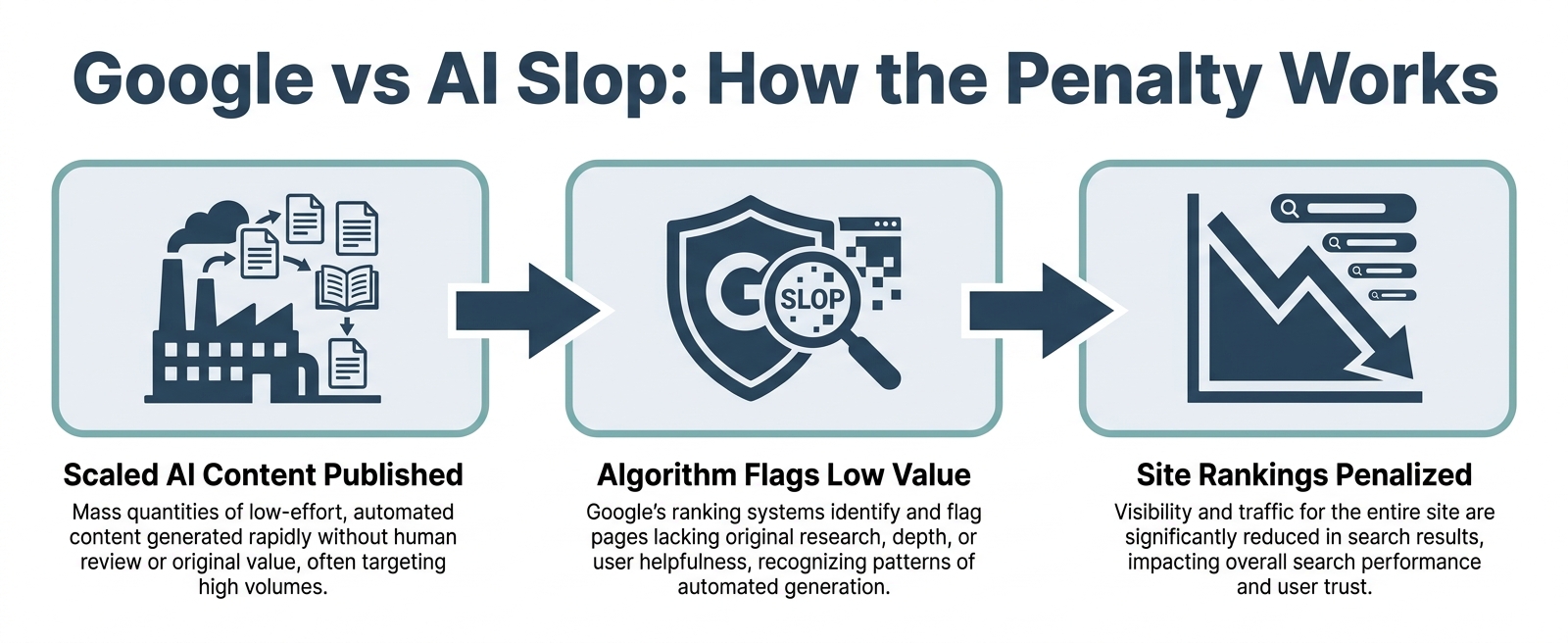
Google's position on AI-generated content is often misunderstood. The search giant isn't against AI writing tools. What it targets is content created purely to game rankings, with little value for real readers. That distinction matters a lot for anyone publishing online today.
AI Content Isn't the Problem. Unhelpful Content Is.
Google has been clear on this point. Using AI to help write content isn't a violation of its guidelines. But publishing content at scale with no real purpose other than ranking higher? That's exactly what the latest updates are designed to catch.
The focus has shifted from how content is made to why it was made. If the intent is to manipulate search results rather than help a reader, Google treats it as an abuse of the system.
The March 2024 Core Update
The March 2024 core update was one of Google's most significant moves against low-quality content. It introduced tighter rules around what Google calls "scaled content abuse."
According to Google's official search blog, scaled content abuse means generating large numbers of pages designed primarily to manipulate rankings, not to help users. And critically, the policy applies regardless of whether the content was written by a human, an AI, or a mix of both.
The key quote from Google's own documentation sums it up: "Scaled content abuse is when many pages are generated for the primary purpose of manipulating Search rankings and not helping users."
Scaled Content Abuse: What It Covers
The updated policy closed a loophole that some publishers tried to exploit. Before, the focus was often on purely automated content. The new rules make clear that human-assisted AI content counts too, if the intent is manipulation.
As detailed in Google's Search spam policies documentation, the update specifically calls out more sophisticated forms of scaled content creation. That includes cases where it's harder to tell whether a human or a machine wrote it.
The result is that volume alone can now trigger a penalty. Publishing thousands of thin pages, even with some human involvement, puts a site at risk.
Site Reputation Abuse: A Newer Problem
The March 2024 update also introduced the concept of "site reputation abuse." This one targets a specific tactic where a trusted website rents out part of its domain to a third party publishing low-quality content.
The idea behind the tactic is simple: borrow the authority of a reputable domain to rank content that wouldn't otherwise perform well in search. Google now explicitly penalizes this.
A well-known news site's subdomain hosting thousands of AI-generated coupon pages or listicles with no editorial oversight is a classic example. The host site's reputation gets used as cover for slop content.
What This Means for Publishers
These updates send a clear message. The metric that matters isn't how much content you publish. It's whether that content actually helps someone.
Sites that built traffic on bulk AI output started seeing ranking drops after the March 2024 rollout. And Google has signaled that this direction won't reverse. The algorithm is getting better at spotting content that exists to rank rather than to inform.
For writers, editors, and site owners, the practical takeaway is straightforward: human review, genuine expertise, and real value for readers aren't just good practices. They're now the baseline Google expects.
The Future of Information: Navigating a World with AI Slop
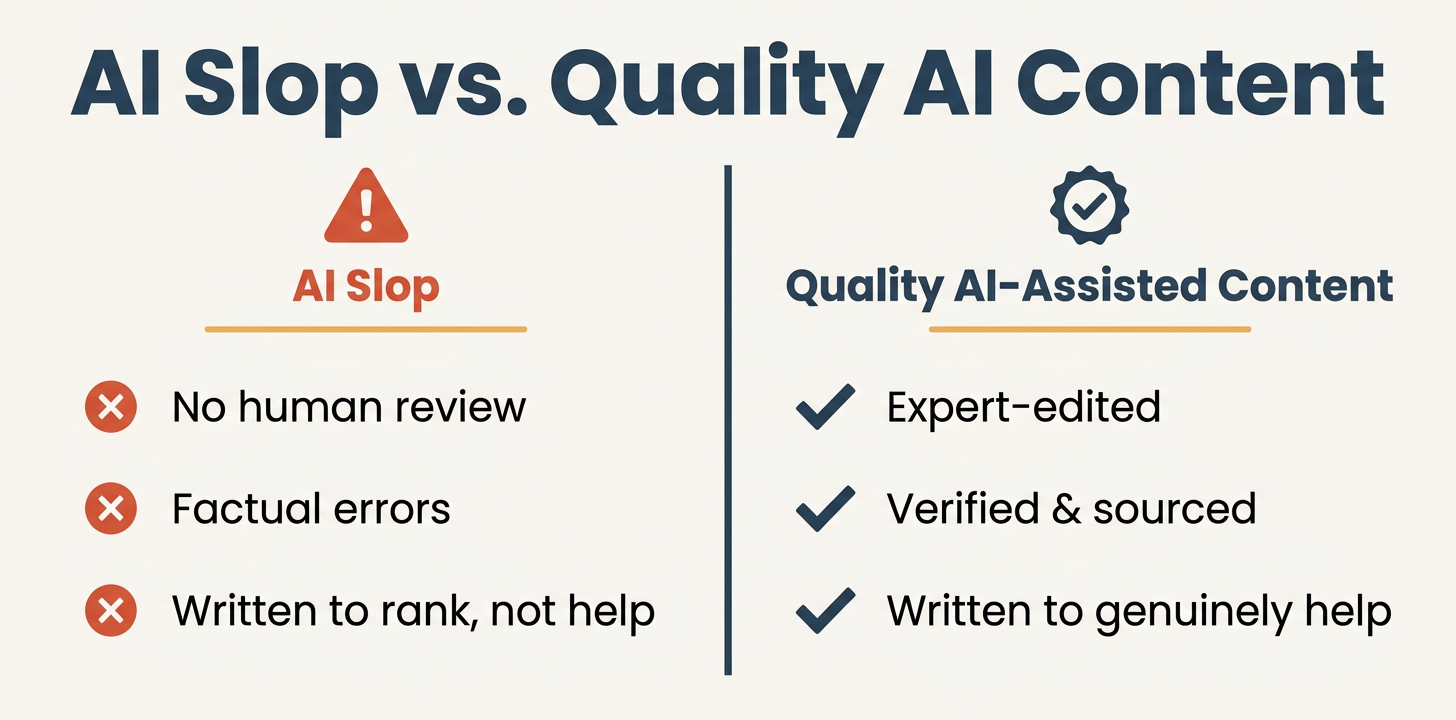
The web is already flooded with AI-generated content, and that flood isn't slowing down. So what does a world with even more AI slop look like? And what can everyday people do about it? The answers involve sharper personal habits, new kinds of online communities, and a technology race that's only just getting started.
Building Your Own Defenses
The most practical thing anyone can do right now is slow down before trusting what they read. That means checking who wrote something, whether there's a named author with real credentials, and whether the claims link to verifiable sources.
Favoring brands and publications that are transparent about their editorial process also helps. When a site shows real authors, real dates, and real accountability, that's a signal. It doesn't guarantee quality, but it raises the bar considerably.
Tools exist to help too. Browser extensions like GPTZero's Chrome extension can scan pages for AI-generated text. But these tools aren't perfect. They should be one signal among many, not a final verdict.
The Rise of Trusted Spaces
One response already taking shape is a move toward closed or curated communities. When the open web fills with noise, people retreat to spaces where quality is filtered by humans they trust.
Newsletter communities, members-only forums, and expert-curated feeds are growing in popularity. They trade reach for reliability. You get less volume, but what you do get is more likely to be worth your time.
Some experts predict this trend will deepen. According to research from the Imagining the Digital Future project on AI's long-term impact, verifying content origins and using clear labeling will become critically important as synthetic content spreads. The future may involve separate tiers of the internet, where provenance and trust signals matter as much as the content itself.
The Detector Arms Race
As AI tools get better at producing convincing content, detection tools are racing to keep up. It's a genuine technological arms race.
Slop generators improve constantly. The weird hands and gibberish text that made early AI images easy to spot are fading. Newer models produce cleaner, more coherent output that's harder to flag automatically.
But detection tools are improving too. Watermarking, provenance tracking, and AI classifiers are all active areas of development. An Ahrefs analysis of newly detected web pages found that 74.2% of new pages contained some form of AI-generated content by April 2025. That scale makes automated detection not just useful but necessary.
The honest truth is that no single tool will solve this. The future of information quality likely depends on a combination of smarter algorithms, better platform policies, and people who've learned to read more critically.
And that last part, the human habit of questioning what we read, might end up being the most durable defense of all.
Critical Questions to Ask When Evaluating Online Content
- Is there a named author with verifiable credentials and expertise in this topic?
- Are the claims linked to specific, credible sources that I can check myself?
- Does the publication show transparency about its editorial process and fact-checking standards?
- Does the writing contain generic filler phrases like 'In today's fast-paced world' or repetitive sentence structures that feel mechanical?
- If it's an image, do the hands, eyes, and text look anatomically correct and coherent, or do they show signs of AI generation?
- Does this content actually teach me something new, or does it just restate the obvious in clean language without real insight?
- Was this content created to genuinely help readers, or does it seem designed primarily to rank in search results or generate ad revenue?
From Understanding the Meaning to Demanding Value
AI slop meaning, at its core, is simple: it's mass-produced, low-value content that AI generates without any real human care or review. It floods search results, social feeds, and online stores. And it wastes people's time.
But here's the important thing to remember. The problem isn't AI itself. Plenty of writers and creators use AI tools responsibly, as a helper rather than a replacement. The issue is what happens when those tools get used purely for speed and volume, with no human stepping in to check, edit, or add anything real.
That's the line between useful content and slop. Intent and effort.
The Authors Guild has warned that AI text generators pose a serious threat to the writing profession, as market dilution from AI-generated works makes it harder for human authors to earn a living. When slop competes with real work, everyone loses.
So what can you do? Start with your own habits. Slow down before you share or trust something online. Look for named authors, real sources, and genuine expertise. Reward the sites and creators who put actual thought into what they publish.
And ignore the slop. Don't click it. Don't share it. Don't let it take up space in your attention.
The internet gets better when readers demand better. That part is still up to us.

A: AI-generated content is a neutral term for any content created by AI. AI slop specifically refers to the low-quality, unhelpful subset created without human oversight—the key difference is quality, value, and human involvement in review and editing.
Q: Is all AI-generated content bad?A: No. AI can assist human creators, generate ideas, and automate tasks. The problem arises when it's used to create content at scale with no regard for quality or accuracy—prioritizing volume and ranking manipulation over reader value.
Q: Who coined the term 'AI slop'?A: While its exact origin is diffuse, the term was popularized in late 2023-2024 within tech communities. Developer Simon Willison amplified it in his May 2024 blog post, citing user @deepfates as inspiration, though the term was already circulating on platforms like 4chan and YouTube since 2022.
Q: How does Google detect AI slop?A: Google focuses on content quality and intent, not creation method. Its systems look for signals of unhelpful, unoriginal, low-value content through analysis of "scaled content abuse" and E-E-A-T (Experience, Expertise, Authoritativeness, Trustworthiness), penalizing mass-produced pages regardless of whether they involved AI or human effort.
Q: Why is it called 'slop'?A: The metaphor comes from the term for cheap, unappetizing food fed to livestock. It effectively captures the idea of indigestible, low-nutrient, mass-produced material that fills space but provides no real value or satisfaction.