
Published on: May 27, 2026 | Time to read: 19 min
AI in marketing uses intelligent systems to analyze data and automate decisions, helping businesses deliver personalized experiences at scale. From content optimization and hyper-personalization to predictive analytics, AI tools are transforming how marketers connect with customers—with the market projected to grow from $36 billion in 2024 to over $107 billion by 2028.
Key Takeaways
- AI-powered content creation and SEO tools can identify search intent gaps and build topical authority, with proven results like 3,000% organic traffic growth
- Hyper-personalization using AI drives measurable results—personalized emails see 60% higher conversion rates and Netflix's recommendations drive 75-80% of viewership
- Predictive analytics helps marketers anticipate customer behavior, identify churn risk, and score leads more effectively, improving sales efficiency by up to 20%
- Implementation success requires starting small with a clear business problem, quality data, and a pilot project approach rather than company-wide transformation
- Ethical AI implementation—including data privacy, transparency, and human oversight—builds customer trust and becomes a competitive advantage
- The AI marketing market is growing at 47% CAGR, making it essential for competitive teams, but internal AI development has much lower success rates than vendor solutions
Table of Contents
- AI-Powered Content and SEO That Dominates Search
- Hyper-Personalization in Email and Ad Campaigns
- Using Predictive Analytics to Understand Customers
- Beyond the Hype: A Practical Framework for Implementing AI
- The Human Touch: Navigating Ethical AI in Marketing
- Conclusion: Your Next Step in AI-Powered Marketing
What is AI in Marketing? (And Why It Matters)
AI in marketing uses smart computer programs to analyze data and make quick, automatic decisions. This helps businesses connect with customers on a larger scale, offering more personal experiences and improving results. It's like having a super-smart assistant to help with your marketing tasks.
The impact of this technology is huge. Its growth shows just how many companies are choosing to use AI tools. The global AI in marketing market is expanding incredibly fast as more businesses adopt this technology to stay competitive and improve their results.
In fact, research compiled by Influence Marketing Hub projects the market will grow from $36 billion in 2024 to over $107 billion by 2028. This rapid growth highlights how central AI is becoming to modern business and communication strategies worldwide.
For marketers, this means creating messages that feel personal to each customer. This leads to happier customers and can increase your return on investment (ROI). It's all about making smarter, data-backed choices more efficiently than ever before.
Think of AI as the main idea of making computers smart. Machine Learning (ML) is one part of it where computers learn from data. Deep Learning is an even more advanced type of ML that finds very complex patterns, much like a human brain. Together, they power today's marketing tools.
AI-Powered Content and SEO That Dominates Search
AI tools are changing how we create content and handle search engine optimization (SEO). These smart systems can study what people are searching for. Then, they analyze competitor content to find weak spots. This helps you discover opportunities to rank higher in search results. It's about working smarter, not just harder.
Instead of guessing what might work, AI gives you data. It looks at the top-ranking pages for your target keywords. This way, you learn exactly what search engines like Google want to see. You can identify content gaps and create articles that perfectly match user intent from the start.
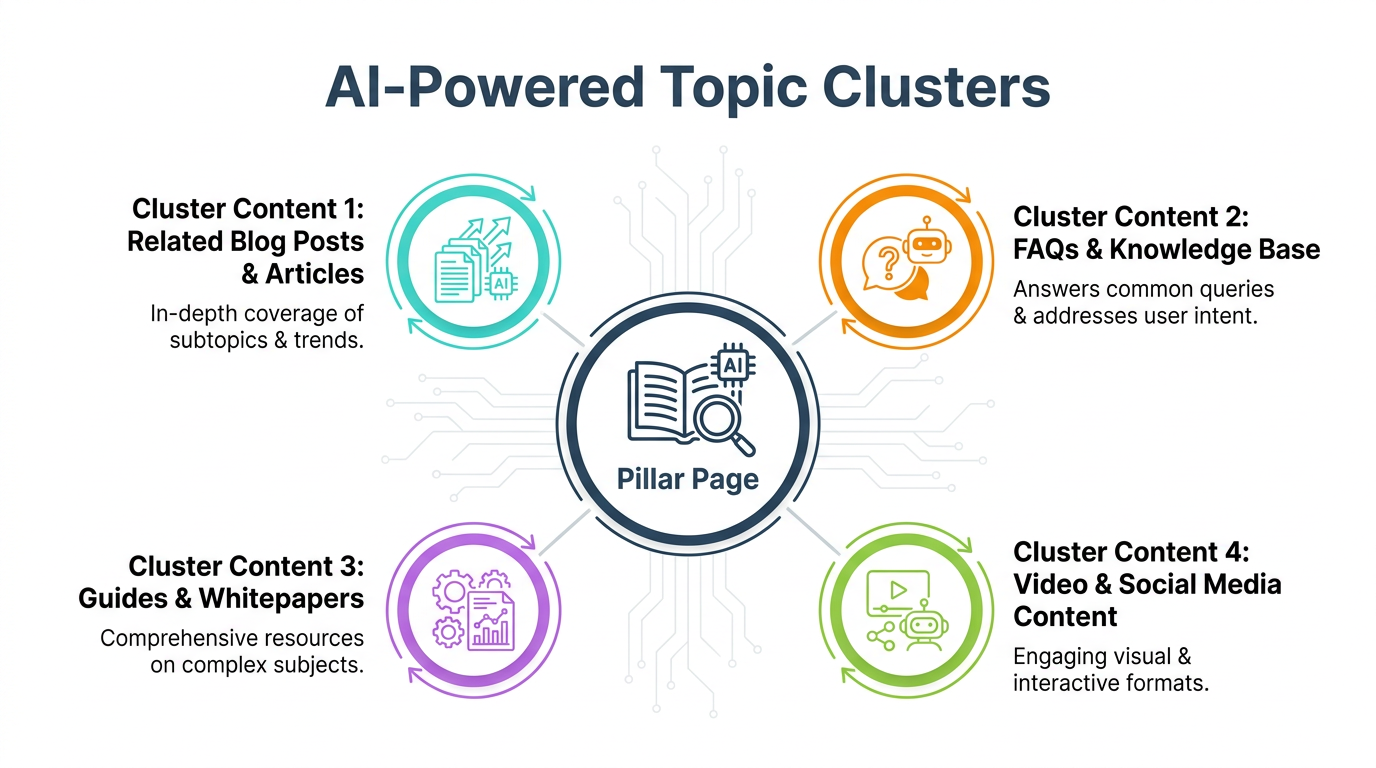
AI is also great for planning your content strategy. It can help you build topic clusters. This means creating a main pillar page and several related articles that link back to it. This structure tells search engines that you are an authority on a subject, which can boost your rankings across the board.
Improving old content is just as important. AI tools can review your existing articles. They suggest ways to optimize them by adding relevant keywords, improving headings, or even rewriting sections for better clarity. This keeps your content fresh and valuable to both readers and search engines.
Many businesses see real results from this approach. For example, one B2B marketing firm reported a staggering 3,000% increase in organic traffic and keyword rankings. This was achieved by using AI to guide its content creation and build topical authority, as documented in an analysis by AIMultiple.
Beyond just writing, AI can also tailor your website's content for each visitor. It analyzes user behavior in real time. Based on this data, it can show personalized headlines, product suggestions, or calls to action. This creates a unique and more engaging experience for everyone who visits your site.
By using these ai in marketing examples, you can create a powerful content engine. This engine not only attracts the right audience but also keeps them engaged. The result is better visibility in search, more website traffic, and a stronger connection with your customers. It puts data at the center of your content decisions.
Example: HubSpot's AI Content Assistant
HubSpot's AI Content Assistant is one of the most practical ai in marketing examples available. This tool is built right into their platform to help users brainstorm blog topics and create outlines. It can even write entire paragraphs for you, acting as a creative partner in the content creation process.
For any marketing team, this kind of assistance is a huge help. It dramatically speeds up the time it takes to produce a blog post or webpage. The tool is also perfect for overcoming writer's block. When you're stuck for ideas, the AI can provide a starting point to get you moving again.
What makes this tool smart is its connection to HubSpot's CRM. It can use your customer data to suggest content that will actually resonate with your audience. Using proven vendor solutions like this is often more effective. In fact, one analysis found internal AI development has a much lower success rate compared to adopting established tools.
Hyper-Personalization in Email and Ad Campaigns

AI takes customer data and uses it to create unique experiences for each person. This is called hyper-personalization. Instead of sending the same message to everyone, AI helps you talk to customers as individuals, even if you have thousands of them. It makes your marketing feel more helpful and relevant.
This is one of the most powerful ai in marketing examples. For email, AI can look at what a customer has bought or browsed before. It then sends them emails with personalized product recommendations that they are likely to be interested in. This makes the email feel less like junk mail and more like a helpful tip.
And this approach really works. When emails are personalized, they perform much better than generic ones. In fact, an analysis noted by Stripo shows that personalized email campaigns can lead to a 60% increase in conversion rates. This shows that customers respond positively when messages are made for them.
AI email automation also improves emails in other ways. It can test different subject lines to find out which one gets more people to open the email. It can even figure out the perfect time to send an email to each person. This ensures your message has the best chance of being seen.Personalization extends to ad campaigns too. AI can change the ad a person sees based on their interests or past actions. It might show different images, headlines, or special offers. This makes your advertising more effective because it speaks directly to what the viewer cares about.
A great real-world example is Netflix. The streaming service uses a powerful AI system to suggest movies and shows. This system is so effective that reporting from Business Insider has noted that its recommendations drive a large part of what people watch. It keeps users engaged by showing them content they will probably love.
Ultimately, hyper-personalization helps you build stronger relationships with your customers. It turns marketing into a service that adds value instead of just an advertisement. This leads to more loyal customers and better business results over time.
Example: Netflix's Recommendation Engine
Netflix offers a classic example of AI-powered personalization in action. The system does not just guess what you might like. It analyzes your viewing history, personal ratings, and what other people with similar tastes enjoy. It even considers factors like the time of day you watch and the device you use. This creates a detailed profile to predict your next favorite show.
But the AI goes deeper than just suggesting titles. It also personalizes the artwork you see for shows and movies. The system shows different thumbnail images for the same content to different users. It learns which pictures are most likely to grab your attention and make you click. This makes your entire homepage a unique experience tailored just for you.
The business impact of this is massive. By making it so easy to find something great to watch, Netflix keeps its customers happy and subscribed. In fact, a breakdown by Flatiron School suggests that over 80% of shows watched are discovered through the platform's recommendation system. This directly translates into higher customer retention and long-term revenue.
This complex system is one of the best ai in marketing examples because it improves the core product. It turns a huge content library into a personal guide. It is a perfect demonstration of how smart technology can keep customers engaged and loyal, creating significant and direct value for the business.
Real-World Example: Netflix's Recommendation Engine
Netflix's AI recommendation system demonstrates hyper-personalization at massive scale. The system analyzes your viewing history, ratings, and what viewers with similar tastes enjoy, while considering factors like time of day and device used. Netflix even personalizes the thumbnail artwork shown for each title to different users based on what's likely to grab their attention. This AI-driven personalization is extraordinarily effective: over 75-80% of content watched on Netflix is discovered through recommendations, directly translating to higher customer retention and lifetime value.
Using Predictive Analytics to Understand Customers
Predictive analytics is a powerful example of AI in marketing. It uses past customer data to make informed guesses about what they will do next. Think of it as a data-powered crystal ball that helps you see what's coming. This lets you anticipate trends and behaviors before they happen.
This lets marketers be proactive. Instead of just reacting to problems, they can get ahead of them. AI can spot early warning signs that a customer might be unhappy. This gives businesses a chance to step in and provide support before the customer decides to leave.
A common use is predicting customer churn. AI identifies patterns suggesting a customer may stop using your service. Maybe they are logging in less frequently. The marketing team can then automatically send a special discount or helpful message to encourage them to stay. This is a targeted way to reduce customer loss.
AI also transforms lead scoring. It automatically rates potential customers on their likelihood to buy. This helps sales teams focus on the best prospects first. The result is higher efficiency, and as analysis from Directive Consulting shows, this focus can lead to a 10% lift in revenue simply by prioritizing smarter.
Forecasting customer lifetime value (CLV) is another key use. AI predicts the total profit you'll earn from a customer over time. This helps you spot your most valuable clients. Then, you can invest more in keeping them happy, knowing it will pay off in the long run.
By using predictive insights, companies make smarter decisions with their budgets. They can focus their time and money where it will have the biggest impact. It helps make sure every marketing dollar is spent wisely, leading to better growth and stronger customer relationships over time.
Beyond the Hype: A Practical Framework for Implementing AI
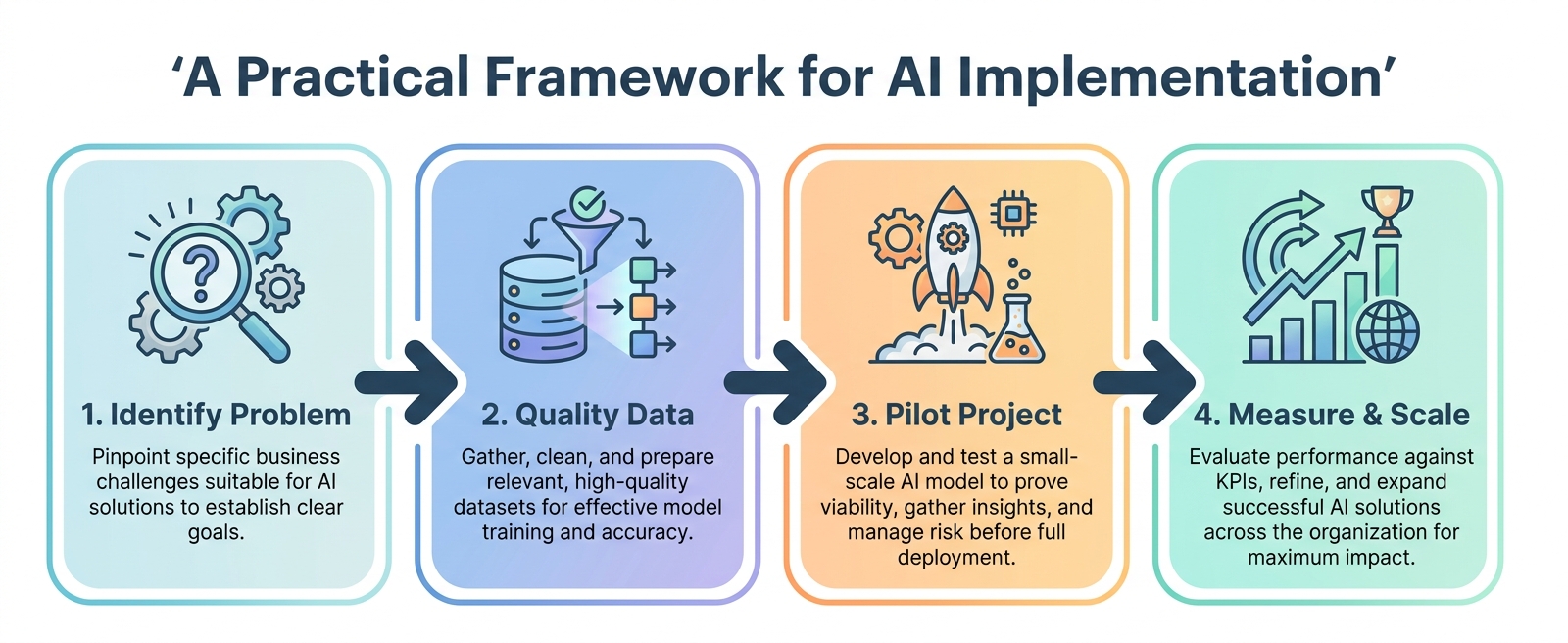
Seeing all these AI in marketing examples can be exciting. But jumping in without a plan can lead to wasted time and money. A better approach is to use a simple, practical framework. This helps you adopt AI in a smart, step-by-step way that focuses on real business results.
1. Identify a Business Problem
First, start with a clear goal. Don't adopt AI just for the sake of it. Instead, find a specific problem you want to solve. Maybe you want to improve customer support, generate better leads, or increase website engagement. For example, a clear goal might be: "reduce customer support tickets by 15%."
Having a well-defined problem gives your AI project a purpose. It makes it easier to measure success and show the value of your investment. This turns AI from a cool toy into a tool that actually helps your business grow.
2. Start with Quality Data
AI learns from data. If your data is messy or inaccurate, your AI tools won't work well. It's like trying to build a strong house with weak materials. Before you launch any AI project, make sure your customer data is clean, organized, and ready to be used. This is a critical step that many companies overlook.
3. Pilot a Small Project
Instead of trying to transform your whole department at once, begin with a small pilot project. This lets you test the technology and learn without a huge risk. This approach is proven to be more effective. In fact, a report from The AI Consulting Network found that businesses using focused pilot projects see a return on their investment 3 to 5 times faster.
Good first projects for a marketing team are often simple but have a big impact. You could implement an intelligent chatbot on your website to answer common questions. Or you could use an AI content optimization tool to help your existing articles rank higher in search results. These are concrete, manageable steps.
4. Measure and Scale
Finally, track your results. Did the pilot project achieve the goal you set in the first step? Look at the data to see what worked and what didn't. If the project was a success, you can then plan how to expand it or start a new project. If it failed, you've gained valuable lessons without a major setback. This measured approach makes AI adoption sustainable.
Questions to Ask Before Implementing AI in Your Marketing
- What specific business problem are you trying to solve with AI—and can you define it with a measurable goal?
- Is your customer data clean, organized, and ready to train an AI system, or do you need a data cleanup project first?
- Should you build AI internally or use an existing vendor solution, and what's the true cost-benefit of each approach?
- How will you ensure your AI marketing respects customer privacy and maintains transparency about how their data is used?
- Do you have a clear pilot project in mind that's manageable but impactful—something you can test without transforming your entire department?
- How will you measure success—what metrics will prove your AI investment delivered real ROI?
- Who will oversee AI decisions on your team to ensure they align with your brand values and catch potential errors?
- Are you prepared to start small and iterate, or are you expecting immediate, company-wide transformation?
The Human Touch: Navigating Ethical AI in Marketing
As we explore these powerful ai in marketing examples, it's important to talk about the human side. Using AI ethically isn't just about following rules. It's about building trust and making sure technology serves people well. When done right, responsible AI becomes a major strength for your brand, showing customers you care about more than just numbers.
A big part of this is data privacy. AI tools often use huge amounts of customer information to make decisions. Customers are more aware than ever about how their data is used. Being transparent about what you collect and why is no longer optional. It is a key part of earning and keeping customer trust.
Another challenge is algorithmic bias. AI systems learn from data they are given. If that data is biased, the AI will learn those biases too. This can lead to unfair or tone deaf marketing. As Digiday notes, a growing consumer backlash against inauthentic AI is making brands rethink their strategies to ensure genuine connection.
This makes transparency a competitive advantage. Being open about how AI works builds loyalty. It's about using tech to support good marketing, not replace it. As NetApp's CMO puts it, AI "removes the excuses" for not doing great marketing. It helps teams focus on strategy that truly moves the business forward.
And always keep a human in the loop. AI is a fantastic assistant but it shouldn't make final decisions alone. This oversight catches errors and ensures marketing reflects your values. Ignoring this can cause big problems. Project Management Institute research shows that internal fears are a top barrier to AI success for a majority of executives.
Using AI ethically is simply smart business. It protects your reputation and builds lasting customer relationships. It ensures your marketing efforts are helpful, not harmful. By focusing on people first, you can use AI in a way that benefits everyone involved.
Your Next Step in AI-Powered Marketing
These ai in marketing examples show us that smart technology is no longer something reserved for tech giants. It's a real, accessible tool that can help businesses of all sizes make their marketing better. The goal isn't to replace the creative and strategic work marketers do. Instead, it's about amplifying your efforts and making your job easier.
And the opportunity is only getting bigger. The global AI software market is growing at a huge rate, with projections from Grand View Research suggesting it will grow to nearly $467 billion by 2030. This expansion means more powerful and user-friendly tools are becoming available for everyone, every day.
The best way to begin is by not getting overwhelmed. Forget trying to transform your entire marketing department overnight. The key is to start small. Look back at the framework we discussed and identify one single, clear business problem you'd like to solve. This turns a huge idea into a manageable first step.
So, what is your next step? Think about your daily tasks. Is there a repetitive job that takes too much time? Maybe you struggle to come up with new content ideas. Pick one challenge. Your goal for this week is to simply research one AI tool that is designed to help with that specific problem.
For small businesses especially, there are many free AI tools available that can provide immediate value without requiring a large investment. Taking that first small action is the most important part of the journey. By starting with a focused pilot project, you can learn what works for your team and build momentum. This is how you confidently bring the power of AI into your marketing, one smart step at a time.

Frequently Asked Questions
What is a simple example of AI in marketing?
A common example is personalized product recommendations on sites like Amazon. The AI analyzes your past purchases and browsing history to suggest items you're likely interested in. This tactic is proven to increase sales by making the shopping experience more relevant and engaging.
How is AI used in digital marketing?
AI is used across many areas of digital marketing. It powers content creation and SEO optimization, enabling smarter keyword targeting. It also personalizes ad targeting on platforms like Facebook and Google, optimizes email campaigns for each recipient, powers customer service chatbots, and analyzes data to predict customer behavior and trends.
What are the main benefits of using AI in marketing?
The main benefits are increased efficiency through automation of repetitive tasks, higher ROI from more effective and targeted campaigns, and deeper customer understanding through advanced data analysis. AI allows marketers to make smarter, data-driven decisions at scale while freeing up time for strategic work.
Is AI the future of marketing?
AI isn't just the future—it's the present reality for competitive marketing teams. While AI won't replace human creativity and strategy, it has become an essential collaborative tool. The future will see even deeper integration of AI as a strategic partner, but human insight will remain critical for brand voice and vision.
Can small businesses use AI in marketing?
Absolutely. Many affordable and user-friendly AI tools are now available for small businesses. You can start with AI-powered features within your existing platforms, like email marketing services that offer subject line optimization or social media schedulers with AI content suggestions—no expensive custom development needed.