
Published on: May 11, 2026 | Time to read: 23 min
The marketing industry is at a pivotal crossroads between traditional agencies and AI-powered tools that promise similar results at lower costs. This guide helps marketers identify which functions AI excels at, which still need human expertise, and how to build a hybrid 'cyborg' marketing team that leverages the best of both worlds.
Key Takeaways
- AI marketing tools excel in data-heavy tasks like SEO audits, ad optimization, A/B testing, performance reporting, social monitoring, and email marketing automation, offering speed and scale that agencies can't match.
- The future isn't about replacing agencies but building a hybrid 'cyborg' marketing team with three key roles: Human Strategist, AI Operator, and Creative Finisher.
- Companies can transition gradually from agency reliance to AI-powered models using a three-phase approach: Audit & Pilot (1-2 months), Integrate & Collaborate (3-6 months), and Scale & Own (7+ months).
- AI adoption in marketing has more than doubled in the past year, with 78% of marketers expecting over 25% of their tasks to be automated within three years.
- While AI excels at execution and analysis, human expertise remains essential for strategic vision, creative nuance, and brand storytelling.
- The right balance involves using AI to handle repetitive, data-intensive tasks while human marketers focus on high-level strategy and creative direction.
Table of Contents
- The New Marketing Crossroads: AI vs. The Traditional Agency
- Top 7 Marketing Areas Where AI Outperforms Agencies
- The Hybrid Model in Action: Building Your 'Cyborg' Marketing Team
- Roadmap: How to Transition from Agency to an AI-Powered Model
- Conclusion: The Future is Collaborative, Not Combative
Wondering how to balance AI marketing tools with traditional agency services? AI marketing software is growing at 25-30% annually while promising similar results at a fraction of agency costs. This guide helps you identify which marketing functions AI excels at, which still need human experts, and how to find the right mix for your business needs.
The New Marketing Crossroads: AI vs. The Traditional Agency
Marketing departments find themselves at a pivotal crossroads. On one side stands the traditional agency model with its creative expertise, strategic guidance, and established workflows. On the other, a rapidly expanding ecosystem of AI-powered marketing tools promising similar results at a fraction of the cost.
The numbers tell a compelling story. The broader AI software market is valued at $122 billion in 2024, growing at an impressive 25% annual rate toward $467 billion by 2030, according to ABI Research's global market analysis.
What makes this particularly relevant for marketers is the adoption speed. The 2024 State of Marketing AI Report reveals AI adoption in marketing has more than doubled in just the past year, with 78% of marketers expecting over 25% of their tasks to be automated within three years.
The real-world impact is already visible. STACK Media achieved a remarkable 61% increase in website visits and 80% organic traffic growth in just four months after implementing BrightEdge's AI-driven keyword analysis tools.
But this isn't about declaring agencies obsolete. Rather, it's about finding the right balance in a rapidly evolving landscape.
As Sam Altman, CEO of OpenAI, noted: "It will mean that 95% of what marketers use agencies, strategists, and creative professionals for today will easily, nearly instantly and at almost no cost be handled by the AI — and the AI will likely be able to test the creative against real or synthetic customer focus groups for predicting results and optimizing." This insight from Altman highlighted by CMS Wire underscores the fundamental shift underway.
This article aims to guide you through this transition, helping you identify which functions are best suited for AI automation and which still benefit from human expertise. The goal isn't to abandon agencies entirely, but to develop a strategic approach to resource allocation that maximizes results while controlling costs.
In the sections that follow, we'll explore specific marketing functions where AI demonstrates clear advantages, examine case studies of successful transitions, and provide frameworks for determining the optimal mix of human and artificial intelligence for your specific business needs.
Top 7 Marketing Areas Where AI Outperforms Agencies
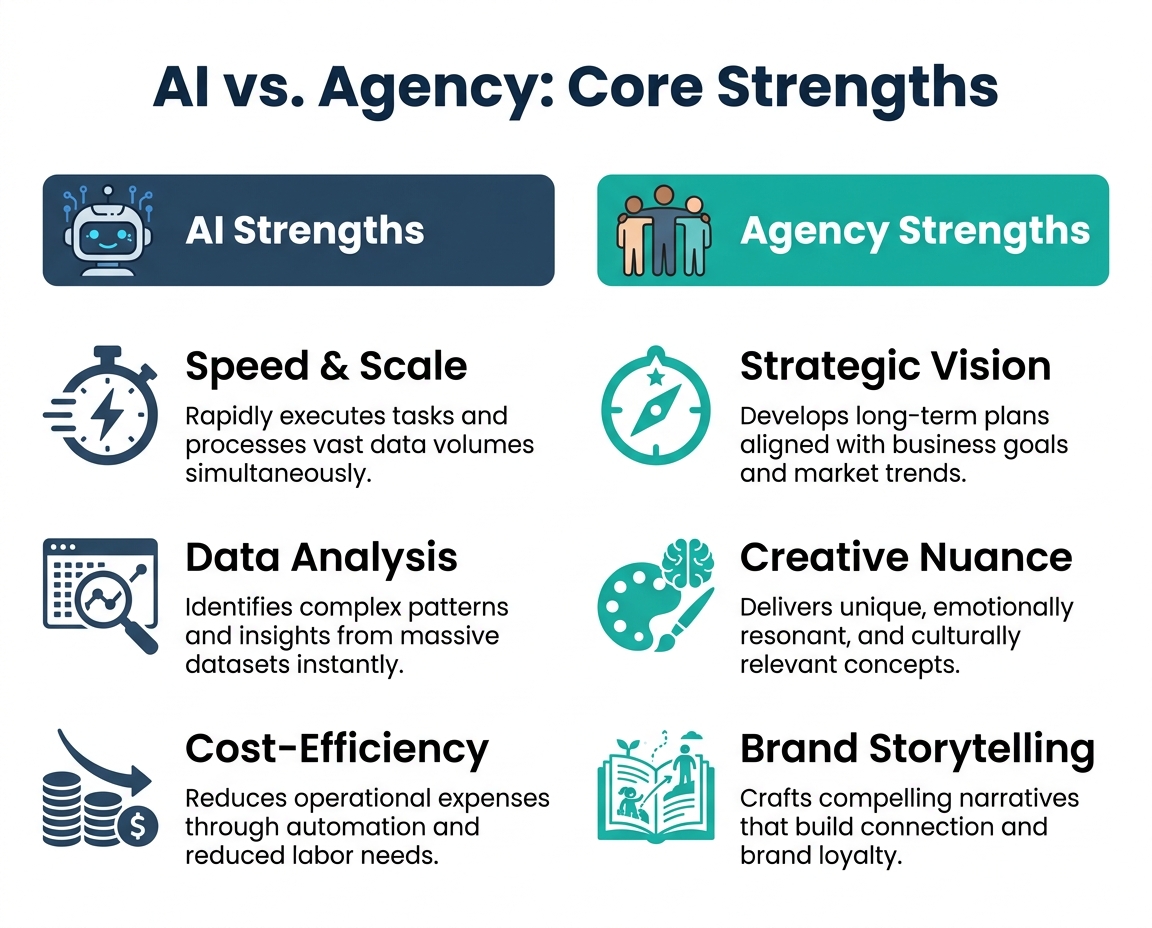
AI is not a magic solution, but it has clear advantages in specific marketing tasks. In the sections below, we explore seven key areas where artificial intelligence consistently outperforms traditional agencies. We'll look at the "why" behind its success, focusing on its unmatched speed, massive scale, deep data analysis, and incredible cost-efficiency. This breakdown helps you see where to apply AI for the biggest impact.
1. Predictive SEO & Technical Audits at Scale
Search engine optimization used to be a long game of manual research. An agency might spend days auditing your website for technical errors or hunting for keyword ideas. It's a slow, labor-intensive process that can quickly become expensive and fall behind fast-moving competitors.
AI changes that completely. Modern AI marketing platforms can crawl your entire site, plus those of your top competitors, in just a few minutes. They identify thousands of technical SEO issues, from broken links to slow page speeds, with a speed and scale no human team can match.
But it goes beyond just finding existing problems. The real power is in predictive SEO. AI tools analyze huge amounts of search data to spot emerging trends and find keyword opportunities your competitors have missed. This shifts your strategy from reactive to proactive, letting you get ahead of search demand.
This capability is driven by the same technology powering the broader AI market, which a Grand View Research report projects will grow at 30.6% annually through 2033. The tools then provide automated suggestions. They can recommend new internal links or show exactly how to tweak a blog post to better match search intent, all based on real-time data.
For tasks this repetitive and data-heavy, AI is the clear winner. Frameworks like The Zulu Method help companies build an in-house system using these tools. This provides better, faster insights for a fraction of the cost of a traditional SEO agency retainer.
Unlock Your Potential: The Surprising Benefits of Morning Meditation
In our fast-paced, always-on world, finding a moment of peace can feel like a luxury. However, dedicating just a few minutes to meditation each morning can fundamentally change the trajectory of your day and, over time, your life. It's not about emptying your mind, but rather about building a conscious, non-judgmental awareness of the present moment. Here's a look at the profound benefits you can unlock by starting your day with intention.
1. Reduced Stress and Anxiety
One of the most well-documented benefits of meditation is its ability to calm the nervous system. Morning meditation helps you start the day from a place of tranquility rather than reaction. By focusing on your breath and observing your thoughts without attachment, you can lower cortisol levels (the stress hormone) and cultivate a sense of inner peace that you can carry with you throughout the day's challenges.
2. Enhanced Focus and Clarity
Do you ever feel like your mind is running in a dozen different directions at once? Meditation is a workout for your attention muscle. A consistent morning practice trains your brain to stay focused on a single point, which translates directly into improved concentration at work or during study. This mental clarity allows you to prioritize tasks more effectively and approach problems with a clearer, more composed mindset.
3. Increased Emotional Well-being and Self-Awareness
Meditation provides a safe space to get to know yourself better. By observing your thoughts and feelings without judgment, you begin to understand your own emotional patterns. This heightened self-awareness is the first step toward greater emotional regulation. You become less reactive to triggers and more capable of responding to situations with compassion and wisdom, fostering a more positive outlook on life.
Starting a morning meditation practice is simple. Find a quiet spot, sit comfortably, set a timer for 5-10 minutes, and focus on the sensation of your breath. When your mind wanders—and it will—gently guide it back. By giving yourself this small gift of stillness each morning, you invest in a more peaceful, focused, and fulfilling day.
3. Hyper-Personalized Ad Targeting & Bidding
An agency team manually managing paid ads can only do so much. They might adjust bids a few times a day based on limited data. It's a constant guessing game that struggles to keep up with the fast-changing digital advertising market. This manual process is often slow and reactive.
AI platforms like Google's Performance Max change everything. They analyze thousands of real-time signals, like user behavior, device, and location, to adjust bids instantly. This is a level of speed and complexity that's simply impossible for a human campaign manager to replicate.
Beyond just bidding, AI excels at creative optimization. It can automatically mix and match thousands of headlines, descriptions, and images. It then tests these combinations to find the perfect ad for each specific audience segment, delivering true hyper-personalization at a massive scale.
This data-driven approach dramatically improves results. For example, by combining AI-powered influencer campaigns with paid ads, Therabody saw its return on ad spend (ROAS) jump by 104%. As a data-backed playbook from The Cirqle explains, AI optimization was key to this success.
The result is less wasted money and more effective campaigns. AI quickly shifts your budget away from ads that are not working and doubles down on the winners. This frees up human marketers to focus on big-picture strategy and creative ideas instead of tedious manual adjustments.
4. Automated A/B Testing & Conversion Rate Optimization (CRO)
Traditional conversion rate optimization (CRO) is often a slow journey. An agency might run an A/B test on a single headline or button color, wait weeks for data, and then try another. This one-at-a-time approach is methodical but can take months to produce meaningful results.
AI platforms completely change the speed of testing. They can run complex multivariate tests, checking dozens of combinations of headlines, images, and layouts all at the same time. This allows you to learn what works best exponentially faster than a human team could manage manually.
Beyond just testing elements, AI digs deep into user behavior. These tools can analyze thousands of session recordings and heatmaps to pinpoint exactly where users get stuck or frustrated. This gives you a clear, data-backed picture of what needs fixing on your site.
This analysis takes the guesswork out of design changes. Instead of relying on opinions, AI provides recommendations based on how real people are interacting with your pages. This leads to smarter improvements that have a higher chance of increasing conversions.
AI also enables predictive personalization. The system can automatically show different versions of your website to different types of visitors. It customizes the experience in real time for each user segment, aiming to maximize the chance of a conversion for every single visit.
This approach delivers powerful results. An analysis of over 300 stores by GoGoChimp found that expert-guided AI tools delivered an average conversion lift of 28% to 34%. This is a significant improvement over the average 4% to 7% lift from self-serve tools, highlighting the power of guided AI.
For optimizing website performance at scale, AI is the clear winner. It provides faster insights, deeper analysis, and personalized experiences that manual agency work simply cannot match.
5. Data Analysis & Performance Reporting
Manually creating marketing reports is a huge time drain for agencies. Teams spend hours pulling data from different places like Google Analytics, ad accounts, and social media. They paste it all into spreadsheets and try to make sense of it. This process is slow, tedious, and prone to human error.
AI completely changes this workflow. It connects directly to all your marketing platforms through APIs. Instead of manual work, AI builds comprehensive dashboards that update in real time. What used to take days of work now happens instantly, giving you a live look at your performance whenever you need it.
But the real advantage is in the depth of analysis. AI can sift through massive amounts of data to spot trends, connections, and strange patterns a human analyst might easily miss. It can show you how a campaign on one channel is affecting another, giving you a much smarter view of your overall marketing ecosystem.
Many tools now use natural language processing. This means you can just ask complex questions in plain English, like, "What was our top channel for new customers in Texas last month?" Instead of digging through spreadsheets, you get an immediate, accurate answer. This transforms how teams interact with their data.
This speed and insight free up your team to do more important work. When AI handles the data crunching, humans can focus on strategy and creativity. As a Deloitte analysis on AI team structures explains, this shift allows people to focus on higher-value tasks that automation can't handle, like making smart business decisions based on the insights AI finds.
6. Social Media Monitoring & Community Management
Keeping up with social media is a 24/7 job. For an agency, trying to track every brand mention, comment, and question across multiple platforms is a huge challenge. It's nearly impossible for a human team to catch everything in real time. Important customer issues or negative feedback can easily slip through the cracks.
AI tools solve this by working around the clock. They automatically scan millions of posts, comments, and stories to find mentions of your brand. More than just finding mentions, these systems can instantly analyze the sentiment. They tell you if the conversation is positive, negative, or neutral, giving you a live look at your brand's health.
AI also transforms community management. Simple chatbots can now handle common customer questions instantly, any time of day. This frees up your human agents to focus on more complex problems that need a personal touch. According to insights from McKinsey's 2024 State of AI report, service operations is a top area where companies see value from AI.
Beyond just listening, AI is great at spotting what's next. It analyzes millions of public conversations to identify new trends and topics that are starting to gain traction. This gives your social media team a head start, helping them create content that is timely and relevant to what people are actually talking about.
For the high-volume, repetitive tasks of listening and responding, AI offers speed and scale that agencies can't match. It ensures you never miss a conversation and allows your human team to focus on building real relationships with customers.
7. Email Marketing Automation & Journey Building
Traditional email marketing from an agency often involves simple drip campaigns. These are one-size-fits-all programs that send the same messages to every contact on a fixed schedule. This generic approach can easily lead to low open rates and fails to build a real connection with individual customers. It's often slow to adapt.
AI email marketing automation completely changes this. Some platforms use a suite of AI-powered tools to predict the best time to send an email to each person. They can also generate and test different subject lines, finding the version most likely to get opened before the campaign even starts. This takes the guesswork out of engagement.But the real power is in building dynamic customer journeys. Instead of following stiff, pre-set rules, AI adapts the path for each user based on their actions. If someone clicks a specific link or watches a video, the system instantly personalizes the next steps for them, creating a unique experience.
It is no surprise so many marketers are using these tools. According to a 2026 benchmarks report from Averi.ai on AI in marketing, 89% of them now use generative AI for creating content like emails. It provides a level of speed and personalization that is impossible to achieve manually.
This advanced capability allows teams to build a powerful in-house email engine. Rather than paying an agency for simple campaigns, a business can adopt a system like The Zulu Method. This helps them create smarter, automated journeys that nurture leads more effectively and drive more revenue at a lower cost.
Real-World Example: STACK Media
STACK Media achieved remarkable results by implementing BrightEdge's AI-driven keyword analysis tools, demonstrating the power of AI in marketing. In just four months, they saw a 61% increase in website visits and 80% growth in organic traffic. By using AI to analyze keywords and redesign pages for high-volume fitness terms, they were able to dramatically improve their search visibility and audience reach in a fraction of the time it would have taken with traditional methods.
The Hybrid Model in Action: Building Your 'Cyborg' Marketing Team
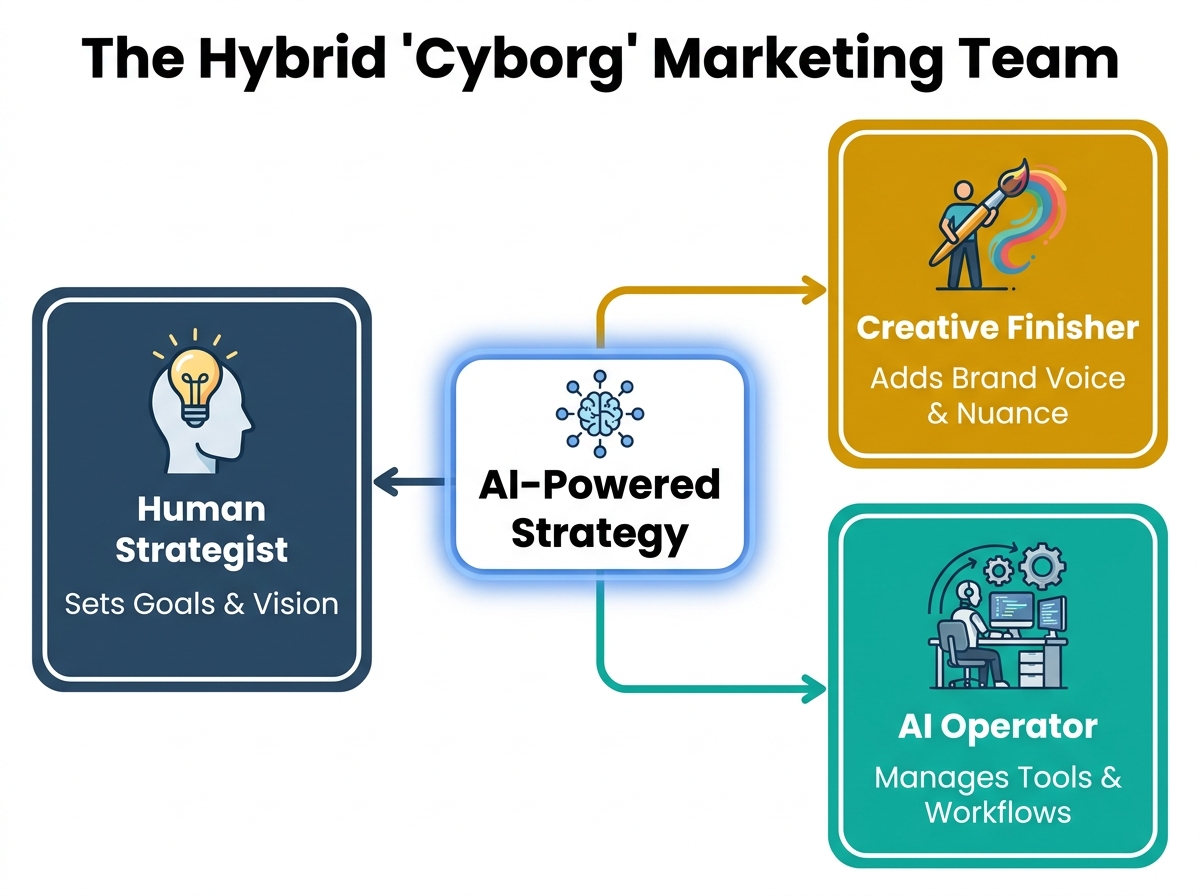
The smartest companies know the goal is not total replacement. It is about smart augmentation. The biggest competitive advantage comes from building a "cyborg" marketing team where humans guide AI to do amazing things. This approach combines the strategic thinking of people with the speed and scale of machines.
This hybrid model creates new kinds of jobs. Your team no longer needs to be filled with people doing repetitive tasks. Instead, you can build a small, powerful team centered around three key roles that work together. This structure maximizes leverage and efficiency.
First, you have the Human Strategist. This person is the captain of the ship. They set the overall marketing goals, define the brand's unique voice, and use AI-driven insights to make smart decisions. The strategy and vision are always human-led, ensuring every action aligns with the business.
Next is the AI Operator. This role is technical but also creative. As one guide for building an AI marketing team explains, this person manages the AI tools, builds automated workflows, and crafts the right prompts to get the best results. They are the bridge between human ideas and AI execution.
Finally, there is the Creative Finisher. AI can generate a great first draft, but it often lacks soul. This person takes the AI's output and adds the final layer of brand personality, nuance, and human touch. They ensure the content truly connects with your audience.
These new roles demand new skills. Success is less about executing tasks and more about strategic thinking and adaptability. Marketers need strong data literacy to understand AI insights. They also need creativity to guide the machines toward unique and powerful outcomes.
One marketing VP put it perfectly, saying the most important quality is a high "figure-it-out" factor. In her interview with The CMO, she notes the people who thrive with AI are not the most technical. They are the curious ones who love to experiment and find what works.
Building an AI marketing team allows a small group to achieve what used to require a large agency. Frameworks like The Zulu Method guide companies in creating this efficient, in-house marketing engine. It puts human strategy at the center, amplified by powerful AI tools.Roadmap: How to Transition from Agency to an AI-Powered Model
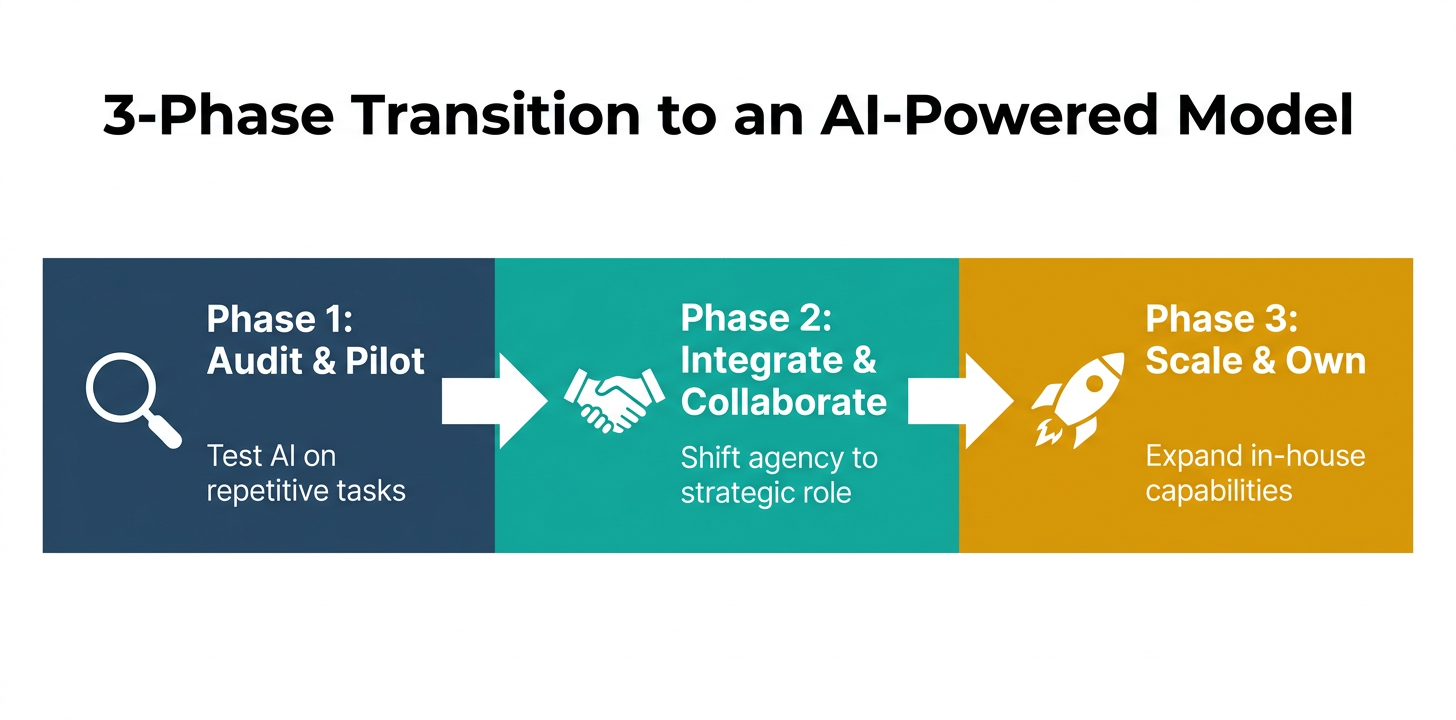
Moving away from a traditional agency doesn't have to be a risky leap. A slow, phased approach is the smartest way to do it. Instead of flipping a switch overnight, think of it as a three-step journey. This method lets you test, learn, and slowly build your own powerful in-house marketing engine.
Phase 1: Audit and Pilot (Months 1-2)
Start by looking at what your agency does every week. Identify the most repetitive, data-heavy tasks. Things like creating weekly performance reports, drafting initial blog post outlines, or researching keywords are perfect candidates for automation. These are often time-consuming but don't require deep strategic thinking.
Next, pick just one or two of these tasks for a pilot program. Choose a user-friendly AI tool and test it for 30 to 60 days. Run it alongside your agency. The goal is to compare the quality, speed, and cost of the AI's output directly against the agency's work on the exact same task.
This process is about creating a clear business case based on real data. You can use a structured approach, like the AI automation roadmap template provided by AI-Marketing Labs, to document everything. This helps you track time saved and prove the value before making big changes.
Phase 2: Integrate and Collaborate (Months 3-6)
Once your pilot proves successful, you can officially hand that task over to your AI system. But this doesn't mean you fire your agency. Instead, you change the relationship. Their role now shifts from doing the work to guiding the strategy behind it.
Have your agency analyze the AI's output. Are the insights it finds valuable? Does the content it generates align with your brand voice? This is the time to redefine your statement of work. You can shift budget away from manual labor and towards high-level strategic guidance from your agency partners.
Phase 3: Scale and Own (Months 7+)
In the final phase, you expand your in-house capabilities. Use the processes you've built to bring more marketing functions under your control. As your internal team gets better at using AI tools, you will rely less and less on outside help for day-to-day execution.
This is when your agency relationship evolves again. They might move to a quarterly retainer for big-picture strategic planning sessions. Their job is to provide an outside perspective and help you set long-term goals. Your skilled internal team handles the rest, creating a highly efficient model.
Following this roadmap helps you transition smoothly and safely. This process, which is central to systems like The Zulu Method, reduces risk and ensures you build a strong, self-sufficient marketing team. You get the best of both worlds: cost savings from AI and strategic wisdom from human experts.
Questions to Ask Before Transitioning to AI Marketing
- Which of our current marketing tasks are most repetitive and data-intensive?
- What unique creative or strategic value does our agency currently provide that AI cannot?
- Do we have team members with the curiosity and adaptability to manage AI tools effectively?
- What governance systems will we need to maintain brand consistency across AI-generated content?
- How will we measure the ROI of AI tools compared to our current agency spending?
- Which marketing functions are most critical to our business success?
- Do we have the data infrastructure necessary to feed AI systems effectively?
- What training will our team need to effectively leverage AI marketing tools?
- How will we ensure AI-generated content aligns with our brand voice and values?
- What is our contingency plan if an AI tool fails to deliver expected results?
The Future is Collaborative, Not Combative
The debate isn't about AI versus humans. It's about smart collaboration. AI is a powerful tool designed to handle repetitive, data-heavy tasks with incredible speed. It doesn't replace the need for human creativity, critical thinking, or relationship building. Instead, it frees up your marketing team to focus on the big-picture strategy and creative ideas that truly drive growth.
The most successful companies won't pick between an AI system and an agency. They will build a lean, powerful in-house team armed with the right AI tools. This creates what you might call a "cyborg" marketing engine. Agencies will still play a valuable part, but their role will evolve. They will become strategic partners for high-level planning, not day-to-day work.
Getting started doesn't have to be overwhelming. You don't need to fire your agency tomorrow. Just take the first step. Look at all the tasks your agency currently handles and pick one single thing that is time-consuming and repetitive. It could be weekly reporting or initial content drafting.
Then, find one AI tool that can do that job and test it. This small-scale pilot is the core idea behind frameworks like The Zulu Method. It allows you to build confidence and prove the value of AI in a low-risk way. Start small, test everything, and build your new marketing engine one piece at a time.
Frequently Asked Questions
Can AI completely replace a marketing agency?
No, not completely. While AI excels at task execution, data analysis, and automation, it cannot replace the high-level strategy, complex creativity, brand positioning, and relationship-building that good agency partners provide. The most effective approach is a hybrid model that leverages AI for repetitive tasks while humans focus on strategic direction.
Is using AI cheaper than hiring an agency?
Initially, yes. AI tool subscriptions typically range from $50 to $1,000+ per month, which is significantly less than agency retainers that run $3,000 to $10,000+ monthly. However, you must also factor in the cost of skilled employees to manage these tools. For many organizations, the combined cost is still lower while providing more control over your marketing.
What core marketing tasks can I replace with AI right now?
You can immediately start using AI for generating first drafts of social media posts and blog content, performing technical SEO audits, analyzing marketing data for reports, running automated ad bidding on platforms like Google, and managing basic customer service inquiries with chatbots. These tasks benefit most from AI's speed and data processing capabilities.
How do I choose the right AI marketing tools?
Start by identifying the single most time-consuming or expensive task you want to automate. Research tools specific to that function (e.g., SEO, content, ads) and look for solutions with positive reviews, strong integration capabilities, and transparent pricing. Begin with a free trial or small pilot program to test effectiveness before making a larger commitment.
What are the biggest risks of relying too much on AI?
The biggest risks include loss of brand voice and authenticity if content is not properly reviewed, over-reliance on flawed or biased data leading to poor decisions, potential privacy or copyright issues, and a lack of genuine human connection in customer interactions. Always maintain a 'human-in-the-loop' approach for governance and quality control.
What new skills does my team need to manage AI effectively?
Your team needs three core skills: Data Literacy to understand and interpret the data AI provides, Prompt Engineering to write clear instructions that get the desired output from generative AI, and Strategic Oversight to align AI-driven tasks with broader business goals and critically evaluate AI recommendations. The most successful AI operators have a high 'figure-it-out factor' and love to experiment.