
Published on: May 5, 2026 | Time to read: 19 min
A 'Google AI Pro' is an advertiser who strategically directs Google's AI advertising tools rather than just activating them. This role shifts from managing campaign details to providing the AI with quality data, creative assets, and business objectives while measuring true business impact instead of vanity metrics.
Key Takeaways
- Becoming a 'Google AI Pro' means strategically directing Google's advertising AI tools rather than simply turning on automation features and hoping for the best.
- Performance Max (PMax) is Google's flagship AI-driven campaign type that lets advertisers reach customers across all Google channels from a single campaign setup.
- The relationship between advertiser and AI is a symbiosis where humans provide strategic direction, business context, and quality inputs while the AI handles data analysis and optimization.
- Troubleshooting AI campaigns requires systematic diagnosis, including checking conversion tracking, reviewing asset performance, and setting appropriate guardrails to guide the AI.
- A comprehensive tech stack including creative tools, advanced reporting solutions, and offline data integration is essential for maximizing AI campaign performance.
- Success should be measured through business outcomes like ROAS, new customer acquisition, and incrementality rather than vanity metrics like clicks and impressions.
Table of Contents
- The Core Components of Google's Advertising AI
- The Human-AI Symbiosis: Beyond Automation to Augmentation
- Advanced Troubleshooting for AI Campaigns (Decoding the Black Box)
- Building Your 'Google AI Pro' Tech Stack
- Measuring Success Like a Pro: Metrics That Truly Matter
- Conclusion: Your Path to Becoming a Google AI Pro
What Does It Mean to be a 'Google AI Pro'?
A 'Google AI pro' isn't an official title or a Google product. It's a term for an advertiser who has mastered Google's AI advertising tools. This means your job shifts from managing tiny campaign details to becoming a smart strategist. You guide the AI to get the best results.
Google's AI advertising tools are now standard in advertising. Simply turning them on is not enough to get ahead. With so many advertisers using them, the real advantage comes from using them better than everyone else. It's about making the technology work harder for your specific goals.
This expert approach changes your role completely. Instead of spending hours adjusting bids manually, you focus on the big picture. You provide the AI with the right data, creative assets, and strategic direction. This lets you manage campaigns at a scale that was once impossible for one person.
Knowing how to properly direct Google's AI gives you a huge competitive edge. In fact, The 2024 State of PPC Global Report shows that 63% of experts plan to increase their AI campaign budgets. They know that mastering these systems leads to better performance, more conversions, and a stronger return on their ad spend.
Of course, becoming a Google AI pro doesn't happen overnight. These advanced strategies work best when they are built on a solid foundation. Having a strong grasp of PPC basics is the first step before you can truly guide the machine.
The Core Components of Google's Advertising AI

To become a Google AI pro, you must understand the key tools in Google's AI toolbox. At the center is Performance Max, or PMax. This all-in-one campaign type lets you advertise across all of Google's channels from a single setup. It is the flagship of Google's AI-driven advertising efforts.
PMax isn't just another option; it's becoming central to many ad strategies. Its growth is massive, with some projections showing it could soon account for almost half of all ad spend. In 2024, PPC trends reported by Proficio.io showed PMax campaigns already made up 28% of total Google Ads budgets. This shows how quickly advertisers are adopting it.
PMax is built on core AI features like Smart Bidding. Instead of manual bidding, you set a goal, like a target cost per acquisition (tCPA), and the AI adjusts bids automatically. This is now standard practice, as the Chartered Institute of Marketing notes that over 80% of advertisers use automated bidding. You can learn about different strategies directly from Google's official Smart Bidding documentation.
AI has also transformed how keywords work, especially Broad Match. This match type used to be risky, often showing ads for irrelevant searches. Now, when combined with Smart Bidding, AI understands user intent much better. It can connect your ads to relevant searches you never would have thought of, finding new customers.
Another core piece is Responsive Ads. You provide multiple headlines, descriptions, and images, and the AI tests countless combinations to find the best performers. This automated creativity really pays off. For example, Google's own data on AI-powered campaigns shows they can deliver around 14% more conversions at a similar cost.
Finally, let's talk about targeting. Instead of picking strict audiences, you now provide "Audience Signals." These are hints for the AI. You can suggest audiences based on their search habits, what websites they visit, or by uploading your own customer lists. This gives the AI a strong starting point for finding the right people.
The real magic is that the AI doesn't stop with your signals. It uses them to learn what a converting customer looks like. Then, it goes out and finds more people like them, even if they weren't in your original signals. This is called optimized targeting, and it's key to scaling your campaigns effectively.
Questions to Ask Before Implementing AI Campaigns
- What specific business goals am I trying to achieve with this AI campaign?
- Do I have clean, accurate conversion tracking set up to properly train the AI?
- What high-quality first-party data can I provide to give the AI a strong starting point?
- How will I measure true business impact beyond the platform's reported metrics?
- What brand safety measures do I need to implement as guardrails?
- How should I structure my campaigns to maintain strategic control while leveraging AI automation?
- What creative assets do I need to provide for optimal AI performance?
- How will I integrate offline conversions and customer value data into the system?
- What reporting tools will I use to gain visibility into the AI's decision-making?
- How will I test for incrementality to prove the true value of these campaigns?
The Human-AI Symbiosis: Beyond Automation to Augmentation
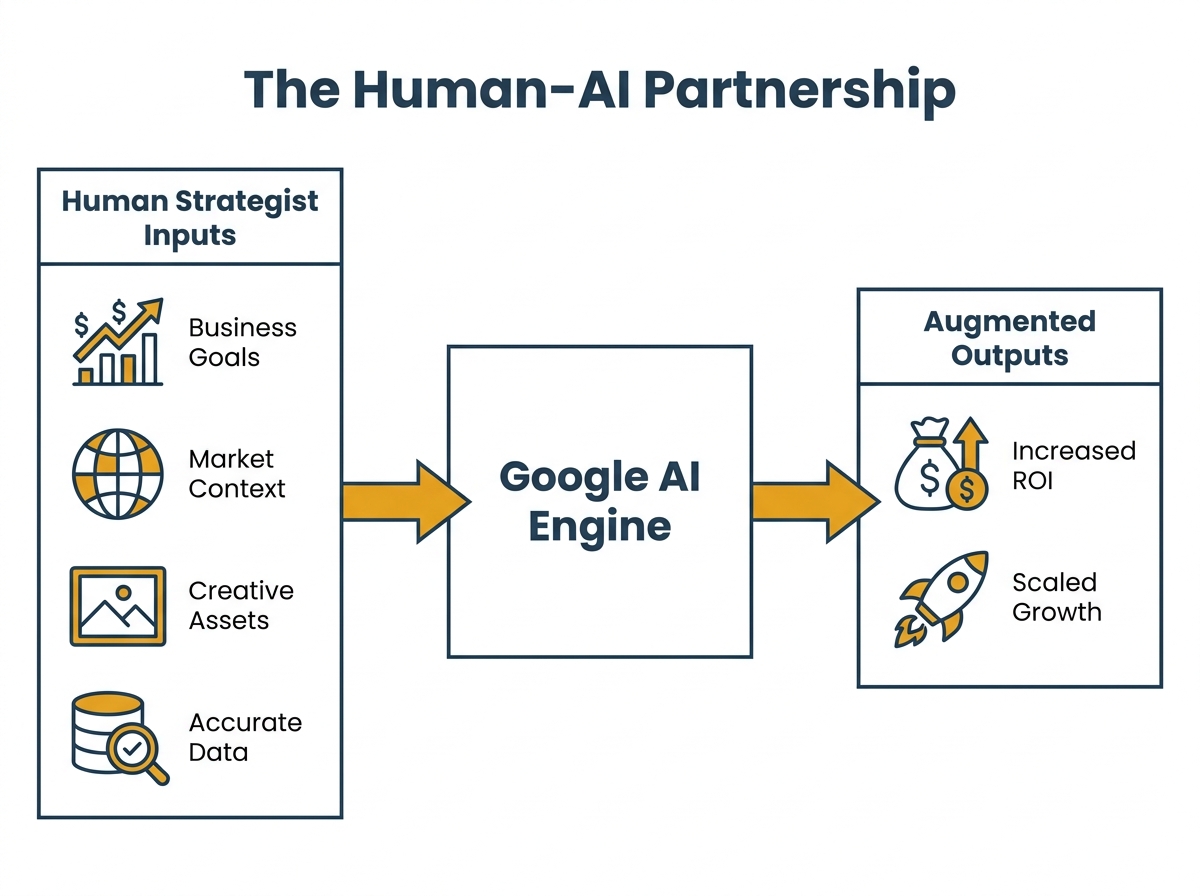
The relationship between an advertiser and Google's AI is a partnership. Think of the AI as a powerful engine. It can go incredibly fast, but it needs a skilled driver to tell it where to go. A true Google AI pro doesn't just turn on automation. They augment it with strategy, context, and high-quality data. This transforms the AI from a simple tool into a strategic partner.
The AI understands metrics like cost per acquisition (CPA). But it doesn't understand your business's true goals. A human strategist knows which products have the best profit margins. You know the lifetime value of a customer from a specific channel. These are business objectives that you must translate into goals for the AI. This guidance ensures the AI optimizes for profit, not just for clicks or leads.
AI also can't grasp market context or brand voice on its own. It won't know your competitor just launched a major sale. And it can't create ad copy that truly connects with your customers' emotions. As one expert on AI in marketing says, generative AI can make brands "more contextually aware, empathetic, adaptive, and, ultimately, more human." Your job is to provide that human touch.
The biggest lever you have for success is the quality of your inputs. This is often called "teaching the AI." Poor or incomplete data will lead to poor results, no matter how powerful the algorithm is. The saying "garbage in, garbage out" has never been more true. The AI learns from the information you provide, so it must be clean, structured, and accurate from the start.
This process starts with providing high-quality first-party data, like customer lists. This gives the AI a strong signal of what your ideal customer looks like. Combining this with human-curated content can be powerful. One case study focusing on AI-guided content created by human writers increased the lead conversion rate by an incredible 383%. This shows the huge impact of smart human input.
Equally important is conversion tracking. If you are not accurately measuring what actions matter most to your business, the AI has no way of knowing if it's doing a good job. It will optimize toward the wrong goals. That's why it is critical to ensure your conversion tracking is set up correctly. This provides the feedback loop the AI needs to learn and improve its performance over time.
Ultimately, being a Google AI pro means working with the system, not just using it. The AI handles the massive scale of data analysis and real-time bidding. The human provides the strategic direction, creative oversight, and business wisdom. This symbiotic relationship is where you'll find the best results and a true competitive advantage in today's advertising world.
Real-World Example: Lenovo
Lenovo demonstrated the power of human-AI partnership by strategically implementing AI automation in their marketing efforts. This approach saved them $16 million annually while reducing campaign execution times by 40%. Rather than simply activating AI features, Lenovo maintained human oversight for strategic direction while allowing AI to handle automated adjustments, resulting in a 25% performance improvement across their campaigns.
Advanced Troubleshooting for AI Campaigns (Decoding the Black Box)
One of the biggest challenges of managing AI campaigns is their "black box" nature. When performance is great, it feels like magic. But when your results suddenly drop, it can be hard to understand what went wrong. You are left with little data and a lot of questions. The good news is, you can still diagnose and fix these issues.
Before assuming the AI has gone rogue, always start with the basics. The most common problem is often the simplest. Check your conversion tracking first. A broken tag or a change on your website can stop sending signals to Google. Without this feedback, the AI has no idea if it is succeeding or failing.
Next, dive into your asset performance reports. Look for any creative elements like images or headlines that are rated "Poor" or have stopped getting impressions. The AI might be pushing a weak asset. Also, review the search term and audience insights sections. These can reveal if your ads are showing for irrelevant queries or to the wrong people.
Troubleshooting is important, but proactive control is even better. You can set guardrails to guide the AI and prevent problems before they start. Use account-level negative keyword lists to permanently block irrelevant traffic. Brand safety settings are another powerful tool. They give you control over which websites and apps your ads can appear on.
One of the biggest mistakes advertisers make is putting everything into a single PMax campaign. This gives the AI too much control with too little direction. Instead, segment your campaigns by a clear objective. For example, have separate campaigns for different product lines or business goals. Guides on smarter e-commerce strategy recommend this approach to regain control and steer budgets effectively.
Sometimes, the native reports in Google Ads do not give you the full story. For a deeper look, you may need extra help. This is where third-party platforms come in. They are designed to unpack the performance data from AI campaigns and make it easier to understand. This gives a Google AI pro more levers to pull.
For instance, a variety of PPC reporting tools can provide more granular insights into asset group performance and channel breakdowns. These platforms can help you see exactly how your budget is being spent across Search, Display, and YouTube. This level of detail helps you make smarter decisions about your creative assets and audience signals.
Ultimately, fixing AI campaigns is not about fighting the algorithm. It is about feeding it better information and learning to interpret its actions. By systematically diagnosing problems and setting smart guardrails, you move from being a passenger to being the pilot. You are the one providing the strategic direction to get the campaign back on track.
Building Your 'Google AI Pro' Tech Stack

A true Google AI pro knows that Google's tools don't exist in a vacuum. To unlock the full potential of campaigns like Performance Max, you need a supporting tech stack. Think of it as a pit crew for a race car. The AI is the powerful engine, but your tech stack provides the diagnostics, fuel, and new tires needed to win.
This approach centers on a simple idea: better inputs create better outputs. The tools you use feed higher quality data into Google's AI. They also help you pull more detailed insights out. This transforms your relationship with the AI from a simple user to a strategic partner who can guide it to success.
Everything starts with creative assets. Google's AI needs a wide variety of high quality images, headlines, and videos to test. Asset generation tools like Canva or Pencil allow you to quickly create and scale up your creative library. This ensures the AI has a rich buffet of options to find the best performing combinations for your audience.
The biggest challenge with AI campaigns is understanding performance. The Google Ads interface can sometimes feel like a black box, making it hard to see exactly where your budget is going. This is where dedicated reporting and analytics tools are essential. They help you see what is actually working.
Tools like Looker Studio or Supermetrics can pull data from Google Ads and present it in custom dashboards. As guides for AI marketing tools like Benly note, unifying data from different platforms is key to getting a clear picture of performance. These tools give you the granular insights that the standard reports might miss.
For many businesses, a successful conversion doesn't happen online. It could be a phone call, a form filled out in a CRM, or an in-store visit. If you don't tell Google's AI about these valuable actions, it has no way to optimize for them. You need to connect that offline data back to your campaigns.
This is where call tracking and CRM platforms become part of your stack. Tools like CallRail or HubSpot can track phone call conversions and import offline sales data directly into Google Ads. This completes the feedback loop. You're showing the AI the full customer journey, which helps it find more people who convert, wherever that may be.
Building a tech stack isn't about making things more complicated. It is about feeding the machine better information and getting clearer answers in return. Providing better creative, tracking offline conversions, and using advanced reporting are the signs of a true Google AI pro. They use technology to become a smarter strategist.
Measuring Success Like a Pro: Metrics That Truly Matter
Basic advertisers watch clicks and impressions. But a Google AI pro knows these are vanity metrics. It's easy for AI campaigns to generate activity. The real challenge is measuring if that activity helps your business grow. True success is measured by impact, not just volume.
Your starting point must be business outcomes. This means focusing on metrics like Return On Ad Spend (ROAS) and Cost Per Acquisition (CPA). These tell you how much you earn or spend per conversion. They are the table stakes for smart measurement.
A true pro looks deeper by tracking new customer acquisition. Are your AI campaigns attracting brand new buyers or just selling to your existing audience? It is important to separate them. Setting this as a goal for the AI to prioritize is key for long-term growth.
Advanced measurement also tracks brand impact. For example, did your campaign lead to more searches for your brand name? This is Brand Search Lift. Also consider modeled Lifetime Value (LTV). This shows the long-term worth of customers your AI campaigns bring you.
The ultimate test of an AI campaign's value is incrementality. This answers one critical question: Are these sales new, or would they have happened anyway? Incrementality testing proves your ads create additional business, not just capture existing demand.
You can measure this with controlled experiments. These split your audience into groups to see the true impact of your ads. You can find detailed guides in resources like Google's playbook for modern marketing measurement. This is how you prove the real value your AI campaigns are delivering.
Conclusion: Your Path to Becoming a Google AI Pro
Becoming a Google AI pro is not about handing over control to a machine. It is the opposite. It is about becoming a more strategic advertiser who uses data and business goals to guide the AI. You are the pilot, not a passenger. Your job is to tell the AI where to go and what success truly looks like for your company.
This means focusing on the big picture. You provide the best inputs, like clear business objectives and a library of high-quality creative assets. You build a smart tech stack to get better insights and track offline sales. And you measure what really matters, like profit and new customer growth, not just clicks.
The human-led approach gets real results. For example, one case study shows how Lenovo used AI automation to save $16 million a year and reduce execution times by 40%. This demonstrates the power of a smart human-AI partnership. It's about working smarter, not just turning on a feature and hoping for the best.
The journey doesn't end here. The world of AI is constantly changing, bringing new tools and challenges. Staying ahead requires a commitment to continuous learning and adaptation. To keep up with the latest strategies, explore our other articles on AI Marketing.
For those looking to develop a comprehensive AI marketing strategy, understanding how to integrate these Google AI tools into your broader marketing approach is essential. Additionally, small businesses can benefit from learning about AI marketing automation to compete effectively with larger competitors.
Frequently Asked Questions
What is Google's AI for ads?
Google's AI for ads is a suite of technologies that automate and optimize advertising campaigns across Google's platforms. It includes features like Smart Bidding for automated auction bidding, Performance Max for cross-channel campaigns, and AI-powered creative optimization that analyzes vast amounts of data in real-time to achieve your conversion goals more efficiently.
Is Performance Max better than standard campaigns?
It depends on your specific goals. Performance Max offers maximum reach and conversion efficiency across all Google inventory, making it better for advertisers seeking to scale. However, standard Search or Shopping campaigns provide more granular control and data transparency, which may be preferable for advertisers with very specific targeting needs or who require detailed troubleshooting capabilities. A professional approach often combines both campaign types strategically.
How does Google use AI in advertising?
Google uses AI in advertising through automated bidding that sets the right bid for each auction, intelligent targeting that finds new audiences likely to convert, creative optimization that combines your assets to create the best ad for each user, and sophisticated measurement that attributes conversions accurately even when tracking is incomplete.
Can I use Google AI for free?
Yes, the AI features within Google Ads like Smart Bidding and Performance Max don't have separate fees. They're built into the platform, so you only pay for your advertising spend through costs per click, impression, or other standard metrics. The AI management capabilities are included at no additional charge.
Will AI take my PPC job?
AI is more likely to transform your PPC job than eliminate it. While it automates repetitive tasks like manual bidding, it increases the need for high-level strategy, creative direction, data analysis, and technical setup. The role is evolving from tactical execution to strategic AI direction, requiring different but equally valuable skills.
How much data do I need for Google's AI to work effectively?
While there's no official minimum requirement, a common guideline is to have at least 30 conversions within a 30-day period for Smart Bidding to be effective. For Performance Max, more data always yields better results. If you have low conversion volume, starting with a 'Maximize Conversions' strategy before moving to target CPA or ROAS bidding is recommended.
How do I protect my brand in AI-driven campaigns like PMax?
Protect your brand by implementing account-level negative keywords to prevent appearing for irrelevant searches, setting placement exclusions for websites and apps where you don't want your ads to show, and utilizing brand safety settings in your account. Regularly review where your ads are appearing and make adjustments, even with the limited reporting available in Performance Max.
What are Audience Signals and why are they important?
Audience Signals are suggestions you provide to Performance Max to help it find the right customers faster. They're not restrictive targeting but rather starting points that help the AI learn more efficiently. By providing high-quality signals like remarketing lists or custom audiences, you help the campaign ramp up faster and more accurately, making this one of the most important strategic levers for a Google AI pro.