
Published on: May 6, 2026 | Time to read: 23 min
ARTICLE CONTENT (Markdown): Many businesses are navigating the choice between traditional marketing agencies and AI tools. As agency costs rise, powerful AI platforms offer effective alternatives for essential marketing tasks at a fraction of the price, enabling companies to build hybrid teams that blend human strategy with automated efficiency.
Key Takeaways
- AI tools can now handle marketing tasks like SEO audits, content creation, and ad optimization at a fraction of the cost of traditional agency retainers.
- The most effective approach is a hybrid model where AI handles repetitive execution while humans focus on strategy and creative direction.
- Small, AI-powered teams can achieve results that once required large agencies, with documented cases showing 28-34% conversion rate improvements.
- A phased transition (audit, integrate, scale) offers the best path from agency dependence to an AI-powered in-house operation.
- The ideal "cyborg" marketing team combines Human Strategists setting direction, AI Operators managing tools, and Creative Finishers adding human polish.
- Success depends on hiring people with adaptability and strategic thinking rather than just technical skills – what one VP calls the "figure-it-out factor."
Table of Contents
- The Unsung Hero of Modern Web: The Role of the API
- Understanding JSON Schema: The Blueprint for Your Data
- The Hybrid Model in Action: Building Your 'Cyborg' Marketing Team
- Roadmap: How to Transition from Agency to an AI-Powered Model
- Conclusion: The Future is Collaborative, Not Combative
Many businesses now face a choice between traditional marketing agencies and new AI tools. With agencies becoming more expensive, powerful artificial intelligence offers a way to handle tasks like content creation and ad management for a fraction of the cost, making it a smart alternative for resource allocation.
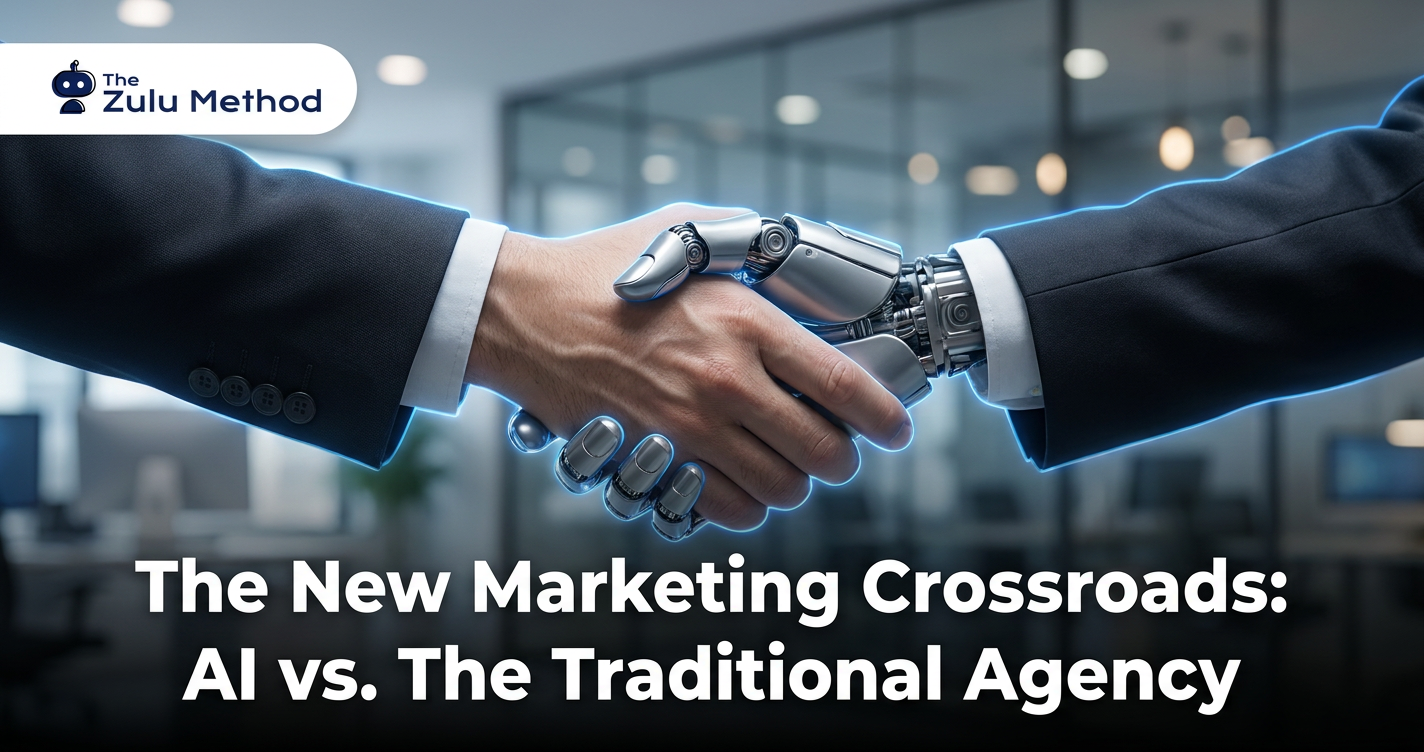
The New Marketing Crossroads: AI vs. The Traditional Agency
Working with a traditional marketing agency is a big investment. Monthly retainers can run into thousands of dollars, straining many budgets. As costs climb, companies are asking if it is the only path to growth.
At the same time, AI marketing tools have become a necessity. The 2024 State of Marketing AI Report showed AI use in marketing more than doubled in just one year. This technology is now powerful, accessible, and affordable for almost any business.
This article is not about declaring agencies obsolete. It is about making smart choices. The real question is how you can use both to your advantage. It is about finding the perfect mix for your business needs and your budget.
Our goal is simple. We will break down key marketing functions and show where AI provides a measurable advantage. You will get a playbook for building a modern marketing engine that smartly blends human expertise with automated efficiency.
The Unsung Hero of Modern Web: The Role of the API
In our digitally connected world, we seamlessly order food, book flights, and get weather updates with a few taps on our screens. But have you ever stopped to wonder how these disparate applications communicate with each other to get you the information you need? The answer lies with an unsung hero of the modern web: the API, or Application Programming Interface.
What Exactly is an API?
Think of an API as a waiter in a restaurant. You, the customer, don't need to know how the kitchen works—what ingredients are used, how the stove operates, or the chef's secret techniques. You simply look at the menu (the interface), place an order with the waiter (the API), and the waiter brings you the finished dish (the data or service you requested).
In technical terms, an API is a set of rules, protocols, and tools that allows different software applications to communicate with each other. It defines the kinds of requests that can be made, how to make them, the data formats that should be used, and the conventions to follow. It's a contract that enables developers to access the functionality of other services without having to understand their internal complexity.
Why APIs are a Game-Changer
The rise of APIs has fueled innovation and created a more interconnected ecosystem. Here's why they are so crucial:
- Efficiency and Speed: Developers can leverage existing APIs instead of building every single feature from scratch. Want to add maps to your app? Use the Google Maps API. Need to process payments? Integrate with the Stripe or PayPal API. This drastically reduces development time and cost.
- Innovation: APIs allow developers to mash up different services to create entirely new products. A travel app, for instance, might combine APIs from airlines, hotels, and review sites to offer a comprehensive trip-planning experience.
- Flexibility: By decoupling the front-end (what the user sees) from the back-end (the server-side logic), APIs allow for greater flexibility. The same back-end can power a website, a mobile app, and even a smart-watch application, all by communicating through the same API.
Ultimately, APIs are the invisible glue holding the digital world together. They enable the seamless flow of information that powers our favorite applications, fostering an environment of rapid innovation and collaboration.
1. Predictive SEO & Technical Audits at Scale

Getting your website to rank on Google takes a lot of technical work. Traditionally, an SEO agency would spend days hunting for broken links, slow pages, and other problems. This manual process is time-consuming and expensive, creating a major bottleneck for growth.
AI tools completely change this. They can perform a full technical audit in minutes, not weeks. These platforms scan your entire site and identify thousands of issues almost instantly. This gives you a complete picture of your site's health right away.
But AI's advantage goes beyond finding errors. It analyzes competitor strategies with amazing accuracy. These tools process huge amounts of data to predict which keywords will bring you the most traffic. This power helps you focus on real opportunities instead of just guessing.
The results are clear. For example, one collection of AI SEO case studies highlights how STACK Media grew its organic traffic by 80% in four months. They used AI to identify high-value keywords and redesign their pages, showing AI's direct impact on growth.
This strategic edge extends to on-page tasks. AI can suggest the best internal links to build your site's authority. It also helps you optimize content in real time based on what currently ranks at the top of search engine results pages.
This level of insight is key to modern marketing operations. It allows smaller teams to manage complex SEO tasks that once required expensive agency retainers. This is how businesses build a powerful, efficient marketing engine from the inside.
Understanding JSON Schema: The Blueprint for Your Data
In modern application development, data exchange is paramount. APIs, the conduits of this data, predominantly use JSON (JavaScript Object Notation) due to its simplicity and readability. However, with this flexibility comes a challenge: how do you ensure the JSON data being sent or received is structured correctly? The answer lies in JSON Schema.
What is JSON Schema?
JSON Schema is a declarative language that allows you to annotate and validate JSON documents. It provides a formal, machine-readable definition of the structure and constraints of your JSON data. Think of it as a contract for your JSON; it specifies what properties are expected, what their data types should be, which are required, and even more complex rules like string patterns or numerical ranges.
For example, you can define that a user object must contain a name (string) and an email (string, formatted as an email address), and may optionally contain an age (integer, minimum 18).
Why is it Essential?
- Data Quality and Integrity: By validating incoming data against a schema, you can reject malformed or incomplete requests at the boundary of your application. This prevents bad data from corrupting your database or causing unexpected application behavior.
- Clear API Contracts: A schema serves as precise documentation for your API. Both frontend and backend developers have a clear, unambiguous understanding of the expected data structure, reducing integration errors and speeding up development.
- Automated Testing and Tooling: With a well-defined schema, you can automatically generate forms, documentation, and test cases. This robust tooling ecosystem helps streamline the entire development lifecycle, from design to deployment.
By adopting JSON Schema, you move from assumptions to assertions, building more reliable, robust, and maintainable applications.
3. Hyper-Personalized Ad Targeting & Bidding

Running digital ads used to involve a lot of guesswork. Marketers would set broad audiences and manually adjust bids, hoping for the best. This approach was slow, inefficient, and often resulted in wasted money. It was nearly impossible for one person to manage all the variables effectively.
AI platforms like Google's Performance Max change everything. They analyze thousands of audience signals in real time. This includes device type, location, time of day, and past browsing behavior. A human team could never process this much data so quickly.
This nonstop analysis allows AI to make smarter decisions instantly. It adjusts bids for every single auction to reach the people most likely to convert. This means your ad budget is always focused on the most valuable opportunities, making every dollar work harder for you.
AI also excels at creative optimization. Instead of just A/B testing one headline against another, it dynamically creates thousands of ad variations. It mixes different images, headlines, and call-to-action buttons. Then, it finds the perfect combination for each specific audience segment.
One of the biggest benefits is reducing wasted ad spend. AI systems can identify underperforming campaigns in hours, not weeks. They automatically shift your budget away from ads that are not working and into ones that are. This speed and agility ensure your money is never tied up in a failing strategy.
The results speak for themselves. For instance, an analysis of data-backed influencer campaigns detailed how the wellness brand Therabody used AI to boost performance. Their return on ad spend (ROAS) jumped from 2.2x to 4.5x, demonstrating a clear financial impact.
By taking over the complex and repetitive tasks of bidding and testing, AI frees up your team. They can focus on big-picture strategy and creative direction instead of getting lost in spreadsheets. This smart automation gives businesses a huge advantage in today's competitive ad landscape.
4. Automated A/B Testing & Conversion Rate Optimization (CRO)
Improving your website's conversion rates used to be a slow guessing game. A marketing agency would typically run a single A/B test, changing one element like a button color. This process could take weeks to produce a single insight. AI changes this by running massive multivariate tests at the same time. It can test dozens of combinations of headlines, images, and copy to find the winner much faster.
AI also provides a deep understanding of user behavior. Tools can analyze thousands of session recordings and heatmaps to see exactly how users interact with your pages. Instead of a human watching a few videos, AI finds patterns at a massive scale. It identifies where visitors get confused, what they click on, and what they ignore. This provides clear, data-driven recommendations for design improvements.
This leads to one of the most powerful features: predictive personalization. AI can automatically show different versions of your website to different types of visitors. For example, a new user might see a different offer than a returning customer. The system learns in real time which version works best for each audience segment, maximizing your chances of making a sale with every single visit.
The impact on performance is clear. While self-serve tools provide a boost, the real power comes from combining AI with expertise. For example, an analysis of e-commerce performance on GoGoChimp shows that expert-guided AI delivers an average conversion lift of 28–34%. This is a huge improvement over the typical 4–7% lift seen from using the tools alone, highlighting the value of a smart strategy.
This level of automated testing and personalization was once only available to large enterprises. Now, platforms can help companies like yours optimize for conversions continuously. It allows you to build a system that gets smarter over time, turning more of your website traffic into actual revenue without the high cost of a dedicated CRO agency.
5. Data Analysis & Performance Reporting
Traditional marketing agencies spend countless hours on reporting. They manually pull data from Google Analytics, Facebook Ads, and other platforms into complex spreadsheets. This process is not only slow and expensive but also leaves room for human error. It can take days just to create a single monthly performance report.
AI completely changes this. These tools use APIs to connect all your data sources automatically. They build live dashboards that show all your key metrics in one place. Instead of waiting weeks for a report, you can check your campaign performance at any time. This instant access gives you amazing agility.
But AI's real advantage is its ability to find things humans might miss. It can scan massive datasets to discover hidden trends and unusual patterns. For example, it may find that a specific ad performs poorly on weekends. Or it might see that a blog post is suddenly getting traffic from a new country.
This is becoming even easier with natural language processing. You can now ask your data simple questions like, "Which channel brought us the most leads last month?" This power is why AI adoption has grown so fast in business. In fact, the latest findings from McKinsey's State of AI survey show a significant increase in AI use for marketing and sales.
This automation frees your team from the boring work of data entry. They can spend their time on what truly matters: strategy. By letting AI handle the numbers, your team can focus on making smart decisions that drive real business growth. It turns reporting from a chore into a strategic tool.
6. Social Media Monitoring & Community Management
Keeping up with social media used to mean endless scrolling. Teams would spend hours each day manually checking mentions and responding to the same questions over and over. This reactive approach left little time for actual strategy or building real connections with customers.
AI tools now act as your brand's eyes and ears, 24/7. They can scan millions of public posts, blogs, and forums to track brand mentions and analyze sentiment. This instantly tells you what people are saying about your company. You can spot potential issues before they grow.
AI also helps with community management. Chatbots can instantly answer common customer questions, like order status or store hours. This frees up your human team to handle more complex or sensitive problems that require a personal touch. It ensures no customer query is ever ignored.
The impact is significant. Look at the lawn care company Rachio, which used AI agents for customer support. According to a case study from Crescendo.ai, they reached up to 99.8% accuracy in handling inquiries. This also led to a 30% reduction in support costs, showing clear financial benefits.
Beyond customer service, AI helps find new opportunities. These systems analyze online conversations to identify emerging trends and topics getting a lot of attention. Your social media team gets a head start on creating content that connects with what your audience is already excited about.
7. Email Marketing Automation & Journey Building
Traditional email marketing often sends the same message to everyone at the same time. While this can work, it leaves a lot of opportunity on the table. Teams would create simple rules for campaigns, but they lacked true personalization at a deep level.
AI changes email from a simple broadcast tool into a smart communication engine. It analyzes individual user behavior to figure out the best time to send an email to each person. This simple adjustment alone can significantly boost open rates without any extra effort from your team.
AI also helps with the creative side. It can generate dozens of effective subject lines and predict which one will perform best before you even send it. For example, Mailchimp's announcement about its new features explains how AI can now write entire email drafts that match your brand's voice, saving you hours of work.
But the biggest advantage is in building customer journeys. Instead of basic if/then rules, AI creates complex, dynamic paths for each lead. It automatically sends personalized follow-ups based on a user's unique actions, like which pages they visited or what products they viewed. This guides customers toward a purchase in a natural, helpful way.
This level of automation turns your email list into a powerful revenue driver. It gives you the ability to deliver a personalized experience for every single subscriber. This is a core part of building a modern marketing operation that scales efficiently.
The Hybrid Model in Action: Building Your 'Cyborg' Marketing Team
 .%20Below,%20two%20boxes%20side-by-side.%20The%20left%20has%20an%20AI%20Operator%20icon%20in%20#14B8A6%20(Manages%20tools).%20The%20right%20has%20a%20Creative%20Finisher%20icon%20in%20#F97316%20(Adds%20human%20polish).%20Clear%20connecting%20lines.)
The goal is not to replace your marketing team with robots. It's about making them smarter and faster. The most effective companies are not choosing between AI and human talent. Instead, they are building a modern marketing team that combines AI and human expertise. This is how you create a real competitive advantage.
Think of this as building a 'cyborg' marketing team. At the center is the Human Strategist. This person is the brain of the operation. They set the high level goals, define the brand voice, and make sense of the insights AI provides. Their job is to ask the big questions and guide the overall direction.
Next comes the AI Operator. This team member translates the strategy into action by working directly with the tools. They are experts at writing prompts and managing automated workflows. Finally, the Creative Finisher takes the AI generated content and gives it a final human polish, ensuring it connects with your audience on an emotional level.
This new structure demands a fresh set of skills. It is less about manual execution and more about curiosity and strategic thinking. As one marketing VP explains, the most valuable people are not always the most technical. They are the ones with a high "figure-it-out" factor who experiment and pull threads until something works.
Success in modern marketing now depends on data literacy and the ability to ask great questions. The most valuable marketers are becoming strategic thinkers who can guide AI instead of just completing tasks. They blend creativity with analytical skills to get the most out of these powerful new tools.
When you build your team this way, something amazing happens. Small, agile groups can achieve results that once required large departments or expensive agencies. By automating the repetitive work, you free up your people to focus on the big-picture ideas that truly drive business growth. This is the core of an efficient, modern marketing engine.
Roadmap: How to Transition from Agency to an AI-Powered Model

Moving away from a full-service agency does not have to be a sudden leap. Instead, think of it as a gradual shift. A smart, phased approach helps you build internal skills, control costs, and make sure your marketing stays on track. Here is a simple three-step roadmap to guide your journey.
This transition is happening in a fast-growing market. According to an analysis from ABI Research, the AI software market reached $122 billion in 2024. Businesses are clearly investing in these tools to gain an edge. It is a clear signal that now is the time to build new capabilities.
Phase 1: Audit and Pilot (First 30-60 Days)
Start small by looking for easy wins. Review your agency's invoices to spot repetitive tasks like drafting initial social media posts or compiling weekly reports. These are perfect candidates for an AI pilot. Pick one task and test a relevant AI tool for a month. The goal is to learn, not to replace anyone just yet.
Phase 2: Integrate and Collaborate (Next 2-3 Months)
Once your pilot is successful, it is time to integrate. Let the AI handle the repetitive task execution, like generating first drafts of content. Then, have your agency focus on the strategic part. They can review the AI's output, add creative direction, and analyze the results. Update your agreement with them to reflect this new, more valuable role.
Phase 3: Scale and Own (Ongoing)
In the final phase, you bring more functions in-house. Your team, now skilled with AI tools, can manage daily operations directly. This is where you see major cost savings and gains in speed. The agency can then slide into a consultant role, helping with high-level quarterly planning or big campaign launches. It's the best of both worlds.
This step-by-step process builds a powerful, cost-effective marketing engine. It puts you in control while still leveraging expert strategic advice when you need it most. Frameworks like The Zulu Method are designed to guide companies through this exact journey, ensuring a smooth and successful transition to a modern, AI-powered operation.
Questions to Ask Before Transitioning to AI
- Which repetitive marketing tasks consume most of my team's time?
- Do we have clear documentation of our current marketing processes?
- What is our annual spend on agency services versus potential AI tool subscriptions?
- Who on our team has the curiosity and adaptability to become an AI operator?
- How strong is our brand voice documentation for guiding AI content creation?
- What governance systems would we need to ensure AI outputs align with our values?
- Which marketing function would benefit most from an initial AI pilot program?
- How will we measure the success of our AI implementation?
- What expertise do we need to keep in-house versus outsourcing?
- How will we handle the change management process with our team?
Conclusion: The Future is Collaborative, Not Combative
The discussion is not about AI replacing marketers. It is about giving them superpowers. AI is a tool designed to handle repetitive and time-consuming tasks. This frees up your team to focus on what humans do best: thinking critically, developing big ideas, and building real customer relationships. It is about working smarter, not harder.
The smartest companies will not choose between AI and an agency. They will build a lean in-house team armed with AI tools. As OpenAI's CEO Sam Altman explained, AI is poised to handle a huge portion of the work agencies do now. This shifts the agency's role to that of a high level strategic advisor, not a daily task manager.
This new model does not make marketers less valuable; it changes what makes them valuable. It is about blending technology with irreplaceable human skill. As LinkedIn's labor market analysis points out, human judgment and storytelling are still what win at the end of the day. AI becomes the engine, but a person is still in the driver's seat.
Getting started does not have to be overwhelming. You do not need to rebuild your entire marketing department overnight. The best approach is to start small. Identify one single, repetitive task your team or agency currently handles. Then, research one AI tool that could automate it. Test it, measure it, and build your confidence from there. This is the foundation of developing a comprehensive AI marketing strategy that will transform your business.
Frequently Asked Questions
Can AI completely replace a marketing agency?
No, not completely. While AI excels at executing tasks, analyzing data, and automating processes, it cannot replace the high-level strategy, complex creativity, brand positioning, and relationship-building that good agency partners provide. The future is a hybrid model that combines AI efficiency with human strategic direction.
Is using AI cheaper than hiring an agency?
Initially, yes. AI tool subscriptions typically range from $50 to $1000+ per month, which is significantly cheaper than agency retainers that can cost $3,000 to $10,000+ monthly. However, you must factor in the salary of skilled employees to manage these tools. For many businesses, the combined cost is still lower while providing more control over your marketing.
What core marketing tasks can I replace with AI right now?
You can immediately start using AI for generating first drafts of social media posts and blog content, performing technical SEO audits, analyzing marketing data for reports, running automated ad bidding on platforms like Google, and managing basic customer service inquiries with chatbots.
How do I choose the right AI marketing tools?
Start by identifying the single most time-consuming or expensive task you want to automate. Research tools specific to that function, whether it's SEO, content creation, or ad management. Look for solutions with positive reviews, strong integration capabilities with your existing systems, and clear pricing. Begin with a free trial or small pilot program before making a larger commitment.
What are the biggest risks of relying too much on AI?
The biggest risks include loss of brand voice and authenticity if content isn't properly edited, over-reliance on potentially flawed or biased data leading to poor decisions, potential privacy or copyright issues, and a lack of genuine human connection in customer interactions. Having a 'human-in-the-loop' is always required for proper governance and oversight.
What new skills does my team need to manage AI effectively?
Your team needs three core skills: 1) Data Literacy: The ability to understand and interpret the data AI provides, 2) Prompt Engineering: The ability to write clear instructions to get the desired output from generative AI, and 3) Strategic Oversight: The ability to align AI-driven tasks with broader business goals and critically evaluate AI recommendations.