
Published on: May 21, 2026 | Time to read: 26 min
AI marketing tools for content creation use artificial intelligence to help businesses produce marketing materials faster, from writing copy to generating images and videos. The market is projected to reach $6.2 billion by 2025, with two main types: generative AI that creates new content and analytical AI that optimizes existing work.
Key Takeaways
- Generative AI creates new content from scratch, while analytical AI improves existing work through optimization and fact-checking
- Top tools serve different needs: Jasper for writing, SurferSEO for SEO optimization, Midjourney and Synthesia for visuals and video
- A human-in-the-loop workflow combining AI drafting with human editing ensures quality, brand consistency, and accuracy
- Prompt engineering skills—crafting clear, specific instructions—are critical for getting high-quality AI output
- AI content is favorable for SEO as long as it's high-quality and helpful; Google focuses on content quality, not creation method
- Fact-checking all AI claims against trusted sources is essential to prevent misinformation and protect brand credibility
- Starting with one specific task (like social media captions) is a low-risk way to test AI integration before scaling
Table of Contents
- The Top 5 Must-Have AI Content Creation Tools
- For Writing & Copywriting: Jasper
- For SEO & Content Optimization: SurferSEO
- For Image & Video Generation: Midjourney & Synthesia
- For Content Ideation & Research: AnswerThePublic
- Developing a Human-in-the-Loop AI Content Workflow
- Ethical Considerations and Navigating AI Content Pitfalls
- Conclusion: Your Future with AI Content Creation
What Are AI Marketing Tools for Content Creation?
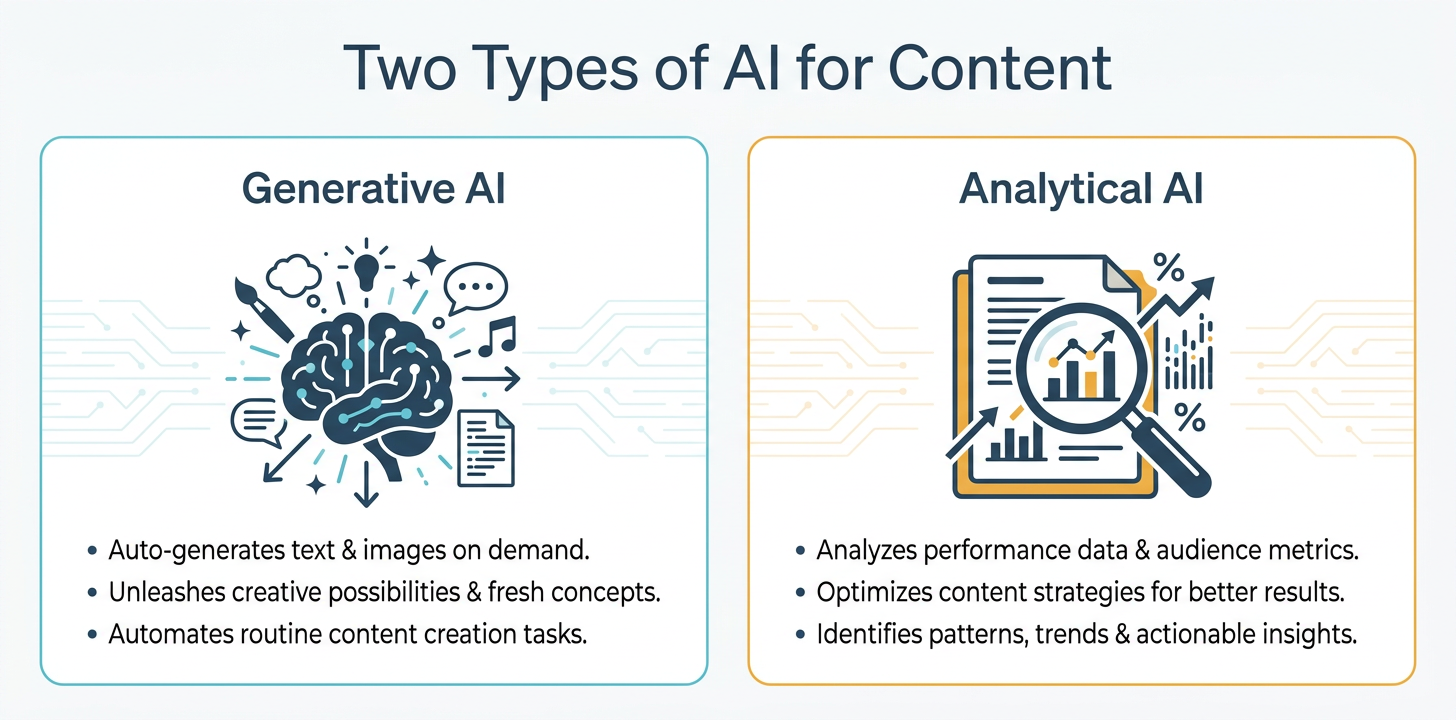
AI marketing tools for content creation are software that uses artificial intelligence to help create marketing materials. They can automatically write text, suggest ideas, or even design images. This helps businesses produce quality content much faster.
These tools are getting really popular. The market is expected to grow by over $60 billion from 2024 to 2029, says a forecast from Technavio. This huge growth shows how many businesses are starting to rely on AI for content.
There are two main kinds of these tools. Generative AI creates brand new content from scratch. You give it a simple prompt, and it'll write a blog post draft, design an image, or create a social media update for you.
The other kind is analytical AI. This type doesn't create new things. It looks at content you already have and suggests improvements. It might find keywords to help your article rank higher in search results or check your spelling.
You can use AI tools for all sorts of marketing tasks. They're great for drafting blog articles, social media captions, and email newsletters. They even help with video scripts, saving teams a lot of time.
The Top 5 Must-Have AI Content Creation Tools
With so many AI tools for content creation, picking the right one can feel tricky. The market is getting bigger every day. In fact, a report from Dataintelo shows the market is set to hit $6.2 billion by 2025. This list will help you cut through the noise.
We picked these tools based on a few key things. We looked at their special features and how simple they are to use. We also checked how well they connect with other software. And, of course, we considered if they offer good value for the price.
It's important to remember there is no single 'best' tool for everyone. Your perfect choice depends on your team's needs. That's why this list is grouped by what the tools do best, like writing or design. This makes finding a good fit for your work easier.
For Writing & Copywriting: Jasper
Jasper is one of the most popular ai marketing tools for content creation, especially for writing. It helps teams create quality copy for everything from long-form blog articles to snappy ad headlines. It is designed to make the writing process faster and easier, no matter what you're working on.
One of its best features is Brand Voice. You can teach Jasper about your company's specific style and tone. This means the content it creates will always sound like it came from your team. It is a great way to keep your messaging consistent across all your marketing channels.
Imagine you just finished a long blog post. Instead of brainstorming social media updates from scratch, you can use Jasper. In just minutes, it can generate ten different post variations from that single article. This saves a huge amount of time for busy marketers who need to create lots of content.
The results can be impressive. A commissioned study by Forrester found that Jasper customers saw a 342% return on their investment. This same Total Economic Impact study also highlighted an average payback period of less than six months. This shows how quickly the tool can provide value.
With its large library of templates and powerful features, Jasper is a solid choice for teams looking to scale their content production. It acts like a writing assistant that helps you get more done without sacrificing quality. This makes it a go-to for many content teams.
For SEO & Content Optimization: SurferSEO
Sometimes, writing great content isn't enough. It also needs to be optimized for search engines. This is where SurferSEO comes in. It is one of the best ai marketing tools for content creation because it analyzes top-ranking pages for your target keyword. It then gives you a data-driven blueprint for what your article needs to include to rank well.
Its main feature is the Content Editor. Here, you write or paste your article, and Surfer gives you real-time feedback. It suggests important keywords to add, ideal word counts, and even how many headings and images to use. Other tools like Keyword Research help you find new topics, while the Audit function can improve your existing pages.
Imagine you wrote a new blog post and its optimization score is only 50. Using the Content Editor, you could see exactly what's missing. By adding the recommended terms and adjusting your structure, you might raise that score to 85 or higher before publishing. This dramatically increases your chances of landing on the first page of search results.
This method gets results. In fact, a content study by SurferSEO found that pages updated with its editor were twice as likely to reach the Top 10 search results within 30 days. This shows how its AI-driven suggestions can directly impact your rankings and visibility.
For teams focused on getting more organic traffic from search engines, SurferSEO is a powerful ally. It closes the gap between creating content and creating content that gets found. It helps turn your writing efforts into measurable SEO success.
For Image & Video Generation: Midjourney & Synthesia
Content is not just about words. Strong visuals are key for grabbing attention. Tools like Midjourney are perfect for this. It is an AI image generator that turns simple text prompts into stunning, unique pictures. Marketers can now create custom art for blog posts, social media, or ads without needing a graphic designer. It is a fast way to get high quality visuals.
Video is another powerful marketing tool, but production can be complex and expensive. This is where tools like Synthesia shine. It lets you create professional-looking videos with AI avatars from just a script. You type your text, choose an avatar, and the AI generates a video of them speaking. This opens up video marketing without needing cameras or studios.
The savings are remarkable. Traditional video production for a short corporate video can easily cost thousands of dollars. But a cost breakdown from Skywork.ai shows that AI video tools create similar content for a fraction of that price. This makes video marketing accessible for businesses of all sizes, not just those with large budgets.
Think about the possibilities. You could use Midjourney to create a unique header image for your latest blog post. Then, use Synthesia to turn a dense whitepaper into an engaging explainer video for your website. This helps you repurpose content and reach a wider audience with different formats.
By handling both image and video creation, these ai marketing tools for content creation let teams produce a full range of high quality visual assets. They help you stay creative and consistent without breaking the bank. This makes them a key part of any modern marketing toolkit.
For Content Ideation & Research: AnswerThePublic
Coming up with fresh ideas for your content can be tough. The best marketing content answers real questions your audience has. But how do you find out what they are searching for? This is where ai marketing tools for content creation designed for research come in handy.
AnswerThePublic is a fantastic tool for this. You give it a keyword, and it shows you a visual map of questions people ask about that topic. It pulls data from search engines to show what your audience is curious about. This provides a goldmine of content inspiration.The real value is in understanding what your audience truly wants. Instead of guessing, you get direct insight into their problems, questions, and interests. This helps your team create content that is genuinely helpful and relevant to them.
Imagine you enter the term "running shoes." The tool might show questions like "how to choose running shoes for flat feet" or "when to replace running shoes." These long-tail keywords are perfect for building out an entire content marketing strategy.
Using tools for ideation is a smart way to integrate AI into your workflow. As content strategy guidance from Brightspot explains, starting with tasks like brainstorming or research is a high-leverage, low-risk way to begin. It sets your entire content creation process up for success.
What is the Pomodoro Technique?
The Pomodoro Technique is a time management method developed by Francesco Cirillo in the late 1980s. The technique uses a timer to break down work into intervals, traditionally 25 minutes in length, separated by short breaks. Each interval is known as a pomodoro, from the Italian word for 'tomato', after the tomato-shaped kitchen timer that Cirillo used as a university student.
How It Works: The 5 Basic Steps
Getting started with the Pomodoro Technique is simple. All you need is a timer!
- Choose a task: Decide on the task you want to work on.
- Set the Pomodoro timer: Set your timer for 25 minutes.
- Work on the task: Work on the task without any interruptions until the timer rings. If a distraction pops into your head, write it down and get back to work immediately.
- Take a short break: When the timer goes off, put a checkmark on a piece of paper and enjoy a short 5-minute break. Stretch, grab a glass of water, or just relax.
- Take a longer break: After four pomodoros, take a longer break of 15-30 minutes. This longer break helps you assimilate new information and rest before the next round of pomodoros.
Why It's So Effective
The Pomodoro Technique isn't just about managing time; it's about managing your focus and energy. By forcing you to take regular breaks, it helps prevent burnout and keeps your mind fresh. The short, focused sprints make even large, daunting tasks feel more manageable. Give it a try and watch your productivity soar!
Real-World Example: Jasper's Forrester Study Results
A commissioned Forrester Total Economic Impact study found that Jasper customers achieved a 342% return on investment with payback in under six months. The study revealed that composite organizations using Jasper produced 31,200 content pieces annually with just 300 users, and savedJasper is one of the most popular ai marketing tools for content creation, especially for writing. It helps teams create quality copy for everything from long-form blog articles to snappy ad headlines. It is designed to make the writing process faster and easier, no matter what you're working on.One of its best features is Brand Voice. You can teach Jasper about your company's specific style and tone. This means the content it creates will always sound like it came from your team. It is a great way to keep your messaging consistent across all your marketing channels.Imagine you just finished a long blog post. Instead of brainstorming social media updates from scratch, you can use Jasper. In just minutes, it can generate ten different post variations from that single article. This saves a huge amount of time for busy marketers who need to create lots of content.The results can be impressive. A commissioned study by Forrester found that Jasper customers saw a 342% return on their investment. This same Total Economic Impact study also highlighted an average payback period of less than six months. This shows how quickly the tool can provide value.With its large library of templates and powerful features, Jasper is a solid choice for teams looking to scale their content production. It acts like a writing assistant that helps you get more done without sacrificing quality. This makes it a go-to for many content teams.
For SEO & Content Optimization: SurferSEO
Sometimes, writing great content isn't enough. It also needs to be optimized for search engines. This is where SurferSEO comes in. It is one of the best ai marketing tools for content creation because it analyzes top-ranking pages for your target keyword. It then gives you a data-driven blueprint for what your article needs to include to rank well.Its main feature is the Content Editor. Here, you write or paste your article, and Surfer gives you real-time feedback. It suggests important keywords to add, ideal word counts, and even how many headings and images to use. Other tools like Keyword Research help you find new topics, while the Audit function can improve your existing pages.Imagine you wrote a new blog post and its optimization score is only 50. Using the Content Editor, you could see exactly what's missing. By adding the recommended terms and adjusting your structure, you might raise that score to 85 or higher before publishing. This dramatically increases your chances of landing on the first page of search results.This method gets results. In fact, a content study by SurferSEO found that pages updated with its editor were twice as likely to reach the Top 10 search results within 30 days. This shows how its AI-driven suggestions can directly impact your rankings and visibility.For teams focused on getting more organic traffic from search engines, SurferSEO is a powerful ally. It closes the gap between creating content and creating content that gets found. It helps turn your writing efforts into measurable SEO success.For Image & Video Generation: Midjourney & Synthesia
Content is not just about words. Strong visuals are key for grabbing attention. Tools like Midjourney are perfect for this. It is an AI image generator that turns simple text prompts into stunning, unique pictures. Marketers can now create custom art for blog posts, social media, or ads without needing a graphic designer. It is a fast way to get high quality visuals.Video is another powerful marketing tool, but production can be complex and expensive. This is where tools like Synthesia shine. It lets you create professional-looking videos with AI avatars from just a script. You type your text, choose an avatar, and the AI generates a video of them speaking. This opens up video marketing without needing cameras or studios.The savings are remarkable. Traditional video production for a short corporate video can easily cost thousands of dollars. But a cost breakdown from Skywork.ai shows that AI video tools create similar content for a fraction of that price. This makes video marketing accessible for businesses of all sizes, not just those with large budgets.Think about the possibilities. You could use Midjourney to create a unique header image for your latest blog post. Then, use Synthesia to turn a dense whitepaper into an engaging explainer video for your website. This helps you repurpose content and reach a wider audience with different formats.By handling both image and video creation, these ai marketing tools for content creation let teams produce a full range of high quality visual assets. They help you stay creative and consistent without breaking the bank. This makes them a key part of any modern marketing toolkit.For Content Ideation & Research: AnswerThePublic
Coming up with fresh ideas for your content can be tough. The best marketing content answers real questions your audience has. But how do you find out what they are searching for? This is where ai marketing tools for content creation designed for research come in handy.AnswerThePublic is a fantastic tool for this. You give it a keyword, and it shows you a visual map of questions people ask about that topic. It pulls data from search engines to show what your audience is curious about. This provides a goldmine of content inspiration.The real value is in understanding what your audience truly wants. Instead of guessing, you get direct insight into their problems, questions, and interests. This helps your team create content that is genuinely helpful and relevant to them.Imagine you enter the term "running shoes." The tool might show questions like "how to choose running shoes for flat feet" or "when to replace running shoes." These long-tail keywords are perfect for building out an entire topic cluster for SEO.Using tools for ideation is a smart way to integrate AI into your workflow. As content strategy guidance from Brightspot explains, starting with tasks like brainstorming or research is a high-leverage, low-risk way to begin. It sets your entire content creation process up for success.What is the Pomodoro Technique?
The Pomodoro Technique is a time management method developed by Francesco Cirillo in the late 1980s. The technique uses a timer to break down work into intervals, traditionally 25 minutes in length, separated by short breaks. Each interval is known as a pomodoro, from the Italian word for 'tomato', after the tomato-shaped kitchen timer that Cirillo used as a university student.How It Works: The 5 Basic Steps
Getting started with the Pomodoro Technique is simple. All you need is a timer!1. Choose a task: Decide on the task you want to work on.2. Set the Pomodoro timer: Set your timer for 25 minutes.3. Work on the task: Work on the task without any interruptions until the timer rings. If a distraction pops into your head, write it down and get back to work immediately.4. Take a short break: When the timer goes off, put a checkmark on a piece of paper and enjoy a short 5-minute break. Stretch, grab a glass of water, or just relax.5. Take a longer break: After four pomodoros, take a longer break of 15-30 minutes. This longer break helps you assimilate new information and rest before the next round of pomodoros.Why It's So Effective
The Pomodoro Technique isn't just about managing time; it's about managing your focus and energy. By forcing you to take regular breaks, it helps prevent burnout and keeps your mind fresh. The short, focused sprints make even large, daunting tasks feel more manageable. Give it a try and watch your productivity soar!.2 million in annual time savings plus ## For Writing & Copywriting: Jasper.1 million in avoided outsourcing costs. This demonstrates how AI content tools can dramatically scale output while dramatically reducing costs.
Developing a Human-in-the-Loop AI Content Workflow

Getting the most from ai marketing tools for content creation isn't about full automation. Instead, it's about building a smart process where people guide the technology. This approach lets you combine the speed of AI with the irreplaceable value of human knowledge. It's a partnership, not a replacement.
Think of AI as a co-pilot, not the pilot. Your team sets the destination with strategy, creativity, and expertise. The AI helps you get there faster. As one MIT Sloan research summary notes, it's about redesigning workflows to be more AI-friendly. This structure ensures high quality results.
A successful workflow often follows five key steps:
- Human Strategy: Your team defines the goals, target audience, and primary keywords for the content. This strategic direction provides the foundation for everything that follows.
- AI Ideation and Drafting: Use generative AI tools to brainstorm ideas, create outlines, or write a first draft. This step can speed up the most time-consuming parts of creation.
- Human Editing and Fact-Checking: This is a critical stage. A human editor must review the AI draft for accuracy, tone, and brand voice. Since AIs can make mistakes, it's smart to fact-check all AI content like a pro.
- AI Optimization: Once the core content is solid, use analytical AI tools to check for SEO improvements or readability enhancements. This fine-tunes the piece for performance.
- Human Final Review: A final human check ensures the content is polished, error-free, and ready to publish. This last look protects your brand's reputation for quality.
The quality of your AI draft depends heavily on your instructions. Clear, specific prompts lead to better results. Learning how to steer these tools is a new skill for marketers. This balanced method works especially well when combined with B2B marketing automation strategies.
By keeping a human in the loop, you can use AI marketing tools for content creation responsibly. It allows you to scale your output while maintaining the trust and authenticity your audience values. This balanced method is the key to long-term success.
Questions to Ask Before Implementing AI Content Tools
- Which content creation tasks currently consume the most time on your team?
- Do you have the resources for human editing and fact-checking of all AI-generated content?
- How will you maintain consistent brand voice and messaging across AI-generated materials?
- What's your budget for subscriptions, and which tools align with your primary content needs?
- How will you measure success—by time saved, content volume produced, or quality improvements?
- Do you have processes in place to verify facts, statistics, and claims before publishing?
- How will you communicate to your audience about the role of AI in your content creation?
- Are your team members trained in prompt engineering to get the best AI output?
- Which integration points with your existing tools (CMS, email, social) are most important?
- How will you ensure AI-generated content aligns with Google's E-E-A-T guidelines?
Ethical Considerations and Navigating AI Content Pitfalls
While ai marketing tools for content creation offer amazing speed, it is important to use them responsibly. Ignoring the ethical side can hurt your brand. Key concerns include originality and factual accuracy. Navigating these pitfalls is key to using AI safely and effectively.
One big worry is plagiarism. AI models learn from existing text, so their output can sometimes be too similar to the source material. Always use AI-generated text as a first draft. A human must rewrite and add unique ideas to ensure the final piece is truly original.
AI tools can also "hallucinate," meaning they invent facts or sources. This is dangerous for your brand's credibility. It is absolutely necessary for a human expert to fact-check every statistic, quote, and important claim the AI generates. Never trust the data blindly.
Being transparent with your readers builds trust. You might want to create a clear disclosure policy. If a piece of content is mostly made by AI, letting your audience know can be a good idea. This honesty shows you are using technology responsibly and keeps you accountable.
Many people wonder what Google thinks about AI content. Google cares more about quality than how content is made. Their focus is on helpful, people-first content that shows experience, expertise, authoritativeness, and trustworthiness (E-E-A-T). As long as your content meets this standard, you're fine.
Google has been clear about its position. Guidance from the Search Central blog states that using AI is not against their rules. However, using it mainly to manipulate search rankings is considered spam. Helpful content is a green light, and spammy content is a red flag.
Your Future with AI Content Creation
The takeaway is simple. AI marketing tools for content creation are not here to replace you. They are here to be your best assistant. They handle the repetitive parts of the job, like drafting and research. This frees you up to focus on the big picture, like strategy and creativity.
We've seen how they can boost efficiency, help you scale content production, and provide data to optimize your work. It is about working smarter, not just harder. This lets your team produce more high quality content for your audience without feeling overwhelmed or burned out.
But the best way to understand the benefit is to try it yourself. Don't try to change your entire workflow at once. Instead, pick one single area to test. Maybe it's drafting blog outlines or creating different social media posts from one article.
Then, test a free trial of a tool from this list that fits that need. Use it for a couple of weeks. Pay attention to how much time it saves you and what the quality of the output is like. This simple test will show you the real value for your team.
The shift is already happening and marketers are embracing this technology to do more meaningful work. In fact, a marketing AI statistics roundup by SurveyMonkey found that 70% of marketers expect AI to play a larger role. Your journey with smarter content creation can start today.

Frequently Asked Questions
What is the best AI tool for content creation?
There's no single 'best' tool because the right choice depends on your specific needs. Jasper leads for writing and copywriting, allowing you to maintain consistent brand voice across all outputs. SurferSEO is the best option for SEO optimization, providing data-driven recommendations for ranking higher in search results. For visual content, Midjourney excels at image generation while Synthesia specializes in creating professional videos with AI avatars. Evaluate which tasks take up most of your team's time and choose accordingly.
Is AI-generated content good for SEO?
Yes, AI-generated content can be excellent for SEO as long as it's high-quality, original, and genuinely helpful to users. Google doesn't penalize content based on how it was created—only on whether it meets their quality standards for experience, expertise, authoritativeness, and trustworthiness (E-E-A-T). AI tools like SurferSEO actually enhance SEO by analyzing top-ranking pages and suggesting specific optimizations like keywords, word count, and heading structure. The key is ensuring the content provides real value to readers and is properly fact-checked before publishing.
Can Google detect AI-generated content?
While detection tools exist, their accuracy is widely debated and unreliable. More importantly, Google's official stance is that detection isn't the focus—they reward high-quality content that meets E-E-A-T principles regardless of whether it was created by humans or AI. Google explicitly states that using AI is not against their guidelines; what violates their policies is using AI primarily to manipulate search rankings. Focus on creating genuinely helpful, well-researched content rather than trying to hide or disguise AI involvement.
Are AI content creation tools free?
Most powerful AI content creation tools operate on paid subscription models, though many offer limited free trials or freemium plans. Jasper, SurferSEO, Midjourney, and Synthesia all have paid tiers starting around $20-30 per month for basic features. The pricing typically scales based on usage—word count generated, number of images created, or video minutes produced. Some tools like AnswerThePublic offer limited free queries. To find the right fit, test free trials of tools that match your primary content needs before committing to a subscription.
How do you maintain a unique brand voice when using AI?
Maintaining brand voice requires a human-in-the-loop approach where AI handles drafting but humans control the polish. Tools like Jasper include 'Brand Voice' features that let you train the AI on your company's tone and style, but the final output should always be refined by someone who deeply understands your brand. After the AI generates a draft, a human editor should review it for authenticity, adjust phrasing to match your brand personality, and add context or nuance that only a human understands. This ensures your content sounds like your team wrote it, not a generic AI.
What skills do marketers need to use AI tools effectively?
Three core skills are essential for effective AI tool use. First is strategic thinking—ability to set clear goals, define your audience, and guide the AI toward outputs that serve your business objectives. Second is prompt engineering, the skill of writing clear, specific instructions that tell the AI exactly what you need (including tone, format, and constraints). Third is critical editing and fact-checking, ensuring you review AI output for accuracy, brand alignment, and any hallucinated claims or sources. These skills transform AI from a toy into a powerful productivity multiplier.
How can I fact-check content produced by an AI?
Treat all specific data, statistics, names, and quotes from AI as unverified until proven otherwise. Use lateral reading by quickly checking claims across multiple trusted sources like government websites, academic journals, and established news organizations rather than relying on a single source. For critical claims, trace back to the original primary source—the actual research paper, official report, or transcript—to ensure the information hasn't been misinterpreted. Tools like Google Fact Check Explorer and websites like Snopes and FactCheck.org can help verify already-debunked claims. Always cross-reference citations the AI provides, as they can sometimes be fabricated or inaccurate.