
Published on: April 23, 2026 | Time to read: 21 min
AI in marketing leverages smart computer programs to understand customers, personalize experiences, and make faster marketing decisions. From content creation to ad optimization, AI helps businesses work smarter while saving time and money, with the market projected to reach $107.5 billion by 2028.
Key Takeaways
- AI in marketing helps businesses understand customer behavior, automate repetitive tasks, and deliver personalized experiences at scale.
- Getting started with AI marketing doesn't require a huge budget, free AI tools like ChatGPT for content, Canva for visuals, and Buffer for social media provide powerful functionality.
- AI-driven personalization significantly improves marketing metrics, with personalized emails seeing 29% higher open rates and 41% higher click-through rates.
- The most effective AI marketing approach is hybrid, where AI handles data analysis and repetitive tasks while humans provide strategy, creativity, and quality control.
- Small businesses can launch AI marketing campaigns in under an hour by using AI for brainstorming, writing captions, creating visuals, and scheduling posts.
- When implementing AI marketing, always fact-check outputs, maintain transparency about data usage, and measure ROI through time saved and performance improvements.
Table of Contents
- The Top 5 Ways AI is Revolutionizing Marketing Today
- Building Your AI Marketing Toolkit on a Budget
- Launch Your First AI Marketing Campaign in Under an Hour
- Beyond the Hype: Measuring Real-World AI Success
- Common Pitfalls and How to Avoid Them
What Is AI in Marketing (and Why Should You Care)?
AI in marketing means using smart computer programs to make your marketing better. These tools help you understand customers and make faster decisions. It's about working smarter, not harder, to grow your business.
Think about how Netflix suggests movies you might like. It learns from what you watch and finds similar shows. AI marketing works the same way. It sees how customers behave and helps you offer things they're genuinely interested in.
Instead of guessing, AI gives you real insights. It analyzes data from your website and social media to paint a clear picture of your ideal customer. You learn what they like, what problems they have, and where they spend their time.
Once you know your customers, AI helps you reach them more effectively. It can personalize emails, show the right ads to the right people, and suggest blog topics. This makes your marketing feel helpful, not like a sales pitch.
So, why should you care? Because this technology is here to stay. The market for AI in marketing is set to hit over $107.5 billion by 2028, according to an analysis from Influencer Marketing Hub. Businesses are adopting it quickly to stay competitive.
Adopting AI saves you time and money. It automates tasks and makes your ad budget more efficient. This frees you up to focus on the creative parts of your business that truly need your attention.
The Top 5 Ways AI is Revolutionizing Marketing Today
AI is more than just a buzzword. It's a set of practical tools that can help your business grow, even if you're just starting. You don't need a huge budget or a team of experts to get started. Let's look at five simple ways you can use AI in your marketing right now.
1. Creating Content in Minutes
Struggling with writer's block? AI can feel like having a brainstorming partner available 24/7. It can generate ideas for blog posts, social media updates, and even video scripts. This helps you stay consistent and keeps your marketing fresh without spending hours staring at a blank page.
You can ask an AI tool to act as a social media strategist for your brand. Give it details about your business and your target audience. It will return a full calendar of ideas. A guide to AI prompts from Blaze.ai shows just how easy it is to get started.
2. Supercharging Your Emails
We all get generic emails that we immediately delete. AI helps you avoid that fate by personalizing your messages for each subscriber. It analyzes customer data to tailor subject lines, product recommendations, and promotions. This makes every email feel like it was written just for them.
This personal touch gets real results. Personalized messages see open rates that are 29% higher than generic emails. They also get 41% more clicks, as Kentico's blog on email analytics highlights. It's a simple way to make your audience feel valued and boost engagement. For those looking to implement these strategies, our guide on AI email automation provides detailed steps to get started.
3. Making Smarter, Cheaper Ads
Running paid ads can feel like throwing money at a wall and hoping something sticks. AI changes that by optimizing your campaigns automatically. It identifies the best audience for your products and adjusts your budget in real time to get the most out of every dollar.
One local bakery doubled its return on ad spend within six months by using AI. They got more clicks for less money and reached new customers. This shows how AI can level the playing field for small businesses, as detailed in a Jasmine Directory case study.
4. Designing Stunning Visuals Instantly
You don't need to be a professional designer to create eye-catching graphics for your brand. AI-powered design tools can create unique images from simple text prompts. Just describe the picture you want, and the AI will generate it for you in seconds.
This feature is a huge help for making blog headers, social media posts, or website graphics. Tools like Canva have made this accessible to everyone. As Viral Marketing Lab explains, free AI tools give beginners the ability to create high-quality visuals without any cost.
5. Understanding Your Customers Better
AI is also fantastic at finding hidden patterns in your business data. It can analyze website traffic, sales figures, and customer feedback to tell you what's working and what isn't. This gives you clear insights to inform your marketing strategy and make better decisions.
For instance, AI can identify gaps in your content that your audience is searching for. By creating content to fill those gaps, you can attract more visitors. Some businesses have seen massive traffic increases by following these AI-driven recommendations, according to case studies from the Marketing AI Institute.
1. Hyper-Personalization at Scale
AI personalization means treating every customer like an individual, even if you have thousands. The technology analyzes data like browsing habits and past purchases to predict what someone might want next. This lets you show them relevant content and product suggestions automatically. It's like having a personal shopper for everyone.
You've surely seen this in action on sites like Amazon with its 'Recommended for you' list. Spotify's Discover Weekly playlist is another great example. These features use AI to create a unique customer journey mapping experience for each user. They make people feel understood and keep them coming back for more.
This level of personalization is a huge reason the AI marketing industry is booming. Experts predict the market will grow to over $107 billion by 2028, as 2024 data from Influencer Marketing Hub shows. Businesses are quickly adopting this tech to connect with customers in more meaningful ways.
2. Supercharged Content Creation
Imagine having a creative partner that never runs out of ideas. That is what generative AI brings to content creation. With the right prompts, AI can brainstorm a month of social media content or draft your next email newsletter. Tools can also generate unique images from a simple text description, speeding up your workflow.
Think of AI as a helpful assistant, not a total replacement. It is best for getting first drafts and ideas quickly. But you always need to add your personal touch and check for accuracy. A complete guide to AI-powered content shows how specific instructions can help you generate better results for your brand.
3. Predictive Analytics for Smarter Decisions
Predictive analytics is just a fancy term for using past data to guess what will happen next. It helps you make smarter marketing decisions by finding patterns. For anyone new to marketing with AI, this removes a lot of the guesswork from your plans.
You can use it to predict which customers might leave or which products will become best-sellers. This allows you to act before it's too late. A Harvard Business Review discussion on AI and personalization shows how effective this can be for campaigns.
4. Automated Ad Campaigns & SEO
AI makes running ads much easier. Tools like Google Performance Max use artificial intelligence to automatically find valuable customers. It adjusts your ad bids and targeting in real time, so you don't have to. This process is explained in Google's official guide on Performance Max campaigns.
AI is also a big help for SEO. It can find the best keywords for your business and group them into topics for your blog posts. These tools also scan your website to find technical issues that could hurt your search engine ranking. This makes improving your site's visibility a lot simpler.
5. Intelligent Chatbots & Customer Service
AI chatbots are a fantastic tool for customer service. They work 24/7 to instantly answer common questions from your visitors. This means your customers get help right when they need it, day or night, without having to wait for a person to reply.
This also helps your human support team. With chatbots managing the simple requests, your staff can focus on solving more complex problems. This approach improves your overall Customer Support Strategy and lets your experts shine where they are needed most.
Questions to Ask Before Implementing AI in Your Marketing
- What specific marketing tasks take up most of my time that AI could potentially handle?
- Which areas of my marketing strategy would benefit most from data-driven insights?
- How will I measure the success of my AI marketing initiatives?
- What personal data am I collecting, and how am I communicating this to customers?
- Do I have processes in place to review and fact-check AI-generated content?
- How will AI complement my team's existing skills rather than replace them?
- What is my budget for AI tools, and which free options could I test first?
- How will I ensure my brand voice remains consistent across AI-generated content?
- What training do I or my team need to effectively use AI marketing tools?
Building Your AI Marketing Toolkit on a Budget

Getting started with AI marketing doesn't mean you need a big budget. In fact, many powerful tools are free or very affordable. The key is knowing which ones give you the most bang for your buck. This guide is your map for marketing with AI for dummies, helping you build a simple yet effective toolkit without breaking the bank.
AI's role in marketing is growing fast. With over 69% of marketers already using AI in 2024, as highlighted by Influencer Marketing Hub, it's clear that AI is here to stay. But you don't need a complex strategy to begin. A few core tools can handle the most important tasks for you.
This simple starter stack can form the foundation of your AI marketing efforts.
| Tool Category | Recommended Tool | Best For Beginners |
|---|---|---|
| Content & Writing | ChatGPT | Brainstorming ideas and writing first drafts |
| Visuals & Design | Canva Magic Studio | Creating custom graphics from text prompts |
| Social Media | Buffer / Blotato | Scheduling posts and getting content ideas |
For content and writing, ChatGPT is your go-to assistant. The free version is perfect for brainstorming blog topics, drafting social media captions, or even outlining an entire email newsletter. It helps you get past that dreaded blank page. Think of it as a creative partner that never runs out of ideas to get you started.
You can get great results by giving it specific instructions. For example, the U.S. Chamber of Commerce suggests prompts that define a role, audience, and goal. Ask it to "act as a social media strategist for a small bakery" to get tailored content ideas that fit your brand perfectly.
Next up is visual design. If you're not a graphic designer, Canva's Magic Studio is a lifesaver. Its most valuable feature for beginners is Magic Media, which creates images from a simple text description. You can type "a bright, abstract background for a summer sale" and get instant options for your social posts or website.
The free plan is surprisingly powerful for everyday marketing needs. While some advanced features are behind a paywall, sources like Viral Marketing Lab note that its free AI tools are generous enough to create professional-looking graphics without spending a dime. It's perfect for making your brand look good online.
To manage your social media, a tool like Buffer is a great starting point. Its free plan lets you connect three channels and use its AI assistant to come up with post ideas. This helps you stay consistent and active on platforms like Facebook, Instagram, and LinkedIn without feeling overwhelmed.
And that's it! With just these three tools, you have a solid foundation for your AI marketing. You can create text, design visuals, and schedule your content. This simple stack covers the basics and empowers you to start using AI to grow your business today.
Real-World Example: Sarah's Bakery
A local bakery implemented AI-driven ad optimization and saw remarkable results. Within six months, their return on ad spend doubled from 1.8:1 to 4.2:1—a 133% improvement. By week six, they were getting 34% more clicks at a 22% lower cost-per-click. The bakery used affordable tools like Canva AI for designs, Copy.ai for text, and automated budget rules that increased spending by 20% when performance was strong.
Launch Your First AI Marketing Campaign in Under an Hour
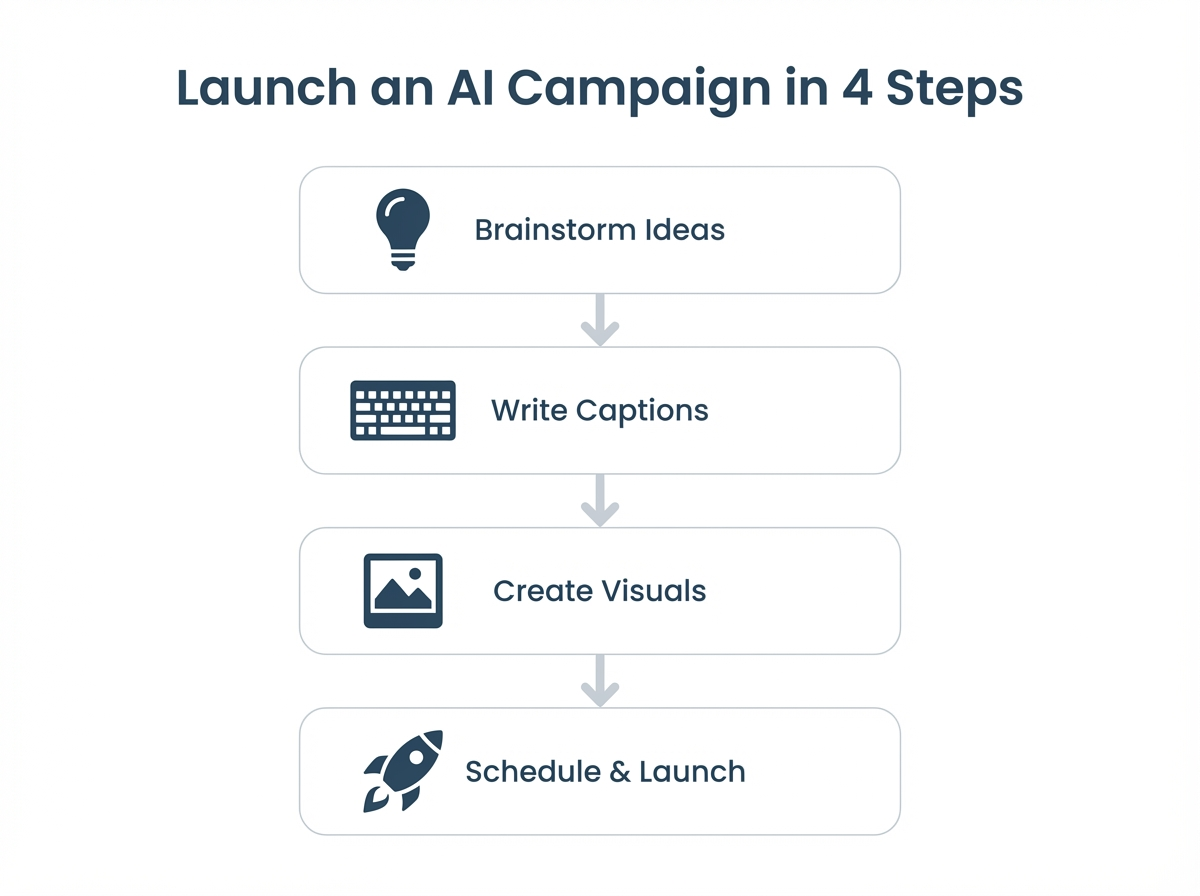
Dipping your toes into Artificial Intelligence for marketing can feel intimidating, but it doesn't have to be. You can launch your very first AI-driven campaign in less than an hour with just a few simple tools. This guide will walk you through creating a week's worth of social media content, from brainstorming to final scheduling.
Step 1: Brainstorm Your Content Pillars with AI
The first step is figuring out what to post. Instead of brainstorming from scratch, let's ask an AI assistant like ChatGPT for ideas. The magic is in the prompt. Be specific about your business and your goals.
Example Prompt:"I run a small, independent coffee shop called 'The Daily Grind'. Our target audience is local students and remote workers. Our goal is to increase foot traffic on weekday mornings. Generate 5 social media content ideas for one week that are fun, engaging, and highlight our coffee and cozy atmosphere."
The AI will give you a list of ready-to-use ideas, such as:
- A "Meet the Barista" Monday post.
- A poll asking followers about their favorite coffee blend.
- A time-lapse video of a latte art creation.
Step 2: Write the Post Captions
Now, pick one of your ideas and ask the AI to write the caption. This saves a ton of time.
Example Prompt:"Write an Instagram caption for the 'Meet the Barista' idea. Introduce our barista, Alex, who is also a local art student. Keep the tone friendly and ask a question to encourage comments."
The AI will output a caption that you can quickly review and edit. It's about 90% of the work done in seconds.
Step 3: Create Eye-Catching Visuals
Every social media post needs a visual. You can use AI image generators like Midjourney or Canva's Magic Media to create unique images.
Example Prompt for an AI Image Generator:"A cozy coffee shop corner with a steaming latte on a wooden table, a sketchbook is open next to it, warm morning light. Photorealistic style."
In moments, you'll have a custom image that perfectly matches your post's theme, without needing a professional photoshoot.
Step 4: Schedule and Go Live
The final step is automation. Use a social media scheduling tool (like Buffer, Hootsuite, or Meta Business Suite) to plan your posts for the entire week. Upload your AI-generated captions and images, pick the best times to post, and you're done.
Congratulations! You've just created and scheduled an entire social media campaign using AI. This simple workflow frees you up to focus on other parts of your business while your marketing runs on autopilot.
Beyond the Hype: Measuring Real-World AI Success
All the talk about AI is exciting, but how do you know if it's really helping your business? It's easy to get lost in the hype. But proving the value of marketing with AI for dummies is simpler than you think. You don't need to be a data expert to see the results. It's all about tracking the right things.
The AI in marketing space is growing incredibly fast. Reports from Influencer Marketing Hub project it will become a $107.5 billion market by 2028. With so many businesses adopting AI, it's important to understand how to measure its impact on your bottom line. This keeps you competitive.
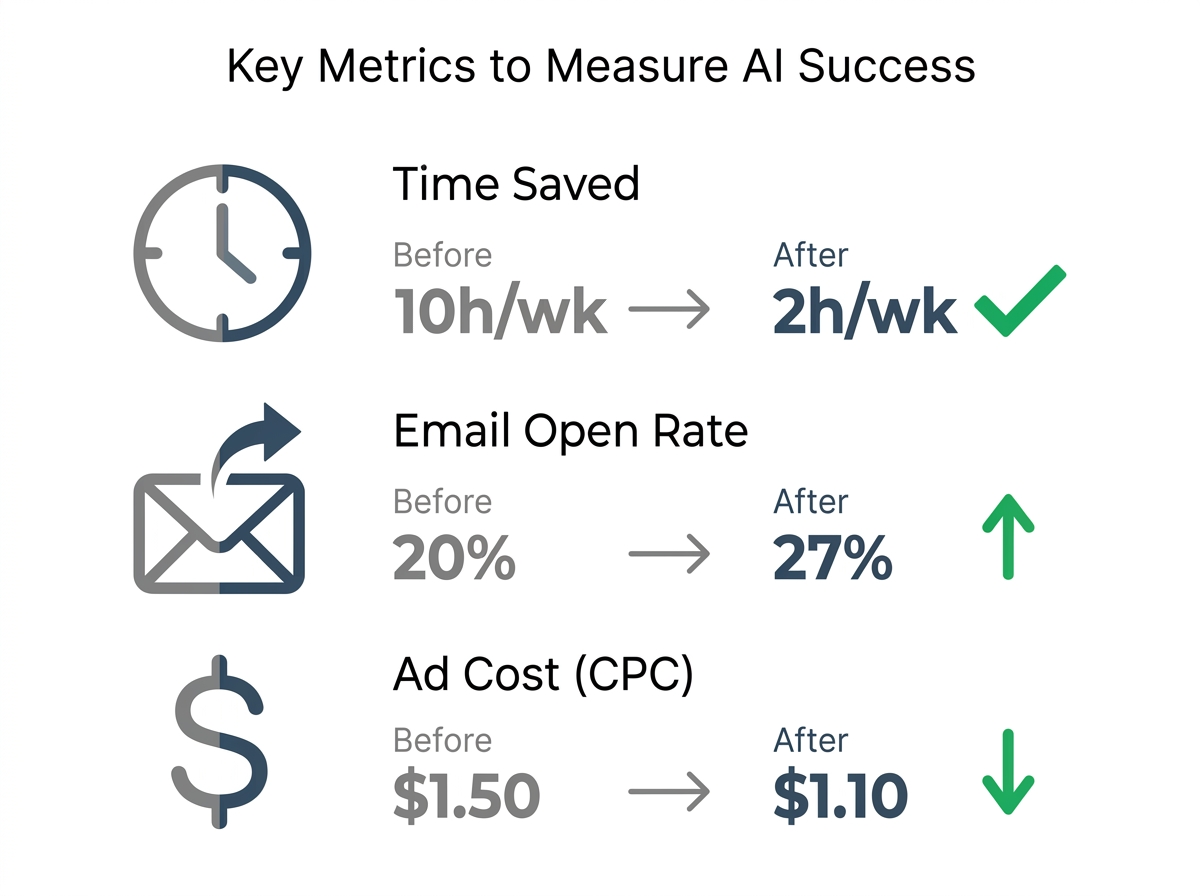
Think of it as a simple "before and after" picture. What did your marketing look like before you started using AI tools? And what does it look like now? By comparing these two snapshots, you can clearly see the difference AI is making. This approach removes the guesswork and shows you real progress.
Instead of complicated reports, focus on a few key numbers. These are often called Key Performance Indicators, or KPIs. They are simple metrics that show you if you're on the right track. Below are a few great examples for beginners to start with.
| What to Track | Example 'Before AI' | Example 'After AI' |
|---|---|---|
| Time Saved on Content Creation | 10 hours per week | 2 hours per week |
| Email Open Rate | 20% | 27% |
| Ad Cost-Per-Click (CPC) | $1.50 | $1.10 |
You can even put a dollar value on it. A simple way to calculate return on investment (ROI) involves looking at the hours you save. A basic formula is (Hours Saved × Your Hourly Rate) – Cost of the AI Tool. As explained by TaskROI, this quickly shows your net financial savings.
Seeing these numbers improve is the best proof that your AI strategy is working. It shows you're not just following a trend; you're making smarter decisions that save time and money. This helps you focus on what truly matters: growing your business. For those ready to take their efforts to the next level, developing a comprehensive AI marketing strategy can help you maximize these benefits across all your marketing channels.
Common Pitfalls and How to Avoid Them
AI is becoming a huge part of marketing. The number of marketers using it is growing fast. In fact, Influence Marketing Hub reports that nearly 70% of marketers used AI in 2024. But moving quickly means you need to watch your step. It's easy to stumble if you aren't aware of the common problems.
One of the biggest concerns is data privacy. AI tools often use customer information to work their magic. But you must be careful with how you handle that data. Being unclear about what you collect can get you into trouble and cause customers to lose trust in your brand. It's a big responsibility.
So, what's a simple fix? Always be open with your audience. Tell them what data you're using and why. Studies on the ethical use of AI in advertising show that this kind of transparency builds trust. Make sure you give people an easy way to opt out if they want to. It's all about respect.
Another trap is AI bias. These tools learn from the information they're given. If that information has old stereotypes or unfair ideas, the AI can learn them too. This could lead to a marketing campaign that accidentally leaves people out or even offends them. That's a mistake you don't want to make.
AI can also create content that sounds boring and generic. Even worse, it sometimes makes up facts or details that are just plain wrong. This is often called an "AI hallucination." Relying on it completely without checking can damage your reputation and spread bad information. It's important to be careful.
The best solution for these issues is simple: you! Always fact-check anything an AI creates. Read it over to make sure it sounds like your brand. Think of AI as your assistant, not the boss. Your creativity and common sense are still the most important tools you have.
Using AI in marketing isn't about letting a robot take over. It's about using a new tool wisely. By staying aware of these potential problems, you can avoid them. You're the one guiding the strategy, which ensures your marketing stays effective, human, and true to your business.
Conclusion: Your Journey with AI Marketing Starts Now
Getting started with AI in marketing can feel like a big step. But it's easier than you think. You don't need a huge budget or a team of experts. AI is already a common tool for many. In fact, data from Influence Marketing Hub shows that nearly 70% of marketers are using it in 2024. The AI marketing world is growing fast because it works.
The key to learning is to not try to do everything at once. Don't worry about mastering the entire AI landscape. Instead, think about one small, repetitive task in your day. Could you use help brainstorming social media ideas? Or maybe creating a quick graphic for a blog post? Starting with one specific goal makes the whole process feel much more manageable. It's the best way to build confidence and see real results quickly.
So, what's your next move? Your journey into marketing with AI starts with a single action. Go back to our list of recommended tools earlier in this guide.
Pick one tool that looks interesting and try the step-by-step campaign today. Don't wait for the perfect moment. Just dive in and experiment. You'll be surprised at what you can achieve.
Frequently Asked Questions
How do I start using AI in marketing?
Start small by focusing on one repetitive task in your marketing workflow, such as writing social media captions or brainstorming blog ideas. Choose a beginner-friendly tool with a free plan from our guide and dedicate one hour to learning its basic features. Use our step-by-step campaign walkthrough as your first project to build confidence quickly.
What is the best AI tool for marketing?
There isn't a single "best" tool as it depends on your specific needs. For content writing, beginners often start with Jasper or Copy.ai. For SEO optimization, tools like SurferSEO offer powerful AI features. If you want an all-in-one solution, HubSpot's Marketing Hub includes many AI capabilities. Identify your biggest marketing challenge first, then find a tool designed to solve it.
Can AI replace marketers?
No, AI is a tool to augment marketers, not replace them. While AI excels at data analysis and repetitive tasks, human marketers remain essential for strategy, creativity, brand building, and complex problem-solving—areas where human nuance and emotional intelligence are irreplaceable.
What is an example of a company using AI marketing well?
Netflix is a classic example of successful AI marketing. Its recommendation engine, which suggests what you should watch next, is entirely powered by AI. The system analyzes your viewing history, what you've rated, and what similar users watch to create a highly personalized experience that keeps viewers engaged and increases watch time.
How do I write a good prompt for an AI content generator?
Be specific and provide context in your prompts. Instead of "write a blog post about AI," try "Write a 500-word blog post for beginners explaining AI in marketing. Use a friendly and encouraging tone. Include an analogy to explain personalization." The best prompts specify the role, format, topic, tone, and goal of the content you want to create.