
Hannon Brett | Published on: June 4, 2026 | Time to read: 22 min | Last Updated on: June 4, 2026
What Exactly Are OpenAI Paid Ads? A New Advertising Paradigm
OpenAI paid ads refer to two very different things. First, there's the idea of placing ads on OpenAI platforms like ChatGPT. Second, there's using OpenAI tools to create ads that run on Google, Meta, or other networks. Right now, only the second option actually exists. No commercial ad platform on ChatGPT is live yet.
Advertising On OpenAI vs. Advertising With OpenAI
This distinction matters a lot. Many marketers mix these two ideas up, and it causes real confusion.
Advertising on OpenAI means placing sponsored content directly inside ChatGPT or other OpenAI products. This does not exist yet as a public, commercial product. Semafor reported that OpenAI has explored an ad-supported model internally, and a patent application spotted by Patently Apple hints at contextual ad formats tied to conversation topics. But none of this is open to advertisers today.Advertising with OpenAI tools means using ChatGPT to write ad copy or using DALL-E to generate visuals. Those ads then run on existing platforms like Google or Meta. This is already happening at scale across many marketing teams.So when people search for "OpenAI paid ads," they're often asking about both. This article covers both angles clearly.
What Future Ad Formats Might Look Like
Based on the patent filing and industry reports, the most likely future format would be sponsored results inside conversational search. Think of it like this: a user asks ChatGPT where to buy running shoes, and a sponsored recommendation appears alongside the organic answer.
This is different from a banner ad. It's contextual, tied to the exact conversation happening in real time. Axios also reported on OpenAI weighing advertising as a future revenue stream alongside its subscription and enterprise business lines.
No confirmed beta exists for external advertisers yet. No public dashboard. No announced pricing.
Who Uses ChatGPT and Why It Matters for Ads
Understanding the ChatGPT audience helps explain why advertisers are so interested in this space. These users are not casual browsers. They come with specific goals.
According to Exploding Topics, ChatGPT hit 100 million monthly active users within two months of launch. That's faster than any consumer app in history. The user base skews toward educated, professionally active adults aged 18 to 44.
These are productivity seekers. They use the tool to solve real problems: writing, research, planning, coding. That mindset makes them receptive to relevant recommendations but quick to reject anything that feels like a generic interruption.
For advertisers thinking about marketing personas, the ChatGPT user is a high-value target. They're curious, often in decision-making mode, and already engaged in a task. That's the kind of context that makes advertising far more effective than a cold display impression.
The Core Benefits: Why Your Business Should Pay Attention

Even before a formal ad platform launches, the opportunity around OpenAI paid ads is already shaping up to be a big deal. Whether you're thinking about the future of advertising inside ChatGPT or using AI tools to sharpen your current campaigns, there are three solid reasons to start paying attention right now.
A Massive, Engaged Audience That's Different From the Rest
The ChatGPT user base isn't your average social media crowd. These are people who show up with a specific goal. They're researching purchases, solving problems, planning projects, or comparing options. They're not passively scrolling.
Demographics lean toward educated, professionally active adults in the 18 to 44 age range. Many have above-average incomes. And they're not just curious about AI. They're using it regularly to make real decisions in their work and personal lives.
That creates a rare advertising environment. You're reaching people mid-task, not mid-boredom. That's a very different kind of attention.
First-Mover Advantage in an Unsaturated Channel
Here's the honest truth about new ad channels: the best time to be there is early. When Facebook Ads launched, early adopters paid pennies per click. When TikTok opened its ad platform, brands who moved fast grabbed massive share of voice before the crowd arrived.
Right now, no commercial OpenAI ad platform exists for most businesses. But the moment it does open up, the brands already paying attention will move faster. They'll have thought through their messaging, their audience fit, and their budget approach.
Being ready is its own kind of competitive advantage. Lower cost per click and higher share of voice tend to go to whoever shows up first. That's not speculation. It's the consistent pattern across every new digital ad channel.
High-Intent Targeting Based on Real Conversation Context
This is where things get genuinely interesting. Traditional ad targeting relies on demographic data or keyword matches. Contextual advertising on a conversational AI platform is a different thing entirely.
Imagine a user asking for help planning a home renovation. A relevant ad for building materials, interior design services, or home financing fits naturally into that moment. The targeting isn't based on a cookie from three weeks ago. It's based on what the person is actively thinking about right now.
Research published by the Harvard Business Review highlights that generative AI's ability to understand nuanced user intent could make it one of the most precise targeting tools marketers have ever had access to.Contextual advertising at this level has been a goal for digital marketers for years. Standard display ads match on broad topics. AI-powered contextual targeting can match on the full meaning of a conversation. That's a meaningful leap in relevance.
For any business that cares about reaching the right person at the right moment, that's not a minor upgrade. It's a fundamentally better way to connect.
Getting Started: A Step-by-Step Guide to Your First Campaign
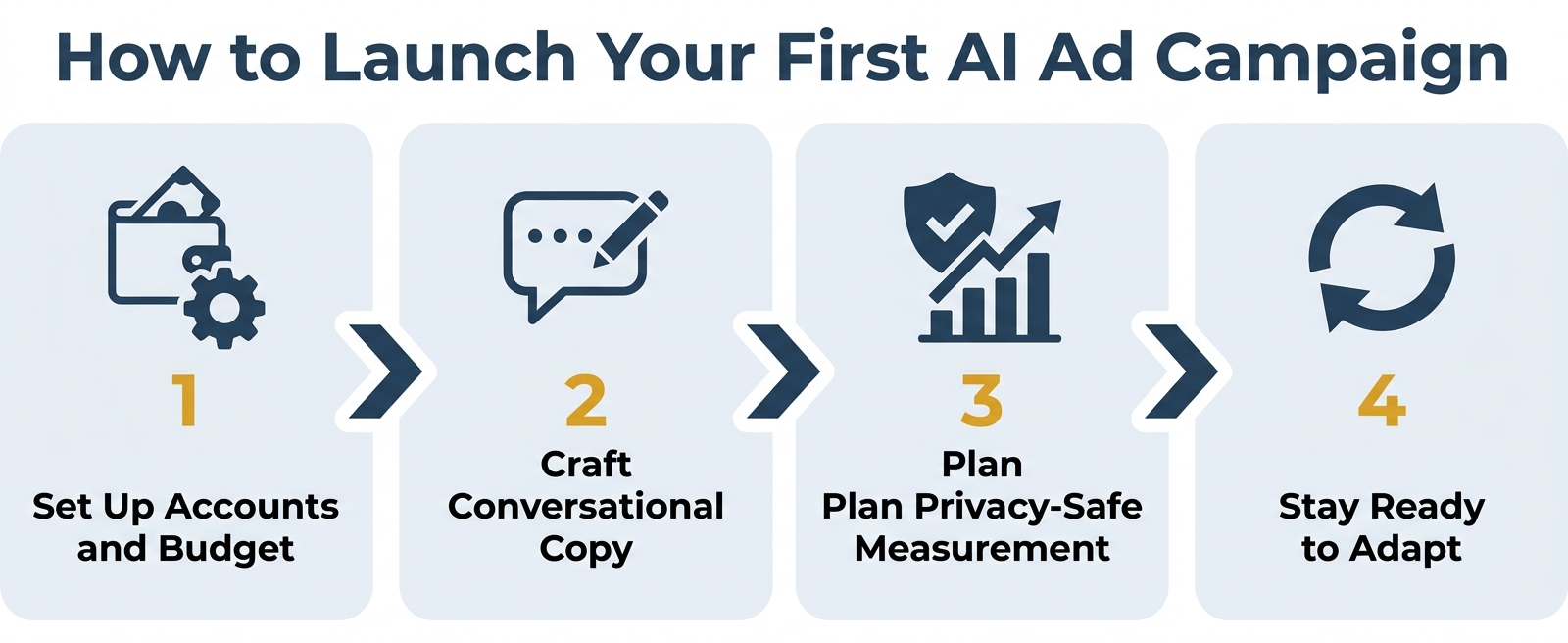
Since no public OpenAI ad platform exists yet, "getting started" means two things right now. You can use OpenAI tools to build better ads for platforms like Google or Meta. And you can position yourself to move fast when a native ChatGPT ad product does launch. Here's how to approach both.
Step 1: Set Up Your Accounts and Understand Your Budget
Start with the tools that exist today. A ChatGPT Plus or API account gives you access to the AI capabilities that power smarter ad creation. From there, your actual ad spend still runs through existing platforms.
For budget planning, think in two buckets. The first is your AI tool subscription cost, which is relatively small. The second is your media spend on whatever ad network you're using. Keep these separate so your ROI reporting stays clean.
When a native OpenAI ad platform does launch, expect a setup process similar to Google Ads or Meta Ads Manager. You'll likely create a business account, verify payment details, and define campaign objectives before anything else.
Step 2: Craft Copy That Feels Natural in a Conversational Context
This is where most marketers need to shift their thinking. Traditional ad copy is interruptive by design. It grabs attention by standing out. But inside a conversational AI environment, the rules flip entirely.
Ad content that feels like a helpful response will always outperform content that feels like a pitch. Write like you're continuing the conversation, not breaking it.
A few best practices to keep in mind:
- Match the question being asked. If someone is asking about home loans, your copy should answer that context, not just promote a product.
- Lead with the benefit, not the brand. Get to the value quickly.
- Keep calls-to-action soft and relevant. "Learn more" or "See your options" fits better than "Buy Now" inside a chat interface.
- Avoid superlatives. Phrases like "the best" or "number one" feel out of place in a conversational reply.
Using ChatGPT itself to draft and test copy variations is a smart move. Feed it your offer, your audience, and the conversation context. Ask it to write in the tone of a helpful assistant rather than a salesperson. The difference in output is significant.
Step 3: Plan for Measurement Without Traditional Pixels
This is the part most marketers overlook. Conversational AI environments may not support standard tracking pixels the same way a website does. Privacy regulations are also pushing the industry toward less invasive measurement methods.
The good news is that privacy-safe measurement approaches are maturing fast. The IAB's guidance on privacy-preserving ad measurement outlines practical alternatives including aggregated event measurement, modeled conversions, and first-party data strategies that don't rely on third-party cookies or page-level pixels.
For now, plan your measurement stack around these principles:
- UTM parameters on landing page URLs still work and give you basic attribution.
- First-party data capture at the point of conversion, like email signups or purchases, gives you reliable signal.
- Incrementality testing helps you understand lift from a channel even without direct tracking.
If you're building campaigns with AI-generated copy on existing platforms today, set up your conversion tracking on the destination, not the ad source. That way, when your traffic source changes or expands to include a new AI platform, your measurement setup doesn't need to be rebuilt from scratch.
Step 4: Stay Ready to Adapt
No confirmed campaign dashboard exists for OpenAI ads. No public beta is open to general advertisers. That's the honest reality as of now.
But the groundwork you lay today matters. Teams who have already refined their AI-assisted copy process, thought through contextual targeting, and built privacy-safe measurement will be ready to scale the moment the platform opens up.
Being prepared isn't passive. It's a strategic advantage.
Beyond the Hype: Early Performance Benchmarks and Case Studies
Here's the honest truth: there are no real performance numbers for OpenAI paid ads yet. No public CTR data. No confirmed CPC benchmarks. No conversion rate reports from actual campaigns run inside ChatGPT. The platform simply doesn't exist in a commercial form that advertisers can access today.
But that doesn't mean we're flying blind. There's still useful data to work with.
What Analysts Are Projecting (And Why It Matters)
Industry analysts have started modeling what performance could look like on a conversational AI ad platform, based on how contextual targeting works in other environments.
The core argument is simple. When an ad matches the exact topic a person is actively thinking about, engagement goes up. Not by a small margin. Potentially by a lot.
Gartner's analysis of AI-driven marketing transformation points to hyper-contextual relevance as one of the defining shifts in how brands will reach buyers. The reasoning is that ads tied to live conversational intent should outperform demographic or cookie-based targeting on standard metrics like CTR and conversion rate.Early adopters on new ad channels also tend to pay less. This pattern showed up with Facebook Ads, TikTok Ads, and Pinterest. Less competition means lower cost per click and more share of voice. That dynamic would almost certainly repeat itself if OpenAI opens an ad platform.
A Hypothetical Case Study: A SaaS Company in the Research Phase
To make this concrete, imagine a SaaS company selling project management software. They want to drive free trial sign-ups from small business owners.
Right now, they're running Google Search ads targeting keywords like "team task management" and "project tracking tool." They're paying a competitive CPC in a crowded category.
On a hypothetical OpenAI ad platform, the same company could show a sponsored recommendation when a user asks ChatGPT: "What's the best way to manage tasks across a small remote team?" The ad isn't interrupting anything. It's answering the question.
That's a fundamentally different kind of placement. The user is already in research mode. The intent is explicit. And the ad fits the moment instead of fighting for attention against it.
For a deeper look at how AI tools are changing campaign strategy, see our case study on AI-assisted ad workflows.
How It Stacks Up Against Google and Meta
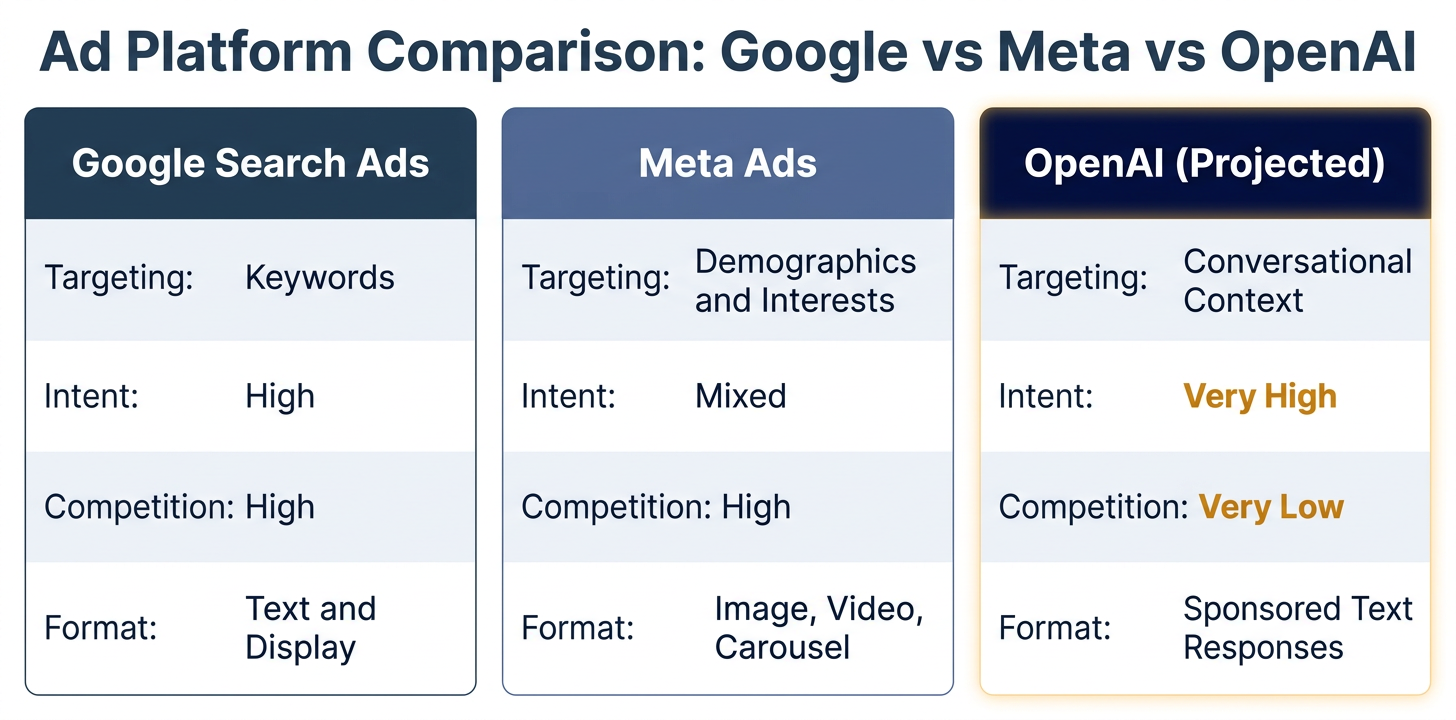
This table gives a realistic comparison of what we know and what we're projecting:
| Factor | Google Search Ads | Meta Ads | OpenAI (Projected) |
|---|---|---|---|
| Targeting basis | Keywords | Demographics and interests | Conversational context |
| User intent | High | Mixed | Very high |
| Competition level | High | High | Very low (no platform yet) |
| Ad format | Text and display | Image, video, carousel | Likely sponsored text responses |
| Measurement maturity | Established | Established | Unknown |
| Early adopter CPC advantage | Low | Low | Potentially high |
Google Search is still the gold standard for high-intent targeting. But it's crowded. Digiday has covered how generative AI advertising could challenge that position by matching user intent at an even more specific level than keyword search allows.
Meta offers scale and audience depth but relies more on interest modeling than active intent. A user scrolling Instagram may or may not be ready to buy. A user asking ChatGPT for product recommendations almost certainly is.
The weakness of the OpenAI model, at least for now, is everything we don't know. No measurement standards. No confirmed pricing. No brand safety data from live campaigns.
But for businesses willing to stay informed and prepare early, that uncertainty is also an opening.
Real-World Example: SaaS Company in Research Phase
A project management software company currently runs Google Search ads on keywords like "team task management" (competitive CPC, crowded market). On a hypothetical OpenAI ad platform, the same company could show a sponsored recommendation when a user asks ChatGPT: "What's the best way to manage tasks across a small remote team?" The ad isn't interrupting anything—it's answering the question in context. The user is already in research mode with explicit intent, and the ad fits the moment instead of fighting for attention. This represents a fundamentally different and more relevant placement than traditional display advertising.
Advanced Strategy: Using AI to Create Your AI Ads
You don't have to wait for a native OpenAI ad platform to start using AI in your advertising workflow. Right now, today, you can use ChatGPT and DALL-E 3 to build better ads for every platform you're already running. Here's how to do it well.
Using ChatGPT to Write and Test Ad Copy Variations
The fastest way to get value from ChatGPT in your ad workflow is to treat it like a creative partner. Don't just ask it to "write an ad." Give it real context.
Try prompts like these:
- "Write 3 Facebook ad headlines for a home cleaning service targeting busy parents. Keep each under 30 words. Lead with the time-saving benefit."
- "Rewrite this Google ad copy in a warmer, more conversational tone. Avoid hype words."
- "Generate 5 variations of this CTA for A/B testing: 'Start your free trial today.'"
The more specific your input, the better the output. Include your audience, the platform, the character limit, and the tone you want. ChatGPT can generate dozens of variations in seconds, which means your team spends less time on drafts and more time on testing.
According to Shopify's guide on ChatGPT prompts for marketing, specificity is the single biggest factor in prompt quality. Vague prompts get generic copy. Detailed prompts get copy worth testing.
Generating Ad Visuals With DALL-E 3
Don't overlook the visual side of your ad strategy. DALL-E 3 lets you generate custom images without needing a designer or a stock photo library.
For ad creatives, try prompts that describe the exact scene and mood you need. For example: "A clean, minimalist flat-lay of a coffee mug and open notebook on a white desk, warm morning light, lifestyle photography style, no text."
You can iterate fast. Test a bright lifestyle image against a bold product-focused image. Generate multiple visual directions in an afternoon instead of a week.
The goal isn't to replace your creative team. It's to speed up the early stages of creative development so your team can focus on refinement and brand consistency.
Using AI to Analyze Competitor Ad Strategy
This is an underused move. ChatGPT can help you break down what competitors are doing in their ads, and where they're leaving gaps.
Start by pulling examples from tools like Meta's Ad Library or Google's Transparency Center. Then paste the ad copy into ChatGPT and ask:
- "What benefits is this ad emphasizing? What's it leaving out?"
- "Who does this ad seem targeted at? What audience is being ignored?"
- "What objections does this copy not address?"
This kind of structured analysis used to take hours. With AI, it takes minutes. You end up with a clearer picture of the messaging gaps in your category, and a head start on writing copy that fills them.
Pair this with regular reviews of competitor creative and you'll build a real strategic edge over time, not just faster output.
Common Pitfalls and How to Avoid Them
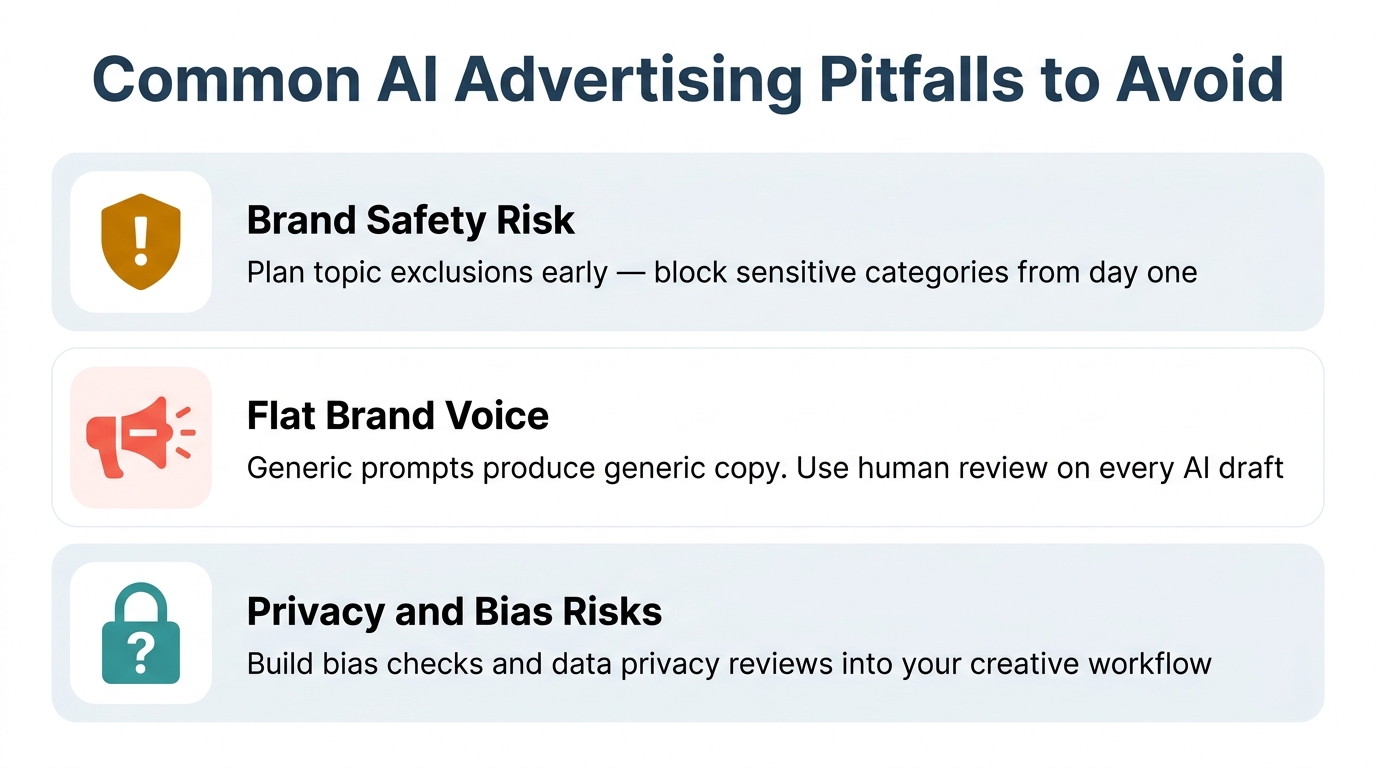
Using AI in your advertising workflow comes with real risks. Getting ahead of them now saves you from expensive mistakes later. Here are the three biggest pitfalls marketers run into, and how to handle each one.
Brand Safety: Protecting Your Reputation in an AI Environment
Brand safety is a real concern in any AI-driven ad context. If a native OpenAI ad platform eventually launches, your sponsored content could appear alongside AI-generated responses on almost any topic. Without proper controls, that includes topics you'd never want your brand near.
The fix is to think in exclusions from the start. Just like you'd set negative keywords in Google Ads, plan topic categories you want to block. Sensitive topics, controversial news, and emotionally charged conversations should all be on your exclusion list.
Also, watch how OpenAI's usage policies evolve. Their current safety guidelines already prohibit harmful content, hate speech, and misinformation. Any future ad platform will likely build on those foundations. Staying familiar with those rules helps you build campaigns that align with them.
The Creativity Tax: Don't Let AI Flatten Your Brand Voice
This is the quiet killer of AI-assisted advertising. You ask ChatGPT to write ad copy, it gives you something grammatically clean and completely forgettable. You run it. It performs poorly. And you wonder why.
The problem isn't the AI. It's the prompt. Generic input produces generic output. If you're not feeding the model your brand's tone, your audience's specific pain points, and clear examples of what good looks like for your brand, you're getting averaged-out content.
The solution is a human-in-the-loop workflow. Use AI to generate the first draft fast. Then have a real person refine it. Check for voice, check for accuracy, and check whether it actually sounds like your brand.
A simple rule: AI writes the first draft, a human approves the final version. Every time.
Ethical Risks: Privacy, Data, and Algorithmic Bias
This is the part most advertisers skip. But it matters, both ethically and legally.
Conversational AI advertising raises real questions about how user data gets used. Even if OpenAI relies on real-time conversation context rather than user history for targeting, the inference capabilities of large language models are powerful enough to raise legitimate privacy concerns.
There's also the issue of algorithmic bias. AI systems trained on internet-scale data can reflect the biases in that data. In an advertising context, that could mean your ads get shown or withheld from certain groups in ways you never intended. The Electronic Frontier Foundation's ongoing coverage of AI and digital rights outlines why these concerns are not theoretical. They show up in real systems.
Protect yourself by building bias checks into your creative review process. Ask whether your copy makes assumptions about your audience based on demographics. Review targeting parameters for unintended exclusions. And stay current on data privacy regulations in your market.
Being proactive here isn't just the ethical move. It's the smart business move too.
Conclusion: Your Next Steps in the New Age of AI Advertising
The opportunity around OpenAI paid ads is real, even if the native platform isn't open to advertisers yet. And that gap is actually good news for you.
Right now, you have time to prepare. Teams that build their AI-assisted ad workflows today will move faster when the platform does open up. That's not a small advantage. It's the difference between being first and playing catch-up.
Start Small, Learn Fast
The best move right now is to start experimenting with the tools that already exist. Use ChatGPT to write and test ad copy variations for your current Google or Meta campaigns. Try DALL-E for creative testing. Build your prompting skills now so they're sharp when you need them most.
Set aside a small test budget. It doesn't need to be big. Even a few hundred dollars in AI-assisted campaign experiments will teach you more than any report or projection can.
Keep AI Ads as One Part of a Bigger Strategy
Don't make the mistake of treating any single channel as a silver bullet. OpenAI paid ads, whenever they arrive, should sit inside a diversified marketing mix alongside your proven channels.
Contextual AI advertising will be a powerful addition. But Google Search, Meta, email, and content marketing aren't going anywhere. A balanced approach protects you from over-relying on an unproven platform while still letting you capture early-mover benefits.
Build Your Experimentation Roadmap Now
The smartest thing you can do today is document your plan. Map out what you'd test first, which audiences you'd target, and how you'd measure results when a native OpenAI ad product becomes available.
A simple marketing experiment planning template can help you structure this thinking before the platform even launches. That way, you're not starting from zero when the moment arrives.
The brands who win in new channels are the ones who show up prepared. That can be you.
Questions to Ask Before Launching Your OpenAI Ad Strategy
- Is your target audience among the 100M+ monthly active ChatGPT users (educated, professional, high-intent, ages 18–44), and does your business model benefit from reaching people mid-decision rather than mid-browsing?
- Have you documented which conversation topics and user intents would be most relevant for your product or service, and are you prepared to set topic exclusions for brand safety?
- Does your team currently have the skills and workflows to use ChatGPT for ad copy generation and DALL-E for visual testing, or do you need training before a native platform launches?
- What privacy and ethical concerns does contextual AI advertising raise for your brand, and have you audited your targeting logic and creative for algorithmic bias?
- Do you have a measurement strategy that doesn't rely on third-party pixels or cookies—such as UTM parameters, first-party data capture, or incrementality testing—that will work on a conversational AI platform?

A: No, there is no public or commercial ad platform on ChatGPT available to advertisers today. OpenAI has explored ad-supported models internally and filed patents hinting at contextual advertising, but no official beta exists and no commercial dashboard is open. The most accurate way to check for updates is monitoring OpenAI's official blog and announcements.
Q: How much do OpenAI ads cost?A: Official pricing models (CPC, CPM, or CPA) are not yet public since the platform hasn't launched. However, based on patterns from early-stage ad platforms like Facebook and TikTok, early adopters typically pay significantly less per click than later entrants, potentially $0.50–$3.00 CPC depending on targeting specificity and competition. Expect factors like conversation topic relevance and user intent level to influence final pricing.
Q: Are OpenAI ads effective?A: While there are no real performance benchmarks from live campaigns, the potential for high effectiveness is strong due to users being in a high-intent state when interacting with ChatGPT. Gartner and industry analysts project significantly higher engagement and conversion rates than traditional display ads due to hyper-contextual targeting. A "test and learn" approach is advised as this channel matures.
Q: What kind of businesses should advertise on OpenAI?A: Ideal candidates include B2B and B2C SaaS companies, tech vendors, e-learning platforms, high-consideration consumer products (home services, financial services, premium goods), and any brand targeting educated, tech-savvy, professionally active audiences aged 18–44 who actively use AI for research and decision-making.
Q: How will OpenAI handle ad and user privacy?A: OpenAI currently uses a privacy-first approach with no default use of conversational data for training. Any future ad platform would likely rely on real-time conversation context rather than deep user history, and would align with OpenAI's existing safety guidelines and data policies. The industry shift toward privacy-centric advertising via contextual targeting (rather than cookies or pixels) positions OpenAI's likely approach as aligned with emerging privacy standards.