Hannon Brett | Published on: June 4, 2026 | Time to read: 23 min | Last Updated on: June 4, 2026
The Dawn of the AI-Augmented Marketer
A modern AI marketing team is a strategic blend of human creativity and artificial intelligence working side by side. It's not about replacing marketers with machines. It's about giving skilled people better tools to think, create, and connect with audiences faster and smarter than ever before.
According to HubSpot's 2024 marketing research, 64% of marketers now use AI or automation in their day-to-day work. That's not a small shift. That's a fundamental change in how marketing teams operate across every industry.
From Manual Work to Smarter Workflows
Traditional marketing teams spent hours on repetitive tasks. Think manual A/B testing, hand-curated audience segments, and gut-feel decisions on ad spend.
AI-augmented teams work differently. They let algorithms handle testing at scale while humans focus on strategy and storytelling. The marketer's job shifts from doing the repetitive work to guiding, reviewing, and improving what AI produces.
This is a big deal. And it changes what skills a marketing team needs to succeed.
Human Talent Still Leads
AI handles speed and scale. But humans bring judgment, empathy, and brand voice. The best modern marketing teams know exactly which tasks to hand off to AI and which ones need a real person's touch.
Think of it like a co-pilot relationship. AI processes data and surfaces insights. The marketer decides what to do with them. Together, they move faster and make smarter calls than either could alone.
This shift is reshaping the future of marketing from the ground up, and teams that adapt early are already seeing real competitive advantages.
The New Anatomy: Key Roles in an AI-Powered Marketing Team
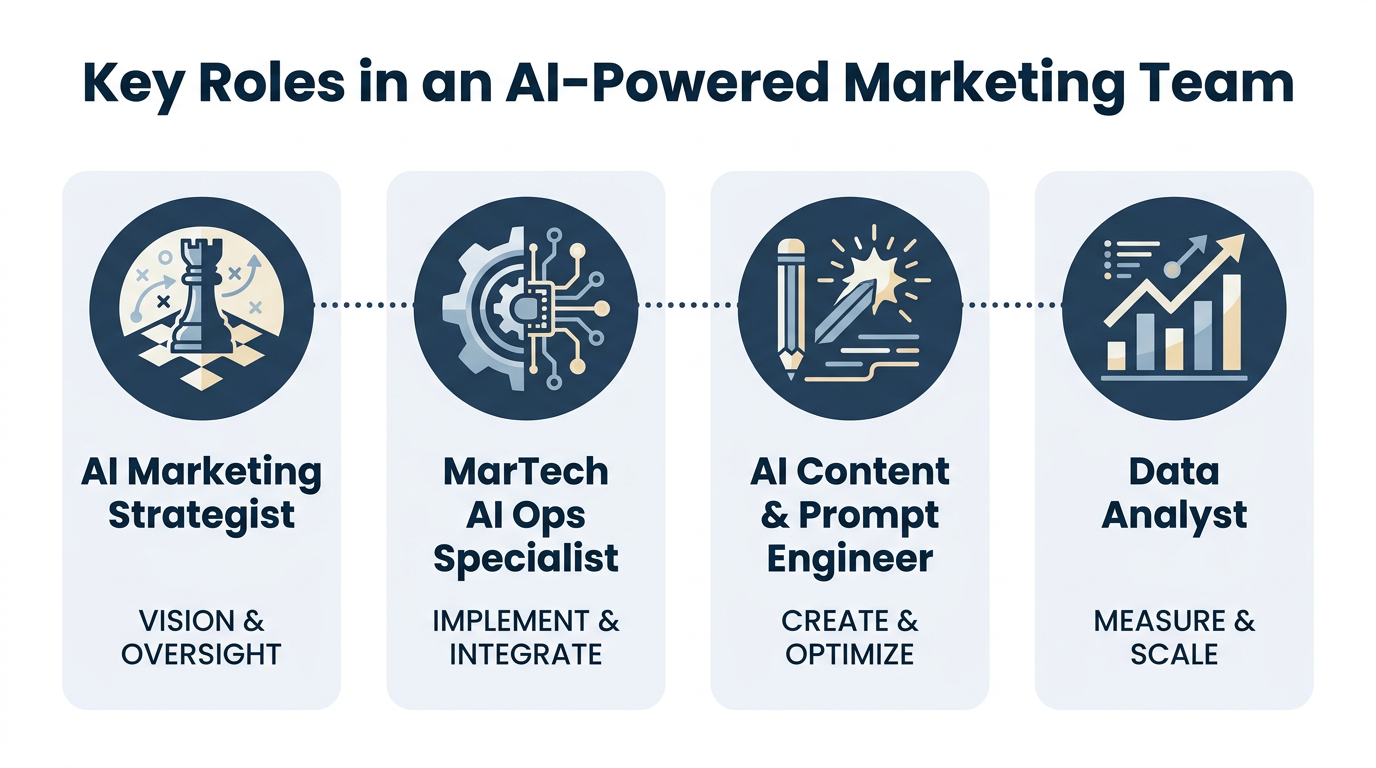
A modern AI marketing team isn't just a traditional team with new software. It's a rethought structure where roles have shifted, expanded, and in some cases, been created from scratch. Understanding who does what in this new setup is the first step to building one that actually works.
Existing roles haven't disappeared. They've changed shape. A Content Manager today isn't just writing blog posts. They're reviewing AI-generated drafts, refining prompts, and making sure the brand voice stays consistent across dozens of automated outputs.
Same goes for SEO Specialists. They're not just chasing keywords anymore. They're working alongside AI tools to analyze search patterns, test content variations, and adapt to how search engines themselves are changing.
These roles work together, not separately. An AI prompt specialist needs input from the brand strategist. The data analyst needs to work closely with the campaign manager. The whole team moves as one connected unit toward shared goals.
And the skills gap is real. According to the Digital Marketing Institute, 54% of marketers believe their team's current AI skill level is low. That's a big challenge, but also a big opportunity for teams willing to invest in learning.
The AI Marketing Strategist
Think of the AI Marketing Strategist as the architect of the whole operation. This person sees the big picture. They identify where AI can create real business value and make sure every AI initiative connects directly to marketing goals that actually matter.
This isn't a technical role in the traditional sense. It's a visionary one. The AI Marketing Strategist doesn't just pick tools. They build a portfolio of AI solutions that work together, each chosen to solve a specific business challenge.
Core responsibilities include:- Setting AI-driven KPIs like personalization depth and AI-influenced revenue
- Selecting and managing the right mix of AI tools for the team
- Translating business goals into clear AI use cases the team can act on
- Overseeing the entire AI marketing ecosystem from strategy to execution
Getting this right takes serious strategic thinking. Harvard Business Review's guide to modern marketing strategy highlights how the best marketing leaders now tie AI decisions directly to competitive positioning, not just efficiency gains.
And the demand for this skill set is growing fast. According to intelliarts.com's 2024 AI marketing statistics, nearly three out of four marketers used at least one AI tool in 2024. Someone has to make sure all those tools are pointing in the same direction. That's exactly what this role is built to do.
The MarTech AI Operations Specialist
If the AI Marketing Strategist is the architect, the MarTech AI Operations Specialist is the builder. This is the technical expert who makes sure every AI tool in the marketing stack actually works, connects properly, and delivers clean, usable data.
Their job is all about the plumbing behind the scenes. They ensure smooth data flow between platforms, so information moves correctly from one tool to the next without getting lost or corrupted along the way.
Core responsibilities include:- Implementing and integrating AI tools into existing marketing systems
- Maintaining platform connections and troubleshooting when things break
- Training the rest of the team on how to use new tools effectively
- Managing data pipelines to keep information accurate and consistent
This role requires a solid understanding of how different marketing platforms connect. Knowing how data moves between systems is just as important as knowing the tools themselves.
Data management is also a big part of the job. Poor data in means poor AI output. This specialist makes sure the team is always working with reliable, well-organized information.
And the need for this expertise keeps growing. According to SurveyMonkey's AI marketing statistics, 51% of marketing teams already use AI tools for content optimization. Someone has to keep all those tools running smoothly. That's exactly what this role is built for.
The AI Content & Prompt Engineer
This is one of the most creative roles on a modern AI marketing team. The AI Content and Prompt Engineer sits right at the intersection of copywriting and technology. They know how to speak to generative AI tools in a way that gets great results every single time.
It's a unique combination of skills. You need a writer's instinct for tone and brand voice, plus a curious, analytical mind that loves testing and refining. Not every copywriter can do this. And not every technical person can either.
Core responsibilities include:- Building and managing a library of prompts for content, ad copy, and imagery
- Refining AI outputs so they sound on-brand and human
- Testing different AI models to find the best fit for each task
- Documenting what works so the whole team can benefit
The prompt library is a big deal. Think of it as a living knowledge base that gets smarter over time. Every tested prompt that delivers great output gets saved. Every failed attempt teaches the team something new.
Understanding how language models actually work gives this role a real edge. Knowing why a prompt produces a certain output, and how to adjust it, means faster results and less wasted effort.
Want to go deeper on this skill? Our guide to prompt engineering for marketers breaks down the exact techniques this role uses every day.
Essential Skills for the AI-Driven Marketer

Building a modern AI marketing team isn't just about hiring people who can use AI tools. It's about finding people who pair technical know-how with strong human judgment. The best AI-driven marketers blend data fluency with creativity, and tool proficiency with strategic thinking.
And here's the thing: soft skills matter just as much as technical ones. Creativity, critical thinking, and adaptability are not optional extras. They're the foundation that makes every other AI skill actually useful.
Data Literacy and Analysis
Every marketer on an AI team needs to be comfortable with data. Not necessarily a statistician, but someone who can look at AI-generated reports and ask the right questions.
Can they spot when a result looks off? Can they tell the difference between a meaningful trend and statistical noise? Can they turn a dashboard full of numbers into a clear recommendation for the team?
These are the real data skills that matter. It's not about knowing every formula. It's about trusting the data without being fooled by it.
AI Tool Proficiency and Adaptability
Knowing one AI tool well is a start. But the AI landscape moves fast. New platforms emerge constantly, and what works today may be outdated in six months.
The skill that really counts is the ability to evaluate and learn new tools quickly. Can someone jump into an unfamiliar platform, test its strengths, and decide if it fits the team's needs? That adaptability is what keeps a team competitive.
Exploring a broad range of tools is easier when you use directories like G2's AI marketing software listings to compare options side by side.
Strategic and Creative Thinking
Knowing how to use AI is one thing. Knowing when and why to use it is something else entirely. Strategic thinking means understanding which problems AI actually solves well, and which ones still need a human touch.
Creative thinking matters just as much. Guiding AI to produce content that feels genuinely on-brand takes real creative judgment. Anyone can run a prompt. Not everyone can shape the output into something that truly connects with an audience.
According to the World Economic Forum's analysis of in-demand skills, creativity and adaptability consistently top the list of what employers want most. That's especially true now that AI handles the routine parts of the job.
These three skill areas work together. Data tells you what's happening. Tools help you act on it. And strategy plus creativity determine whether any of it actually moves the business forward.
Structuring Your Modern Marketing Team for Maximum Impact

How you structure your modern AI marketing team matters just as much as who you hire. The right model helps AI initiatives scale. The wrong one creates silos, confusion, and wasted investment. There are three main models most organizations use today, and each one fits a different stage of growth.
Model 1: Centralized (AI Center of Excellence)
A Centralized model means building a dedicated AI Center of Excellence. One specialized team owns all AI strategy, tools, and implementation across the organization. Large enterprises like AB InBev have used this approach to coordinate AI across marketing, customer engagement, and operations at scale, as detailed in this AI Center of Excellence analysis.
Pros: Consistent standards, deep expertise, and clear governance.Cons: Can feel slow and disconnected from the day-to-day needs of individual marketing teams.Model 2: Decentralized (Embedded Specialists)
A Decentralized model places AI specialists directly inside each marketing function. Content teams get their own AI expert. Paid media gets theirs. Each specialist learns the specific needs of their team and moves fast.
Pros: Faster execution, better context, stronger team buy-in.Cons: Inconsistent practices across teams and duplicated effort when no one shares learnings.Model 3: Hybrid Hub-and-Spoke (Recommended)
The Hub-and-Spoke model blends both approaches. A small central AI hub sets strategy, standards, and governance. Embedded AI specialists in each team handle day-to-day execution. The hub and spokes stay connected through shared tools, shared learning, and regular communication.
This balance is why most organizations should start here. You get consistency without losing speed. According to Hyland's research on closing the AI skills gap, organizations that struggle with AI adoption often lack both central guidance and ground-level execution. This model solves both problems at once.
Building this kind of structure also touches on how people, processes, and culture change together. Our guide to organizational change management walks through exactly how to lead that transition without losing momentum.
| Model | Best For | Main Risk |
|---|---|---|
| Centralized | Large enterprises | Too slow for fast-moving teams |
| Decentralized | Agile, smaller teams | Inconsistency across functions |
| Hub-and-Spoke | Most organizations | Requires strong communication |
Start with the Hub-and-Spoke model. Refine it as your team grows and your AI maturity deepens.
Powering Your Team: The Essential AI Marketing Tech Stack
The right AI marketing tech stack turns a capable team into a high-output machine. But the tools you choose matter less than how they work together. A well-connected stack shares data cleanly across every function. A disconnected one creates chaos, duplication, and wasted budget.
Scott Brinker's Marketing Technology Landscape now tracks over 14,000 martech solutions. That number can feel overwhelming. The key is to organize your choices around core marketing functions, not just pick tools at random.
Content Creation and SEO
This is where most teams start with AI. Tools in this category help you write faster, optimize for search, and scale content output without scaling headcount.
Generative writing assistants help marketers produce first drafts, ad copy, and social posts at speed. AI-powered SEO platforms analyze search intent, surface content gaps, and suggest optimizations in real time. Together, they cut the time from brief to published piece significantly.
Personalization and Customer Analytics
AI shines when it comes to understanding individual customer behavior. Personalization platforms use machine learning to serve the right message to the right person at the right moment.
Customer analytics tools go deeper. They map behavior across touchpoints, predict churn, and identify which segments are most likely to convert. This layer of the stack turns raw behavioral data into actionable audience intelligence.
Marketing Automation and Ad Management
Automation tools connect your workflows so leads, data, and campaign triggers move without manual effort. They free your team from repetitive tasks and reduce the risk of human error.
AI-driven ad management platforms go further. They optimize bids, rotate creatives, and adjust targeting in real time based on performance signals. The result is smarter spend with less hands-on management.
Why Integration Is Everything
Each tool category is valuable on its own. But the real power comes from integration. When your content tools, analytics platforms, and automation systems share clean data, the whole stack gets smarter.
According to Salesforce's State of Marketing report, high-performing marketing teams are nearly three times more likely to use integrated AI across their entire stack compared to underperformers. That gap is not about budget. It's about architecture.
Map your data flows before adding new tools. Ask one simple question about every platform you consider: does it connect cleanly with what you already use? If the answer is no, the tool creates more problems than it solves.
Measuring the True ROI of Your AI-Powered Marketing
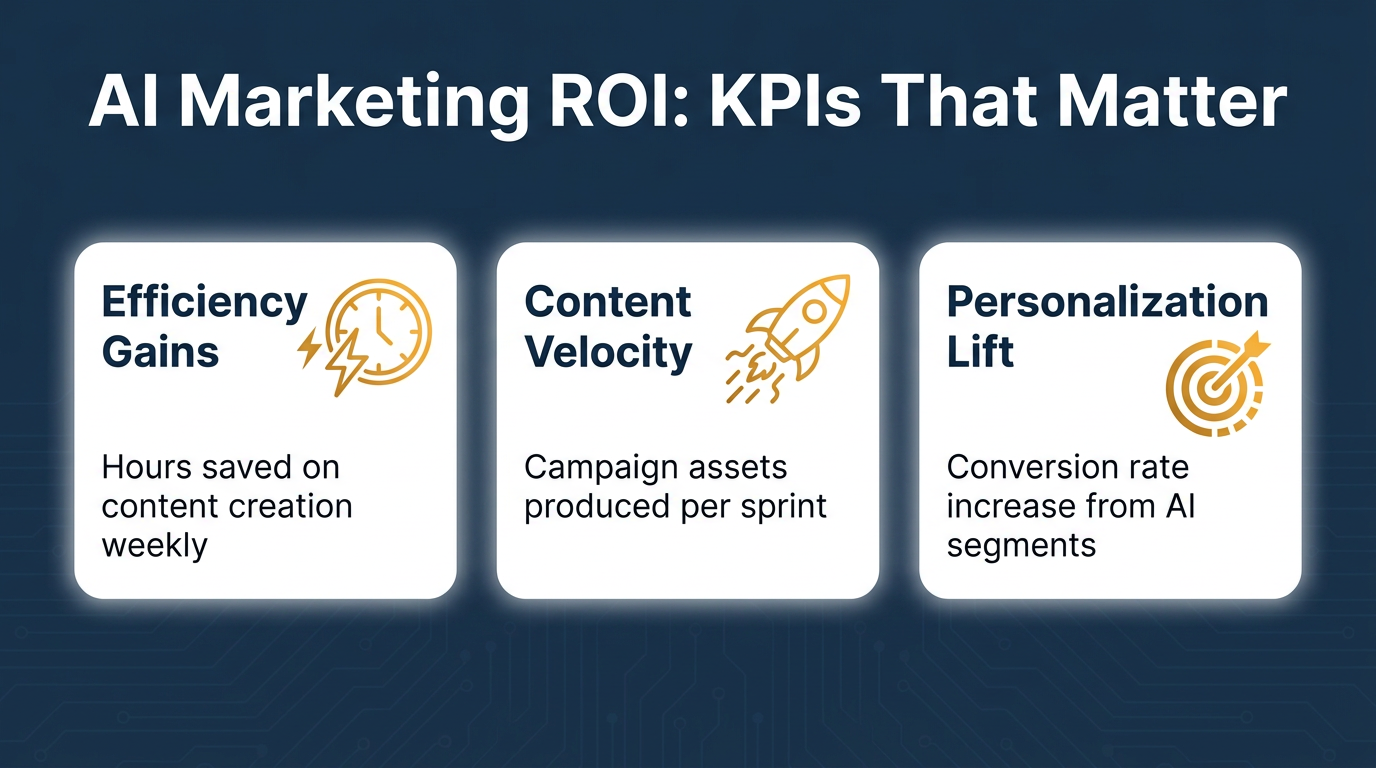
Measuring AI marketing ROI means tracking more than clicks and conversions. You need new metrics that capture speed, scale, and personalization gains. The right framework shows exactly where AI is creating value and where it isn't.
New KPIs Built for AI Marketing
Traditional metrics like impressions and click-through rates don't tell the full AI story. You need KPIs that reflect what AI actually changes.
Here are three to start with:
- Efficiency Gains: Hours saved on content creation each week. Track time from brief to published piece before and after AI adoption.
- Content Velocity: Number of campaign assets produced per sprint. More output with the same team size is a direct AI dividend.
- Personalization Lift: Conversion rate increase from AI-driven audience segments versus generic campaigns.
According to McKinsey's analysis of AI marketing workflows, AI-influenced revenue and personalization depth are now among the most important metrics for connecting AI investment to real business outcomes.
Attribution Models That Isolate AI Impact
Attribution is tricky when AI touches multiple parts of the funnel. Multi-touch attribution models work best here. They distribute credit across every AI-assisted touchpoint rather than giving it all to the last click.
Data-driven attribution goes further. It uses machine learning to weight each interaction based on actual conversion patterns. This approach helps isolate which AI initiatives are genuinely moving the needle.
A Simple ROI Framework for Any New AI Tool
Before adding a tool, run this quick checklist:
- What specific problem does this tool solve?
- How will you measure success in the first 30 days?
- What's the time or cost saved versus current process?
- Does it integrate cleanly with your existing stack?
- What's the cost if results don't improve?
For financial modeling and ROI calculations, the Growth Channel AI marketing whitepaper includes real company benchmarks. HelloFresh achieved a 68% conversion rate in one AI-powered campaign. Nestlé drove 84,000 additional page views through AI hyper-targeting. Those numbers give you a realistic baseline for setting your own targets.
Start measuring before you launch any AI initiative. Baseline data makes the ROI case much easier to prove later.
Real-World AI Marketing ROI Examples
HelloFresh achieved a 68% conversion rate in a holiday campaign powered by AI personalization. Nestlé Toll House drove 84,000 additional page views through AI hyper-targeting. These results demonstrate that when AI tools are properly integrated into workflows and guided by strategic marketers, the ROI compounds quickly—often showing measurable gains within 30-90 days of implementation.
Navigating the Ethical Landscape of AI in Marketing
Using AI in marketing comes with real responsibilities. The decisions your AI systems make, from who sees your ads to how your content gets personalized, have consequences for real people. And getting this wrong doesn't just create compliance headaches. It can seriously damage customer trust.
The Three Ethical Pillars
Three principles should anchor every AI marketing team's ethical approach.
Transparency means being open about when and how AI is involved in your marketing. Customers deserve to know when they're interacting with AI-generated content or personalized recommendations. Clear disclosure builds confidence rather than eroding it.Fairness means actively working to prevent algorithmic bias. Research has shown that AI ad systems can exclude older workers from job ads, or show higher-paying opportunities more frequently to men than women. Real-world AI bias examples show the reputational and legal risks of getting this wrong.Data Privacy means respecting how you collect and use customer data. GDPR and CCPA aren't optional. Consent management must be built into your workflows before AI touches any customer data.Building an Ethical AI Framework
Ethical AI doesn't happen by accident. Here are practical steps to put guardrails in place:
- Run regular bias audits on your targeting algorithms and creative outputs
- Create clear internal guidelines on approved AI use cases and disclosure standards
- Assign ownership for ethical review before campaigns launch
- Map your AI risks using a structured approach like the NIST AI Risk Management Framework, which gives marketing teams a practical structure for identifying and managing AI-related risks
Ethics as a Trust Builder
Ethical AI isn't just about avoiding fines. It's a genuine competitive advantage. Customers are paying closer attention to how brands use their data and AI systems. Teams that prioritize fairness and transparency earn loyalty that no ad spend can buy.
Start with clear guidelines. Review them often. And make ethical AI a team-wide conversation, not just a legal checkbox.
Future-Proofing Your Team: A Framework for Continuous Adaptation
AI in marketing doesn't stand still. New tools, new capabilities, and new best practices emerge constantly. The teams that stay ahead aren't the ones with the biggest budgets. They're the ones that build continuous learning into how they work every single day.
Set a 'Test and Learn' Budget
Dedicate a slice of your time and budget specifically for experimenting with new AI tools. It doesn't have to be large. Even 10% of a sprint's capacity creates space for your team to explore emerging platforms before everyone else catches on.
This budget should be protected. When deadlines pile up, experimentation is usually the first thing cut. But that's exactly when staying curious matters most. Protect the time, and the learning compounds.
Build an Internal Knowledge-Sharing System
What one person learns about a new AI tool shouldn't stay with that one person. Create simple, low-friction ways to share findings across the team.
A dedicated Slack channel for AI tool updates works well. Monthly lunch-and-learns where someone shares a quick demo or key takeaway keep everyone informed without adding meeting bloat. The goal is a living knowledge base that grows with your team.
According to Coursera's analysis of emerging marketing trends, teams that prioritize shared learning adapt faster to AI shifts than those relying on individual upskilling alone.
Reward Experimentation, Not Just Results
Culture is the hardest thing to change and the most important. If your team fears failure, they'll stop experimenting. And a team that stops experimenting falls behind fast.
Make it safe to test something that doesn't work out. Celebrate the learning, not just the win. When a failed test teaches the team something useful, that's a success worth recognizing.
Google's well-known approach of giving employees dedicated time for side projects shows how protecting space for curiosity drives real innovation. That same principle applies directly to marketing teams navigating a fast-moving AI landscape.
The teams that adapt aren't the ones waiting for the perfect tool. They're the ones building the habit of always looking for what's next.
Critical Questions for Your AI Marketing Strategy
- - Which repetitive marketing tasks in your current workflow could AI handle better, and what would your team do with the freed-up time?
- - Do your current marketing tools integrate cleanly with each other, or do they create data silos that would limit what AI can accomplish?
- - What new metrics beyond clicks and conversions should you be tracking to capture the true value of AI in your marketing operations?
- - Has your team been trained on how to use AI tools effectively, and do you have someone who can bridge strategy and AI capabilities?
- - How will you ensure your AI-driven personalization and targeting practices don't inadvertently exclude audiences or reinforce algorithmic bias?
- - What percentage of your team's time and budget are you protecting specifically for testing and learning about emerging AI tools before they become industry standard?
Conclusion: Your Next Steps to Building a Resilient AI Marketing Team
Building a modern AI marketing team comes down to one core idea: augmentation, not replacement. AI makes skilled marketers faster and smarter. It doesn't make them unnecessary. The teams that win are the ones pairing human creativity and judgment with the right tools, structures, and ethical guardrails.
Here's a simple three-step plan to get started today.
Step 1: Audit your current team's skills and tech stack. Map what your team can do now. Identify where the gaps are between current capabilities and where AI could create real value. Look honestly at your tools and ask whether they connect cleanly or create silos.Step 2: Pick one small, high-impact pilot project. Don't try to transform everything at once. Choose a single use case, like AI-assisted content drafting or automated audience segmentation, and test it properly. Measure before and after. Let the results guide your next move.Step 3: Start building your ethical guidelines and learning culture now. Don't wait until something goes wrong. Set clear standards for transparency, fairness, and data privacy. And according to Forrester's 2024 marketing outlook, teams that invest in shared learning and clear AI governance are significantly better positioned to scale AI responsibly.The marketing landscape keeps moving. Teams that embrace this change thoughtfully, with the right roles, skills, and mindset, won't just keep up. They'll lead.

A: The AI Marketing Strategist is arguably the most critical role. This person acts as the bridge between business goals and AI capabilities, ensuring technology is used purposefully to drive measurable results rather than just for the sake of innovation. They set AI-driven KPIs, select the right tool mix, and translate business goals into actionable AI use cases.
Q: Can AI replace marketers?A: No. AI is a powerful augmentation tool that handles repetitive, data-intensive tasks, freeing marketers to focus on strategy, creativity, customer relationships, and complex problem-solving. Human oversight, intuition, and brand voice remain irreplaceable in marketing.
Q: How much does it cost to build an AI marketing team?A: Costs vary dramatically. You can start small by investing in a few SaaS AI tools (a few hundred dollars per month) and upskilling your existing team. A full-scale transformation involves higher costs for specialized talent, enterprise-grade platforms, and data infrastructure. Start with a pilot project to prove ROI before scaling investment.
Q: What AI tools are best for small businesses?A: Small businesses should focus on accessible, multi-functional AI tools with user-friendly interfaces and scalable pricing. Platforms that combine content creation, social media scheduling, and basic analytics—such as AI-powered features within Canva, Semrush, or Mailchimp—are ideal starting points.
Q: How can we ensure our use of AI in marketing is ethical?A: Build a framework around three pillars: Transparency (disclose when AI is used), Fairness (regularly audit targeting and segmentation for bias), and Data Privacy (adhere to GDPR/CCPA and prioritize user consent).
Q: What's a realistic timeline for transitioning to an AI-powered marketing team?A: A phased approach is realistic. Phase 1 (1-3 months): Run a pilot and upskill a small group. Phase 2 (3-9 months): Roll out successful tools and hire for one key role. Phase 3 (9-18+ months): Achieve wider integration, optimize the tech stack, and build a culture of continuous learning.
Q: Which KPIs are most important for measuring AI marketing success?A: Beyond standard metrics, focus on: Efficiency Gains (hours saved per campaign), Content Velocity (time from idea to publish), Personalization Impact (engagement lift from AI-driven segments), and Cost-per-Acquisition Reduction (from AI-optimized spend).
Q: How do you foster a culture of experimentation with AI tools?A: Designate a protected 'test and learn' budget even if small (10% of sprint capacity works). Schedule regular informal share-outs where team members demo new tools. Celebrate learnings from failed experiments, not just successes, to reinforce that knowledge acquisition is the real goal.