
Published on: June, 3 2026 | Time to read: 25 min
What Exactly Are AI Marketing Agents?
AI marketing agents are autonomous software systems that can reason, plan, and execute multi-step marketing tasks on their own. Unlike standard AI tools that wait for your next prompt, these agents set goals, make decisions, and take action with little to no hand-holding. They're a fundamentally different category of technology.
According to AI21 Labs' definition of autonomous agents, these systems independently perceive their environment, reason about goals, plan actions, and execute tasks with minimal human supervision. That's a big leap from typing a prompt and waiting for a reply.
AI Agents vs. Standard AI Tools
Most marketers are already familiar with AI tools like content generators or chatbots. You give them a task, they complete it, and then they stop. Every action requires your input.
AI marketing agents work differently. They can receive a high-level goal like generate 50 qualified leads this week and then figure out the steps themselves. They research, write, send, track, and adjust without you guiding each move.
Think of it this way. A standard AI tool is like cruise control in a car. It holds a steady speed, but you still steer, brake, and make every decision.
An AI marketing agent is more like a self-driving car. You set the destination, and it handles the full journey, including navigating detours along the way.
Common Roles AI Agents Play in Marketing
Within a marketing workflow, agents typically fill several distinct roles:
- Researcher agents gather market data, monitor competitors, and synthesize insights
- Writer agents draft content, create ad copy variations, and produce campaign text
- Analyst agents track performance, measure results, and surface patterns in data
- Orchestrator agents coordinate the other agents, making sure tasks happen in the right order
These roles can work independently or together, depending on what your campaign needs. And they run around the clock, which is something no human team can match on its own.
AI Marketing Agents vs. Traditional Automation

Most marketing teams already use some form of automation. Tools like Zapier or HubSpot Workflows are everywhere. But there's a real difference between those tools and AI marketing agents, and understanding that difference can change how you think about your entire marketing operation.
How Traditional Automation Actually Works
Traditional automation runs on fixed rules. You set up a trigger, define an action, and the tool does exactly that one thing every time. It's essentially "if this happens, then do that."
For example: if someone fills out a form, send them a welcome email. If a contact reaches a certain lead score, notify a sales rep. These rules work great when conditions stay predictable.
But the moment something falls outside the rules you wrote, the automation stops dead. It can't adapt, reason, or figure out a better path. You have to go back in and reprogram it manually.
According to an analysis by Straive comparing AI agents to traditional automation, rule-based systems are deterministic and brittle. They handle structured data well but require constant manual updates when conditions change.
What Makes AI Agents Different
AI marketing agents flip this model entirely. Instead of following a script, you give them a goal. Something like: "increase organic traffic for this keyword cluster" or "generate 40 qualified leads this month."
The agent then figures out the steps itself. It researches, plans, executes, and adjusts based on what's actually working. It's not waiting for you to tell it what to do next.
This is what makes them goal-oriented rather than rule-driven. The agent holds the objective in mind and keeps working toward it, even as conditions shift.
Static Rules vs. Dynamic Adaptation
Here's a simple way to see the contrast:
| Feature | Traditional Automation | AI Marketing Agents |
|---|---|---|
| Logic type | Fixed "if-then" rules | Goal-driven reasoning |
| Setup | You define every step | You define the objective |
| Adaptability | None; needs reprogramming | Adjusts based on real-time data |
| Data handling | Structured inputs only | Structured and unstructured |
| Maintenance | High; manual updates required | Lower; self-improving over time |
| Task scope | Single-step actions | Multi-step, complex workflows |
Traditional automation is consistent inside its boundaries. But those boundaries are rigid. If a campaign isn't performing, the automation keeps running the same playbook regardless.
An AI agent notices the performance dip, reasons about why it might be happening, and tries a different approach. That's a fundamentally different kind of system.
Why This Matters for Marketing Teams
Marketing conditions change constantly. Audience behavior shifts. Search trends move. A rule-based system built last quarter may already be outdated today.
AI marketing agents are designed for that kind of environment. They can monitor real-time signals and adjust strategies without you having to redesign the entire workflow from scratch.
And the efficiency gains are real. According to MindStudio's research on autonomous AI agents, autonomous agents can save marketing teams 20 to 30 hours per week on routine work, which adds up fast across a full quarter.
The bottom line: traditional automation is a powerful tool for predictable, repeatable tasks. But if your marketing goals are dynamic and your campaigns need to respond to the real world, AI agents offer something B2B marketing automation simply can't match.
Key Benefits of Integrating AI Agents into Your Marketing

So why are so many marketing teams making the switch? The short answer: AI marketing agents do things that traditional tools and human teams simply can't match on their own. From saving hours every week to personalizing content for millions of users at once, the benefits stack up fast.
Massive Efficiency Gains on Complex Workflows
Marketing involves a lot of time-consuming work that doesn't require creativity. Things like pulling competitor data, building content briefs, scheduling posts, and analyzing campaign results eat up hours every week.
AI marketing agents handle these tasks automatically. You give them the goal, and they work through the steps without you managing each one. Teams using AI-powered workflows report saving 20 or more hours per week on reporting, research, lead handling, and campaign analysis alone.
That's time your team gets back to spend on strategy, creative work, and decisions that actually need a human brain.
And it's not just speed. Agents can run tasks in parallel, around the clock. A researcher agent can gather market data overnight while a writer agent prepares content drafts. By morning, work is done that would've taken a team days.
Hyper-Personalization at a Scale No Human Team Can Match
Personalization is one of the biggest drivers of conversion in modern marketing. But doing it well requires analyzing individual user behavior, preferences, and timing. At scale, that's impossible for humans to do manually.
AI marketing agents make real-time personalization possible for thousands or even millions of users. They analyze data points like browsing history, purchase behavior, and engagement patterns. Then they tailor content, offers, and messaging for each person automatically.
The results are real. Research on AI-powered marketing tools shows businesses can see conversion rate boosts of 15% or more when AI handles personalization and messaging decisions at scale.
This kind of precision used to require a massive team. Now it takes a well-configured agent.
Smarter Data Analysis Running 24/7
One of the biggest competitive advantages AI marketing agents offer is what they do with data. Most marketing teams are sitting on mountains of it, but don't have the bandwidth to analyze it all in real time.
Agents don't have that problem. They monitor performance metrics, spot patterns in audience behavior, and flag opportunities as they happen. Not once a week in a Monday report. Continuously.
According to IBM's overview of AI agents in marketing, analyst agents can process both structured data like conversion rates and unstructured data like customer feedback to surface insights that human analysts would likely miss or catch too late.
That means you're not just reacting to what happened last week. You're acting on what's happening right now, with a system that never sleeps and never stops looking for the next opportunity.
Practical Use Cases for AI Marketing Agents
Knowing what AI marketing agents are is one thing. Seeing exactly where they fit into real marketing work is another. Here are three of the most impactful ways teams are putting these agents to work right now.
SEO and Content Strategy
SEO is one of the most research-heavy jobs in marketing. You've got keyword research, competitor analysis, content gap reviews, and outline creation. Done manually, that work takes days every week.
An AI marketing agent can handle all of it in a fraction of the time. It crawls search results, maps competitor content, identifies gaps in your current coverage, and builds optimized article outlines automatically.
The agent doesn't just pull data either. It reasons about which keywords match your goals, which content angles are underserved, and what structure will perform best. That's a level of analysis that would take a dedicated SEO strategist hours to replicate.
And because the agent runs continuously, it catches shifts in search trends before they become problems. You're not reviewing data once a month. You're acting on fresh intelligence every day.
Paid Campaign Management
Managing paid ads across multiple platforms is exhausting. Bids need adjusting, budgets need reallocating, and ad copy needs testing constantly. Most teams can't keep up with the pace that effective paid media requires.
AI marketing agents take on this work directly. They monitor performance metrics in real time across platforms, adjust bids based on performance goals, and move budget toward the creatives and audiences that are actually converting.
They also run A/B tests automatically. Instead of waiting for a human to notice that one headline is outperforming another, the agent detects the pattern and shifts spend right away.
Research on AI-driven lead generation and conversion shows that businesses using AI-powered tools for intent analysis and campaign optimization report an average 35% increase in conversion rates. That's a real lift from removing the lag between insight and action.Personalized Email Nurturing
Standard drip campaigns send everyone the same emails on the same schedule. They feel generic because they are generic. A prospect who just viewed your pricing page gets the same email as someone who downloaded a top-of-funnel guide.
AI marketing agents change this entirely. They analyze each user's on-site behavior, including what pages they visited, how long they stayed, and what content they engaged with. Then they craft email sequences tailored to that specific person's signals.
Someone deep in the consideration phase gets content that addresses objections and highlights proof points. Someone just discovering you gets educational material that builds trust. The right message goes to the right person at the right time, automatically.
According to research from the Academy of Continuing Education on AI marketing metrics, personalized AI-driven email campaigns consistently outperform static drip sequences on open rates, click-throughs, and downstream conversions. The gap widens the larger your contact list gets.
This kind of dynamic nurturing used to require a large team and lots of manual segmentation. Now it runs on its own, getting smarter with every interaction. For teams looking to implement this approach, AI email automation provides the foundation for these personalized workflows.
Real-World Example: SEO Content Research Agent Workflow
A marketing team assigns a Researcher Agent the objective: "Analyze the top 10 competitors for 'AI marketing agents' and produce a report on their main value propositions and content gaps." The agent autonomously browses search results, reads top-ranking articles, scans competitor pages, and synthesizes patterns—work that would take a dedicated SEO strategist half a day. It delivers a structured report clearly mapping what competitors emphasize, where content gaps exist, and where the team has room to differentiate. This report then feeds directly to a Writer Agent with the objective: "Using the research report, write a 1500-word blog post outline targeting the identified content gaps." The Writer Agent picks up seamlessly, reads the structured research, identifies which gaps need filling, and builds a detailed outline with H2/H3 headers, key points, and suggested angles—producing a ready-to-use content blueprint in minutes that a human writer can execute immediately. Together, these agents compress 1-2 days of manual research and planning into hours, with the human team then applying creativity and strategic judgment to the final execution.
Building Your First AI Marketing Agent Team: A Framework
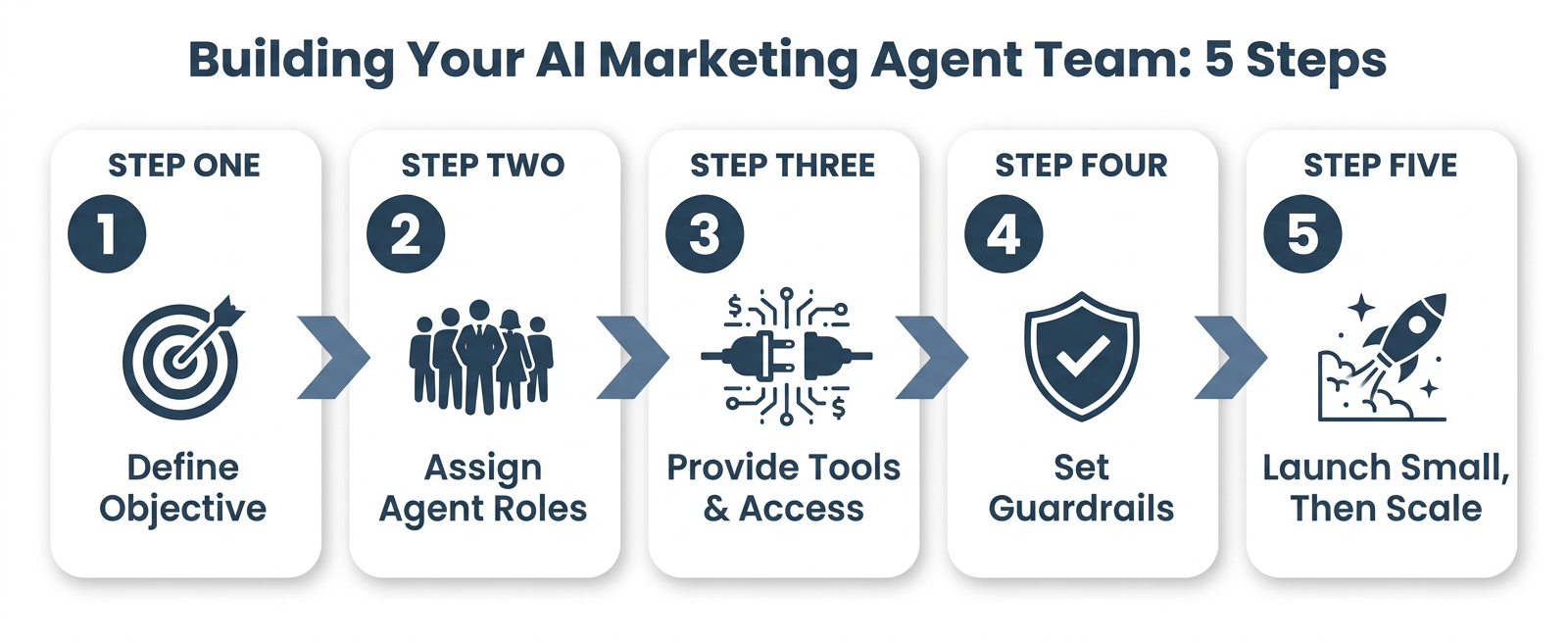
Think of your AI marketing agents like a human marketing team. Each agent has a specific job, a defined role, and a clear lane to work in. When you set it up this way, the whole system runs smoother and gets better results than one generalist tool trying to do everything.
The good news is you don't need a computer science degree to build this. You need a clear plan.
Step 1: Define a Clear, Measurable Objective
Before you assign a single agent, get specific about what you want to achieve. Vague goals like "get more leads" won't work. Your agents need clear targets.
Good examples look like this: generate 60 marketing qualified leads per month, increase organic blog traffic by 25% in 90 days, or reduce cost per click on paid campaigns by 20%. Measurable objectives give your agents something concrete to optimize toward.
According to Dataiku's guide on building agentic workflows, one of the most common setup mistakes is starting with ambiguous goals. Teams that define precise, outcome-based targets from the start see significantly better results from their agent systems.
Step 2: Assign Specific Agent Roles
Once your objective is locked in, assign roles like you'd staff a team. Here's a simple model that works for most marketing operations:
| Agent Role | Primary Job |
|---|---|
| Researcher Agent | Gather market data, monitor competitors, find content gaps |
| Writer Agent | Draft content, create ad copy, write email sequences |
| Analyst Agent | Track performance metrics, spot trends, surface insights |
| Orchestrator Agent | Coordinate the other agents, manage task order and timing |
Each agent does one job well. The orchestrator ties them together so nothing falls through the cracks.
Step 3: Provide the Right Tools and Access
Agents need access to do their work. A researcher agent needs access to web search tools and analytics data. A writer agent needs your brand guidelines and past content samples. An analyst agent needs your campaign dashboards and CRM data.
Think of this like onboarding a new hire. You wouldn't hand someone a job description and then lock them out of every system they need. Set up the right connections so each agent can actually execute its role.
Step 4: Set Guardrails and Human Review Points
This step is critical and easy to skip. Guardrails define what your agents can and can't do without a human checking first.
For example: an agent can draft content, but a human approves it before publishing. An agent can adjust ad bids within a set range, but can't reallocate budget across campaigns without approval.
Vellum AI's framework for agentic workflows recommends starting with tighter guardrails and expanding agent autonomy gradually as you build trust in the system. That's smart advice for any team getting started.Build in at least one human review point per major task type. This keeps you in control while still getting the efficiency benefits.
Step 5: Launch Small, Then Scale
Don't try to automate everything on day one. Pick one workflow, run it with your agent team for two to four weeks, and measure what happens.
See where the agents perform well and where they need adjustment. Tweak the instructions, update the guardrails, and then expand to the next workflow.
This approach keeps risk low and lets your team build confidence in the system. And as your agents accumulate data and feedback, they get more effective over time.
Want to know which platforms make it easiest to build and deploy these agent teams? Look for our upcoming guide on the top AI agent platforms for marketers, covering the tools best suited for teams at every level of technical experience.
Example Role: The Market Research Agent
Let's make this concrete with a real example. Say you give an AI marketing agent this objective: Analyze the top 10 competitors for 'AI marketing agents' and produce a report on their main value propositions and content gaps.
The agent gets to work on its own. It browses the web, reads the top-ranking articles, scans competitor pages, and pulls patterns from the search results. No one is guiding each step.
It then synthesizes everything into a structured report. You get a clear breakdown of what competitors are saying, where the content gaps are, and where you have room to stand out. Work that would take a skilled researcher half a day is done in minutes.
That's the core value of a researcher agent. It doesn't just collect data. It reasons about what the data means and delivers something you can actually use.
Example Role: The Content Creation Agent
Now let's look at the writer agent in action. Say the objective is: Using the research report, write a 1500-word blog post outline targeting the identified content gaps.
The content creation agent picks up right where the researcher left off. It reads the structured report, identifies which gaps need filling, and builds a detailed outline complete with H2 and H3 headers, key points for each section, and suggested angles.
No blank page. No guesswork. Just a ready-to-use content blueprint your writer can run with immediately.
Key Questions to Ask When Implementing AI Marketing Agents
- Does your team have a clear, measurable objective defined before assigning any agents, or are you starting with vague goals like 'get more leads'?
- Have you identified the specific repetitive and complex tasks where agent autonomy will deliver the most ROI—and are you starting with a focused pilot rather than trying to automate everything at once?
- What guardrails and human review points will you implement to maintain control while still capturing efficiency gains, and how will you gradually expand agent autonomy as trust builds?
- Do you have access to the necessary data, tools, and integrations (analytics platforms, CRM systems, content libraries, web search) that your agents will need to execute effectively?
- Which agent-specific KPIs (Autonomous Task Completion Rate, Time-to-Goal Achievement, Cost Per Autonomous Outcome) will you track, and how do these connect to business metrics your leadership already cares about?
- What ethical safeguards—including bias audits, data privacy compliance, explainability checks, and content quality reviews—are you building into your agent system from the start?
How to Measure the ROI of Your Autonomous Marketing Efforts
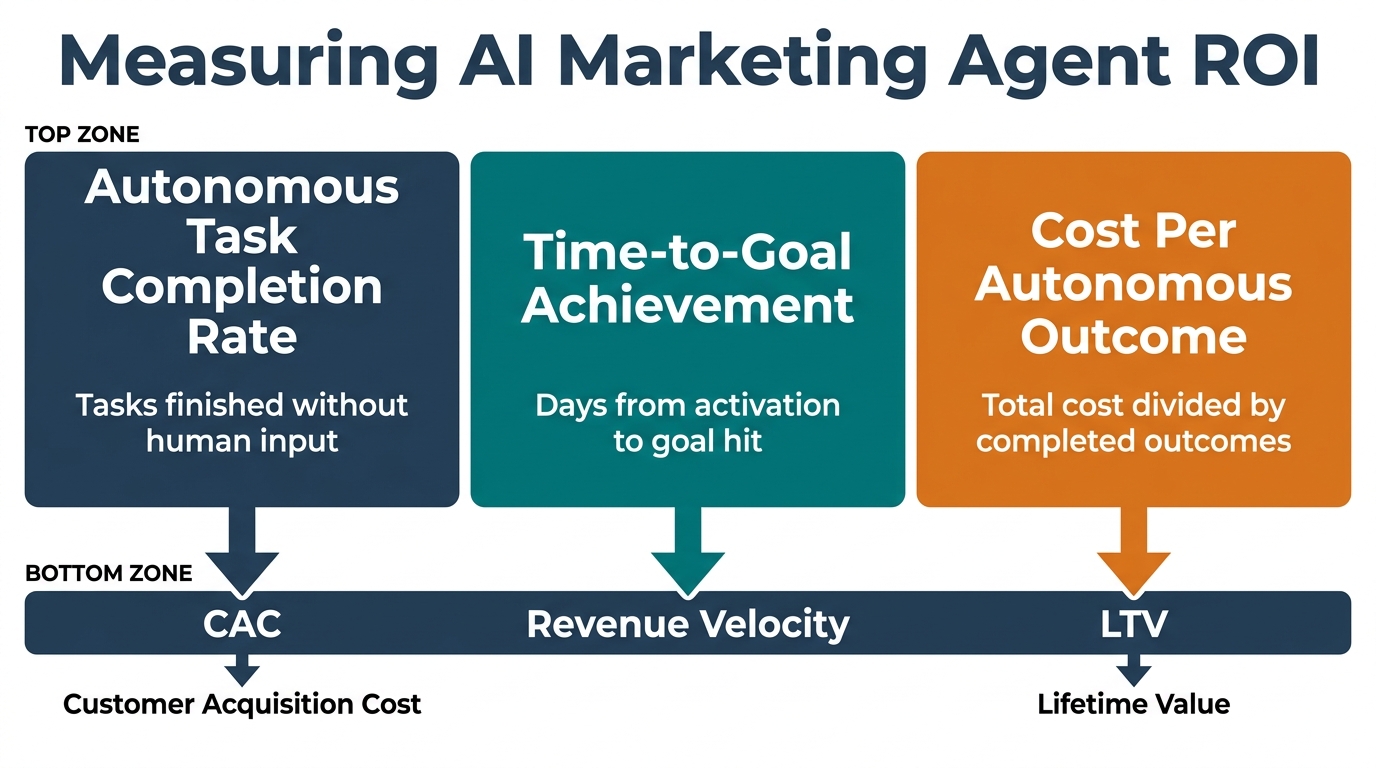
Measuring ROI on AI marketing agents isn't like measuring a simple ad campaign. These systems work across multiple channels, run continuously, and affect outcomes in ways that don't always trace back to a single action. You need a new set of metrics built specifically for autonomous work.
New KPIs Built for Agent Performance
Traditional marketing metrics don't capture what agents actually do. Here are three agent-specific KPIs worth tracking from day one:
Autonomous Task Completion Rate measures how often an agent finishes a task from start to finish without human intervention. A high rate means your agents are working independently as intended. A low rate signals gaps in setup or access.Time-to-Goal Achievement tracks how long it takes an agent system to hit a defined target. Think of it like cycle time for your marketing goals. Shorter cycles mean faster results and better competitive positioning.Cost Per Autonomous Outcome divides total agent operating costs by the number of completed outcomes. An outcome could be a qualified lead generated, a published article, or a completed A/B test. This metric makes agent efficiency tangible.According to Aquiva Labs' guide on measuring AI agent ROI, early adopters who track these performance indicators alongside financial outcomes report 200 to 500 percent ROI in year one, with results improving as systems mature.
Connecting Agent Metrics to Business Outcomes
These new KPIs only matter when tied to numbers your leadership already cares about. Here's how they connect:
- Autonomous Task Completion Rate links to Customer Acquisition Cost (CAC). More tasks completed without human help means lower labor cost per acquired customer.
- Time-to-Goal Achievement links to revenue velocity. Faster campaign cycles mean faster pipeline movement.
- Cost Per Autonomous Outcome links to Lifetime Value (LTV). When you generate better-fit leads at lower cost, LTV improves over time.
A Simple ROI Report Template
Here's a starter template combining traditional marketing metrics with agent-specific indicators:
| Metric Category | Metric | How to Measure |
|---|---|---|
| Agent Performance | Autonomous Task Completion Rate | Tasks completed without human input / total tasks assigned |
| Agent Performance | Time-to-Goal Achievement | Days from agent activation to goal hit |
| Agent Performance | Cost Per Autonomous Outcome | Total agent cost / number of completed outcomes |
| Traditional Marketing | Customer Acquisition Cost (CAC) | Total spend / new customers acquired |
| Traditional Marketing | Conversion Rate | Leads converted / total leads |
| Financial Impact | ROI | (Net Benefits - Total Costs) / Total Costs × 100% |
Run this report monthly for the first quarter. You'll spot patterns quickly and know exactly where to adjust your agent setup for better returns.
The Future of Marketing: Ethical Considerations and Challenges
AI marketing agents are powerful. But with that power comes real responsibility. As these systems take on more autonomy, marketing teams need to think carefully about data privacy, content accuracy, transparency, and the people whose roles are changing fast.
Data Privacy and the Risk of Manipulation
AI agents rely on data. The more data they have, the better they personalize. But there's a line between helpful personalization and manipulation.
When an agent knows a user's browsing history, purchase patterns, and emotional triggers, it can craft messages designed to exploit vulnerabilities rather than genuinely serve the customer. That's not a hypothetical. It's a real risk that needs governance from day one.
Data privacy laws like GDPR and CCPA already apply to how your agents collect and use personal information. But compliance is just the floor. UNESCO's Recommendation on AI Ethics pushes further, calling for proportionality and human rights protections in how AI systems interact with people. That applies to marketing too.
The Black Box Problem
Another challenge is that AI agents don't always explain themselves. An agent might shift budget away from one audience segment and you won't know exactly why. That's the "black box" problem.
When a human marketer makes a bad call, you can ask them to walk you through their reasoning. With an agent, that explanation isn't always available. The NIST AI Risk Management Framework identifies explainability as a core trustworthiness characteristic for any AI system, alongside fairness, safety, and accountability.
Building in human review points, as covered earlier in the framework section, directly addresses this. Don't skip them.
Bias in AI-Generated Content
AI agents can generate inaccurate or biased content if they're trained on skewed data or given poor instructions. A writer agent might consistently favor certain demographics in ad copy. An analyst agent might surface patterns that reflect historical bias rather than real opportunity.
Regular audits of agent outputs help catch this early. Set a cadence for reviewing what your agents produce and flag patterns that don't reflect your brand values or your audience fairly.
How Marketing Roles Are Evolving
None of this means marketers are being replaced. It means the job is changing in a meaningful way.
Routine tasks like campaign setup, report pulling, and content scheduling are moving to agents. According to research from Averi AI on the future of marketing roles, the marketing manager role is shifting toward strategic orchestration, AI governance, and creative direction rather than task execution.
That's actually a better job. You spend less time on spreadsheets and more time on strategy, brand vision, and the kind of creative thinking agents can't replicate.
The marketers who thrive in this shift will be the ones who learn to direct agents well, set smart guardrails, and bring the human judgment that no system can replace. If you want to explore how these shifts are reshaping specific roles and career paths, check out our article on the future of marketing jobs for a deeper look at what's coming next.
Your Next Steps into Autonomous Marketing
AI marketing agents aren't just another tool to add to your stack. They represent a genuine shift in how marketing gets done, moving your team from reactive task execution to proactive, goal-driven strategy. That's a fundamentally different way of working.
The teams winning right now aren't the ones with the biggest budgets. They're the ones who started early, ran small pilots, and built confidence in their agent systems before scaling up.
Here's where to begin:
- Pick one repetitive, complex task in your current workflow. Competitor reporting, content briefs, and lead scoring are all strong starting points.
- Research one AI agent platform that fits your team's technical comfort level and existing tools.
- Run a focused pilot with a clear, measurable goal. Something like: reduce competitor reporting time by 50% in 30 days. Track it closely.
According to MIT Sloan's explainer on agentic AI, the teams that see the strongest results are those that start with well-scoped, high-repetition workflows before expanding agent autonomy. Start small. Learn fast. Then scale what works.
The shift toward autonomous marketing is already happening. The question isn't whether AI agents will reshape this industry. It's whether your team will help lead that change or scramble to catch up later.
Ready to take the next step? Building a comprehensive AI marketing strategy is essential before implementing agents, and our team can help you see what's possible for your specific workflow.

A: An SEO Content Agent exemplifies this. You give it a target keyword and goal like "achieve a top 5 ranking." The agent autonomously performs competitor analysis, researches search engine results pages, generates optimized content briefs, potentially writes the draft, and suggests internal linking strategies—all without step-by-step commands. This demonstrates how agents independently reason through multi-step workflows to achieve defined objectives.
Q: Can AI agents replace marketing teams?A: No, AI agents are force multipliers, not replacements. They automate data-intensive and repetitive tasks like campaign setup, reporting, and content scheduling, freeing marketers to focus on higher-level strategy, creativity, brand building, and customer relationships—areas requiring human nuance and emotional intelligence that agents cannot replicate.
Q: Are AI marketing agents expensive?A: Costs vary widely depending on the platform and implementation. Some offer agent-like features within existing subscriptions, while dedicated autonomous systems may have higher costs. The key ROI metric is productivity gains: if an agent saves 20 hours of manual work per week, the value typically far outweighs operational costs, with early adopters reporting 200-500% ROI in year one.
Q: How do you build an AI marketing agent?A: Most marketers won't build agents from scratch with code. Instead, they use low-code/no-code platforms where they assemble agents by defining the goal, providing access to necessary tools (browsers, APIs, data sources), and setting operational constraints and guardrails for autonomy limits.
Q: What skills do marketers need for the AI agent era?A: Marketers need AI orchestration skills including strategic thinking to set clear goals, prompt engineering to guide agents effectively, data analysis to interpret outputs, and ethical judgment to ensure responsible AI use. These skills shift focus from task execution to strategic direction and governance.
Q: How do AI agents handle creativity in marketing?A: AI agents excel at convergent creativity—synthesizing existing information to generate novel content variations and ad copy. However, divergent creativity—conceiving groundbreaking campaign ideas or brand narratives—still relies on human insight, cultural understanding, and emotional depth. The optimal approach combines human-AI collaboration where agents enhance human creative direction.