Published on: June 8, 2026 | Time to read: 25 min
What Does It Mean to Humanize AI?
To humanize AI means to design AI systems that understand and respect human needs, emotions, and values. It's not just about making a chatbot sound friendly. It's about building technology that feels like a helpful, trustworthy partner. Think of it as the difference between a tool that works and a tool that genuinely gets you.
It Goes Deeper Than Conversation
Many people assume humanizing AI just means giving it a warm tone or a name. But that's only the surface. True humanization is about embedding empathy, context-awareness, and real values into how AI systems think and respond.
According to Stanford's Human-Centered AI initiative, the goal is for AI to augment human abilities and address real human needs, not simply mimic human speech patterns. That's a much bigger idea than just sounding conversational.
Human-Like vs. Humanized: What's the Difference?
This is a distinction that matters a lot. "Human-like" AI focuses on mimicking human behavior, using natural language, showing personality, maybe even cracking a joke. "Humanized" AI goes further. It understands context, respects emotions, and keeps human wellbeing at the center of every interaction.
Experts at Nielsen Norman Group point out that adding humanlike qualities without genuine context-awareness can actually mislead users. False empathy can do more harm than a straightforward, functional response.
Making Technology Feel Like a Partner
The real goal of humanizing AI is simple to say but hard to achieve. It's about making people feel heard, respected, and supported when they interact with a system.
A cold, impersonal AI might answer your question correctly. But a humanized AI answers it in a way that fits your situation, your emotional state, and your actual needs. That shift from "correct" to "genuinely helpful" is what separates functional AI from humanized AI.
And that shift matters more than ever, as AI shows up in healthcare, customer service, education, and daily life.
Why Humanizing AI Is a Non-Negotiable Business Strategy
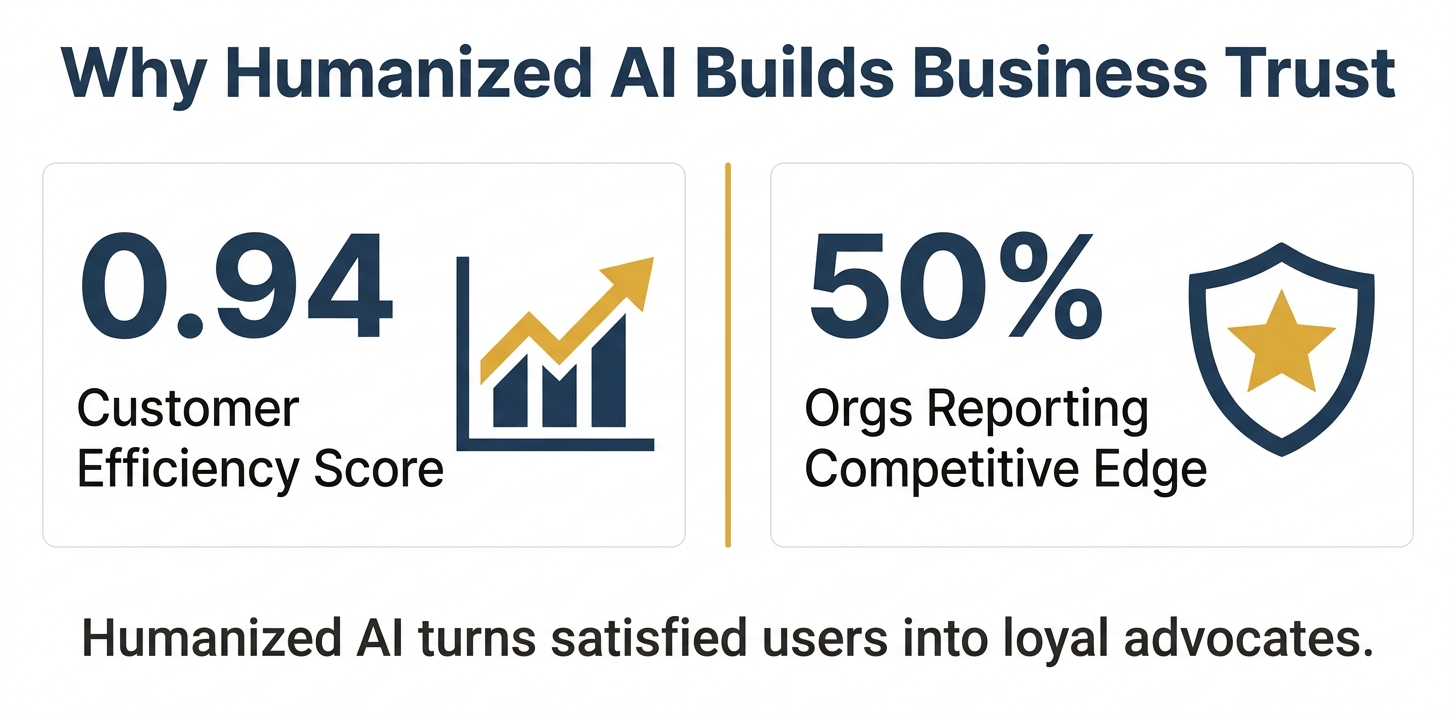
Businesses that humanize AI don't just create better products. They build stronger relationships with customers and employees. When AI feels helpful and understanding rather than cold and robotic, people trust it more, use it more, and stick around longer. That's not a soft benefit. It's a real competitive edge.
The Trust Factor: Why It Drives Customer Loyalty
Customer trust is everything. And the way AI interacts with people directly shapes how much trust a brand earns.
Research published in the ACR Journal on AI and customer loyalty found strong links between AI service quality and customer satisfaction, with satisfaction and perceived efficiency scores reaching 0.92 and 0.94 respectively on a path coefficient scale. Those are remarkably high numbers.
When AI feels respectful and responsive, customers don't just feel satisfied. They feel valued. That emotional connection is what turns one-time buyers into loyal advocates.
Humanized AI as a Brand Differentiator
In a crowded market, product features alone won't set you apart. But a genuinely helpful AI experience? That's harder to copy.
According to McKinsey's State of AI report, nearly half of surveyed organizations reported improved customer satisfaction and competitive differentiation as direct outcomes of AI investment. That's a meaningful signal.
Companies that invest in humanized AI experiences tend to create something competitors can't easily replicate: a distinct brand feeling. Users remember how a product made them feel, not just what it did.
Reducing Friction for Employees and Customers Alike
Humanized AI doesn't just help customers. It also makes internal tools easier for employees to adopt and actually use.
When AI tools feel intuitive and conversational, workers spend less time fighting the system and more time doing their jobs. That reduces friction at every level. For customer-facing tools, the effect is similar. People are more likely to complete a task when the AI guides them clearly and calmly instead of confusing them.
According to Forrester's generative AI research, organizations see the clearest AI ROI through metrics like faster task completion, lower support costs, and higher user retention. All of those outcomes trace back to one thing: making AI easier and more natural to work with.
And that ease starts with making AI feel more human.
The Core Principles of Human-Centered AI Design
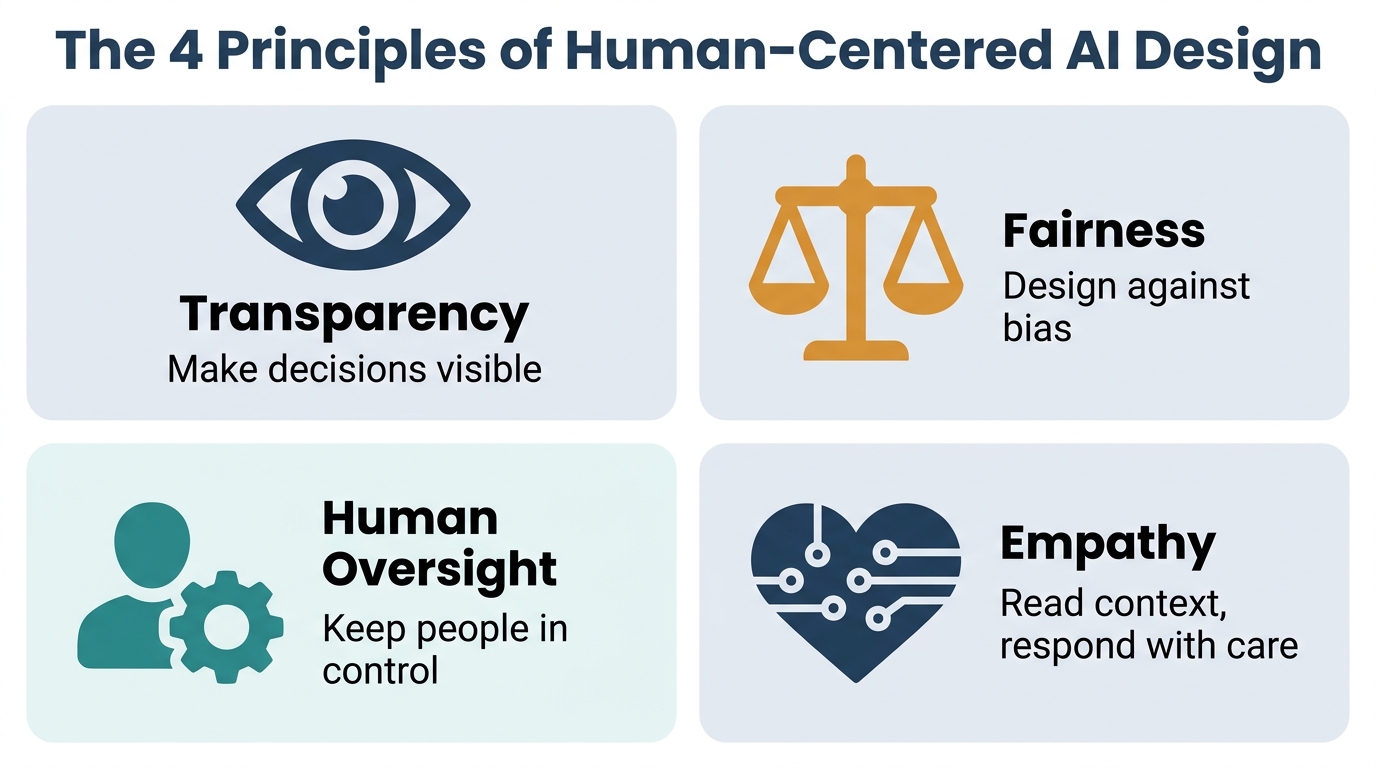
Human-centered AI design is built on a set of guiding principles that put people first at every step. These aren't just features to check off a list. They're a philosophy for building AI that earns trust, respects people, and genuinely helps.
Transparency: Let People See What's Happening
Users need to understand what an AI is doing and why. When AI decisions feel like a black box, trust breaks down fast.
Carnegie Mellon's Software Engineering Institute describes explainability as the ability to answer stakeholder questions about how an AI system makes decisions. That kind of clarity helps users feel informed rather than confused or manipulated.Fairness: Design Against Bias
A humanized AI has to treat everyone equitably. Bias in AI isn't just a technical problem. It's a human one.
Amazon's AI hiring tool is a well-known example. The system showed bias against women because it learned from historically male-dominated hiring data. Amazon ended up scrapping it entirely. According to PwC's analysis of algorithmic bias, unchecked bias erodes user trust and creates real harm. Fairness has to be built in from the start, not added later.
Human Oversight: Keep People in Control
Humanized AI supports human judgment. It doesn't replace it.
IBM's Responsible AI framework highlights human agency as a core pillar of trustworthy AI. People should always be able to review, override, or escalate what an AI decides. This isn't just about safety. It's about dignity.Empathy and Context Awareness
A system can be accurate without being helpful. Humanized AI reads context and responds in a way that fits the moment.
That means adapting tone, recognizing emotional signals, and offering responses that feel appropriate rather than generic. It's what separates an AI that answers questions from one that actually understands them.
These principles work together. Transparency builds confidence. Fairness builds respect. Human oversight builds safety. And empathy builds connection. Together, they make AI feel less like a machine and more like a trustworthy partner.
1. Empathy and Emotional Intelligence
To humanize AI, you have to start with empathy. That means building systems that can read how a person is feeling and respond in a way that fits the moment. It's not just about being polite. It's about making interactions feel real.
Sentiment analysis is one of the key tools here. It helps AI detect emotional cues in text or voice, like frustration, confusion, or excitement, and then adjust its response accordingly. A stressed user gets a calmer, simpler reply. An excited one gets a more enthusiastic tone.
But tone is only part of it. Word choice matters a lot too. Short, clear sentences work better when someone is overwhelmed. More detailed responses help when someone is curious and wants depth.
Even small things like pauses in voice AI or the occasional well-placed emoji in chat can shift how an interaction feels. They signal that the system is aware of the human on the other end.
And that awareness pays off. According to Nextiva's customer service research, fast and relevant responses are the single biggest driver of high customer satisfaction scores in AI-supported interactions. Speed matters, but so does feeling understood.
When AI gets the emotional tone right, people don't just feel helped. They feel heard.
2. Transparency and Explainability (XAI)
Explainable AI (XAI) is the ability of an AI system to describe its decisions in ways that humans can actually understand. It turns the AI from a mysterious black box into something you can follow and verify.
Think of it this way: if an AI denies someone a loan or flags a medical concern, that person deserves to know why. A simple "the system said no" isn't good enough.
This matters most in high-stakes situations. When AI is involved in medical diagnoses, legal decisions, or financial approvals, people need to trust the process, not just the outcome. According to The Decision Lab's guide on explainable AI, XAI helps non-technical users understand AI behavior, which builds the trust and accountability that serious decisions require.
Without transparency, even a well-intentioned AI can feel threatening. And when people don't understand a system, they either stop trusting it or stop using it entirely.
XAI is also a key part of regulatory compliance. The EU AI Act, for example, requires high-risk AI systems to provide clear explanations of how they work. Transparency isn't optional anymore. It's becoming the law.
For AI to truly feel human, it needs to be honest about what it knows, what it doesn't know, and how it reached its conclusions.
3. Ethical Guardrails and Responsible AI
Ethical guardrails aren't something you add at the end. They have to be built into AI from the very beginning. That means proactively designing for fairness, security, and accountability before problems show up.
Bias doesn't always come from bad intentions. It often creeps in through training data that reflects old inequalities or blind spots. The best way to catch it early is to bring in diverse perspectives from the start.
Who builds the AI matters just as much as how it's built. A team with varied backgrounds, cultures, and lived experiences is far more likely to spot assumptions that a homogeneous group might miss entirely. Microsoft's Responsible AI principles specifically highlight inclusivity and fairness as non-negotiable foundations for trustworthy AI systems.
When you humanize AI the right way, ethics isn't a constraint. It's what makes the technology worth trusting.
A Practical Framework to Humanize Your AI Solutions
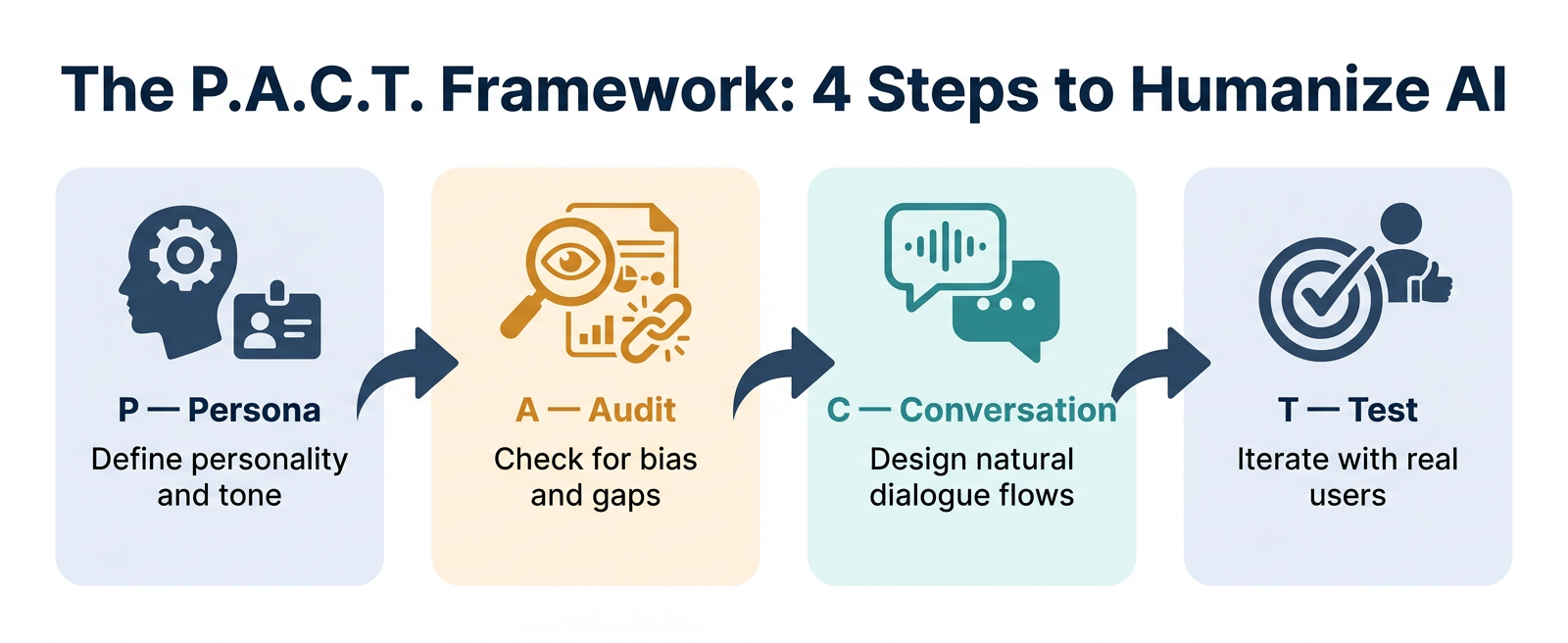
To humanize AI, follow the P.A.C.T. Framework: Persona, Audit, Conversation, Test. This four-step process gives product managers, designers, and developers a clear path from cold, functional AI to interactions that feel genuinely helpful and human.
Step 1: Define Your AI's Persona and Personality
Every AI needs a clear personality before it can feel human. A persona document works just like a brand style guide, but for your AI. It defines exactly how your AI thinks, speaks, and behaves in every situation.
Think of it as giving your AI a job description with a personality attached.
What Goes Into a Persona Document?
A solid AI persona document covers a few key things:
- Name and role: What is this AI called, and what does it do?
- Personality traits: Is it warm, witty, calm, professional, or playful?
- Tone of voice: Formal or casual? Brief or detailed?
- Do's and don'ts: What should it always say? What should it never do?
- Escalation rules: When should it hand off to a human?
Without this document, your AI's personality becomes inconsistent. Users get confused. Trust breaks down fast.
Matching Persona to Context
The right personality depends completely on your audience and purpose. A one-size-fits-all approach won't work.
Here are two quick examples:
| AI Type | Personality Traits | Tone |
|---|---|---|
| Finance AI | Professional, reassuring, precise | Calm and clear |
| Travel AI | Enthusiastic, adventurous, curious | Warm and energetic |
A finance AI that sounds like an excited travel guide would feel deeply wrong. And a travel AI that sounds stiff and corporate would kill the excitement of planning a trip.
The persona has to match the emotional context of the user's needs.
Why This Step Matters First
You can't build an empathetic, humanized AI without knowing who that AI is. Personality shapes everything that follows, from how it handles complaints to how it celebrates a user's win.
According to research from the Conversation Design Institute, conversation designers spend much of their time defining AI personas and tone before a single line of dialogue gets written. That's because getting the personality right first saves enormous time and rework later.
Start with the persona. Everything else builds from there.
Step 2: Master Conversational AI Design
Good conversational AI design goes way beyond simple question-and-answer exchanges. To truly humanize AI interactions, you need systems that manage context across a full conversation, handle interruptions naturally, and use language that feels genuinely human.
Context Is Everything
Users don't speak in neat, isolated questions. They circle back, change topics, and refer to things they said earlier. A humanized AI has to track that thread. If someone says "tell me more about the second option," the AI needs to remember what the second option was.
Without context management, conversations break down fast. Users get frustrated. Trust disappears.
The Art of Graceful Recovery
Every AI will misunderstand something. The real test of good design is what happens next. This is called "repair" in conversational design, and it matters a lot.
A well-designed AI doesn't just say "I don't understand." It asks a clarifying question, offers alternatives, or honestly acknowledges the gap. Something like: "I'm not sure I got that right. Did you mean X or Y?"
According to Balto's CSAT and NPS research, poor chatbot experiences are most often caused by bots failing to understand intent or answer questions accurately. Graceful recovery turns a frustrating moment into a trust-building one.
Small design choices like this are exactly what separate a cold, robotic experience from one that genuinely feels human.
Real-World Examples of Humanized AI in Action
Humanized AI isn't just a theory. It's already showing up across industries, changing how people experience technology every single day. From mental health support to language learning, the best examples share one thing: they make users feel genuinely understood, not just processed.
Healthcare: AI That Listens Before It Responds
One of the clearest examples of humanized AI in healthcare is the AI-powered medical scribe. Instead of a doctor typing notes during your appointment, an AI handles that in the background. The doctor can actually look at you, listen, and engage.
According to Harvard Medical School's analysis of AI in clinical settings, this kind of tool reduces the administrative burden on clinicians and creates more face-to-face interaction time with patients. That's not just a productivity win. It's a human one.
AI is also handling follow-up tasks like medication reminders and symptom check-ins between visits. These small touchpoints keep patients connected to their care team without requiring a phone call or office visit.
Mental Health: Woebot's Empathetic CBT Approach
Woebot is a well-known AI chatbot built around cognitive behavioral therapy (CBT). It asks how you're doing, tracks your mood over time, and responds with evidence-based techniques in a warm, conversational tone.
What makes it humanized isn't that it pretends to be a therapist. It's honest about what it is. But it still creates a space where users feel heard and supported between human sessions. That combination of honesty and empathy is exactly what humanized AI should look like.
Education: Duolingo's Encouraging Characters
Duolingo uses AI to personalize lessons and deliver feedback in a way that feels encouraging rather than mechanical. The app's characters react to your progress, celebrate wins, and gently nudge you back when you skip a day.
This isn't just cute design. It's a deliberate choice to make learning feel emotionally rewarding. And it works. Users return more often when the experience feels personal and supportive.
Customer Service: Context-Aware AI Assistants
In customer service, humanized AI shows up as assistants that remember your previous interactions, skip the repetitive questions, and match their tone to the situation. A frustrated customer gets a calm, solution-focused response. A curious one gets a more detailed explanation.
Healthcare Executive's coverage of patient-facing AI tools notes that AI systems communicating directly with patients between visits can strengthen the connection between clinicians and patients, all while gathering useful data in real time.Across all these examples, the pattern is the same. Humanized AI succeeds when it adapts to context, respects the emotional state of the user, and stays honest about what it is and isn't. That's the bar worth aiming for.
Real-World Example: Healthcare's AI Medical Scribe
A hospital implements an AI-powered medical scribe that drafts visit notes and summarizes patient history during appointments. Instead of typing throughout the encounter, the doctor can now look directly at the patient, listen fully, and engage meaningfully. The AI handles follow-up tasks like medication reminders and symptom check-ins between visits, keeping patients connected to care without requiring phone calls. Harvard Medical School research confirms this reduces administrative burden on clinicians while creating measurable improvements in patient experience through increased face-to-face interaction time. The AI doesn't replace the doctor's judgment—it amplifies the doctor's ability to listen and respond with genuine care.
The Rise of 'AI Whisperers': New Jobs in Human-Centered AI
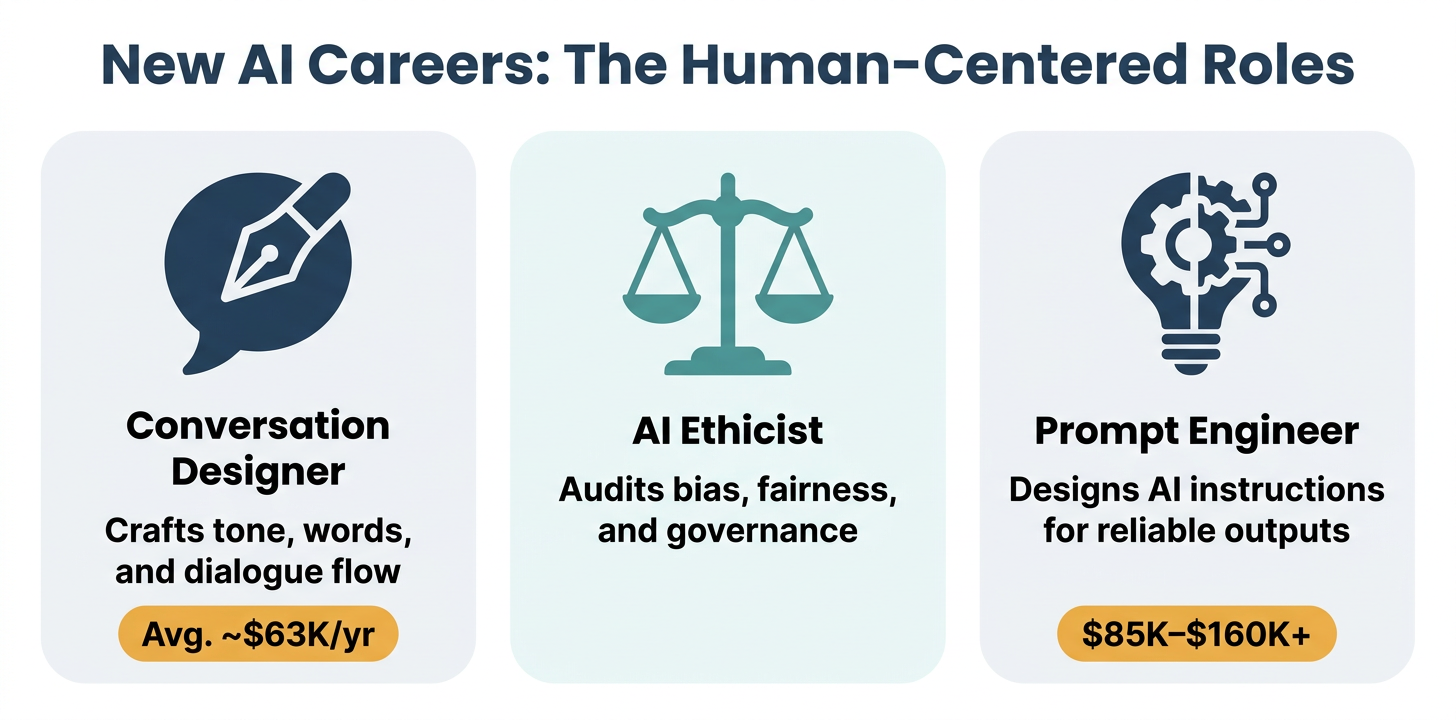
The push to humanize AI isn't just changing products. It's creating entirely new career paths. As companies invest in making AI feel more empathetic, fair, and human, they need people who understand both technology and people. That gap is opening doors for professionals from psychology, design, writing, and the humanities.
Why Human-Centered AI Needs a Different Kind of Talent
Most AI systems are built by engineers. But making those systems feel human? That takes a different skill set. You need people who understand how emotions shape communication, how bias sneaks into language, and how conversations naturally flow.
This is exactly why a new category of roles is emerging at the intersection of tech and human understanding. These aren't niche jobs anymore. They're becoming central to how AI gets built and deployed.
Three Roles Shaping the Future of AI
Conversation DesignerConversation designers craft the words, tone, and flow of AI interactions. They decide how a chatbot responds to a frustrated user, how a voice assistant handles confusion, and what personality the AI projects.
Key skills include UX writing, linguistics, empathy mapping, and an understanding of how people actually talk. According to Glassdoor's salary data for conversation designers, the average annual salary in the US sits around $62,939, with experienced designers earning well above $100,000.
AI EthicistAI ethicists audit AI systems for bias, advocate for fairness and transparency, and translate complex policy into plain language that teams can act on. According to Artisan Talent's profile of the AI ethicist role, their core daily work involves reviewing algorithms, engaging stakeholders, and advising on governance.
This role is ideal for people with backgrounds in philosophy, law, social science, or public policy.
Prompt EngineerPrompt engineers design and test the instructions that guide AI language models toward useful, reliable outputs. It's part creative writing, part logic, part quality control.
Salaries range from around $85,000 for entry-level roles to over $160,000 for senior positions, making it one of the fastest-growing and best-paid roles in AI right now.
A Real Opening for Humanities Backgrounds
Here's the exciting part. You don't need a computer science degree to land one of these roles. In fact, people with backgrounds in psychology, linguistics, communications, and design often have a natural head start.
Understanding human behavior, emotional nuance, and clear communication are skills that take years to develop. And those are exactly the skills that make AI feel human. The tech can be learned. The human instinct is harder to teach.
If you've ever thought the AI world wasn't for you, this shift says otherwise.
Overcoming the Challenges of Building Empathetic AI
Building empathetic AI is genuinely hard. And anyone who tells you otherwise is skipping the real story. There are serious obstacles that every team faces when trying to make AI feel human, and being honest about them is the first step to solving them.
The Bias Problem: Learning the Wrong Lessons
AI systems learn from human-generated data. And human data carries human history, including all its inequalities and blind spots. That means an AI can absorb bias without anyone intending it.
The Amazon hiring tool is the clearest example. The system was trained on past hiring data that skewed heavily male. It learned to penalize resumes with the word "women's" and downrank graduates from all-female colleges. Amazon shut it down.
According to Crescendo AI's analysis of real-world bias cases, bias in AI most often comes from imbalanced training data, not from deliberate design choices. That makes it harder to catch and easier to miss until real harm happens.
The Uncanny Valley: When "Too Human" Backfires
There's a well-known phenomenon in robotics and design called the "uncanny valley." When something looks almost human but not quite right, it stops feeling friendly and starts feeling unsettling.
The same thing happens with AI. An AI that mimics human speech too closely, or claims emotions it can't actually feel, can make users deeply uncomfortable. It feels dishonest. And once that trust breaks, it's very hard to rebuild.
The fix isn't to strip out all warmth. It's to be genuine. An AI can be warm, clear, and supportive without pretending to be something it's not.
The Cost of Getting It Right
Building truly empathetic AI takes real investment. Sentiment analysis, context tracking, and responsible design require skilled teams and ongoing maintenance.
According to Fullstack's analysis of generative AI ROI, roughly 80% of companies see limited returns from AI because they underestimate the ongoing work required after launch. Empathetic AI isn't a one-time build. It needs continuous testing, updating, and human review to stay trustworthy and effective.
These challenges are real. But they're also solvable with the right mindset and process.
The Future of Human-AI Collaboration
The future of AI isn't about machines replacing people. It's about people and machines working together better than either could alone. When you humanize AI, you unlock something more powerful than automation: a partnership where human creativity and AI capability combine to solve problems neither could tackle independently.
From Tool to Collaborator
For most of its history, AI has been treated like a sophisticated tool. You give it a task, it completes the task. That model is changing fast.
The new frame is collaboration. AI handles the things it's genuinely good at: processing large amounts of data quickly, spotting patterns, running simulations. Humans bring what AI can't replicate: creativity, moral judgment, emotional nuance, and the ability to ask better questions.
This shift matters because it changes how we design AI systems. Instead of asking "what can AI do instead of humans," the better question is "what can AI help humans do better?"
Symbiotic Intelligence in Practice
Think of it as symbiotic intelligence. Each side brings strengths the other lacks.
Humans excel at creative leaps, ethical reasoning, and understanding context in messy, unpredictable situations. AI excels at finding signals in noise, processing data at scale, and maintaining consistency across thousands of interactions.
The human-in-the-loop AI market reflects just how much momentum this idea is gaining. According to MarketsandMarkets research on the HITL AI sector, this market is projected to grow from $2.4 billion in 2025 to $9.9 billion by 2033, a compound annual growth rate of over 19%. That's not just investment in AI. It's investment in keeping humans central to how AI works.
Where Humanized AI Will Change Everything
Three areas stand out for how collaboration between humans and AI will reshape work and life:
Creative Arts: AI can generate drafts, suggest variations, and explore thousands of options in seconds. Human artists and writers then shape, filter, and give those outputs meaning and intention. The human is still the author. AI is the creative accelerant.Scientific Research: AI can process research papers, model complex systems, and identify patterns across datasets that no human team could review in a lifetime. Researchers then interpret findings, ask follow-up questions, and make the judgment calls that turn data into discovery.Personal Coaching: AI can track progress, notice patterns in behavior, and deliver consistent encouragement at scale. Human coaches step in for the harder conversations that require real empathy and lived experience.In each case, the humanized AI doesn't take over. It amplifies what the human brings to the table. That's the future worth building toward.
Your Next Steps to Humanize AI
Humanizing AI isn't optional anymore. It's a strategic necessity. When AI feels empathetic, transparent, and fair, people trust it more, use it more, and stay loyal to the brands that build it. That's a direct business advantage, not just a design preference.
The path to humanized AI comes down to four things working together: a clear persona, strong conversational design, ethical guardrails, and continuous testing. Skip any one of them and the experience starts to feel hollow.
Here are three concrete next steps you can take right now:
1. Audit your current AI touchpoints. Go through every place your AI talks to users. Read the responses out loud. Do they sound warm and helpful, or cold and robotic? Look for gaps in tone, empathy, and clarity.2. Assemble a multidisciplinary team. Bring together writers, designers, ethicists, and domain experts to draft your AI persona. Don't leave this to engineers alone. The best humanized AI gets built by people with varied perspectives.3. Start learning from trusted resources. The Linux Foundation's free course on Ethical Principles in Conversational AI is a practical starting point covering privacy, bias, and responsible design.The technology keeps improving. But what makes AI genuinely useful is the human thinking behind it. Start there.
Key Questions to Ask Before Building Humanized AI
- Does our AI's personality match the emotional context of what users actually need? (A finance chatbot shouldn't sound like an excited travel guide.)
- Can we clearly explain why our AI made each decision, especially in high-stakes scenarios like healthcare, lending, or legal matters?
- Who is building this AI, and do we have diverse perspectives in the room to catch blind spots and biases before launch?
- Have we explicitly defined what our AI should never do, and are those guardrails enforced in code, not just in guidelines?
- If our AI makes a mistake or doesn't understand, does it gracefully recover and ask clarifying questions—or does it shut down the conversation?
- Are we measuring success only by task completion, or also by whether users feel heard, respected, and supported?
- Have we planned for ongoing maintenance and human review, or are we assuming the AI will work the same way six months from now?
- Does our design honestly communicate what the AI is and isn't, or are we risking the uncanny valley by making it seem more human than it actually is?

A: Humanizing AI means designing systems that embed empathy, personality, and ethical principles into how they think and respond—not just making them sound friendly. It combines UX design, psychology, and technology to create AI that feels like a trustworthy partner that genuinely understands user needs, respects emotions, and acts with genuine values in mind.
Q: What is an example of humanizing AI?A: Consider a banking app's chatbot. A basic bot answers balance questions mechanically. A humanized bot detects that you sound stressed from your phrasing, uses a reassuring tone, and proactively asks if you'd like to review recent transactions for peace of mind. Real-world examples include Woebot, which uses evidence-based CBT techniques in a warm conversational tone for mental health support, and Duolingo's AI characters that celebrate your wins and gently encourage you to return.
Q: Why is it important to humanize AI?A: Humanized AI builds user trust, which directly leads to higher adoption rates and customer loyalty. Research shows strong correlations (0.92-0.94) between humanized AI service and customer satisfaction. It also creates a better user experience that reduces frustration, and serves as a powerful brand differentiator in a competitive market where features alone won't set you apart.
Q: Can AI truly feel emotions?A: No. Current AI does not have consciousness or feelings. It uses advanced pattern recognition (like sentiment analysis) to identify human emotions in text or speech and respond in a pre-designed, empathetic way. AI simulates understanding emotions through learned patterns—it doesn't experience them.
Q: How do you measure the success of a humanized AI?A: Success is measured through both quantitative and qualitative metrics. Quantitative: task completion rates, user retention, reduced escalations to human agents, CSAT/NPS scores. Qualitative: user feedback, sentiment analysis of conversations, and usability testing focused on emotional response and perceived trust.
Q: What's the difference between AI personalization and humanization?A: Personalization is about 'what'—customizing content based on user data (e.g., Netflix recommendations). Humanization is about 'how'—delivering that content with an appropriate tone, empathy, and conversational style that respects context and emotional state. They work together: personalization provides the right information, humanization delivers it in the right way.