
Published on: May 19, 2026 | Time to read: 19 min
AI marketing tools are no longer optional—they're essential for staying competitive. These tools automate repetitive tasks, enable hyper-personalization, and provide deeper insights, allowing teams to focus on strategy and creativity. With 80% of marketers already using AI and the market projected to reach $82 billion by 2030, businesses that don't adopt this technology risk falling behind.
Key Takeaways
- AI marketing tools automate repetitive tasks like data entry and reporting, freeing teams to focus on strategic and creative work
- Hyper-personalization powered by AI can generate 40% more revenue than average, creating one-to-one marketing experiences at scale
- An integrated AI marketing stack (tools working together) creates unified workflows and prevents data silos, maximizing efficiency gains
- Different AI tools serve different purposes: content creation, SEO optimization, email personalization, and predictive analytics
- ROI measurement must go beyond vanity metrics and focus on business outcomes like Cost Per Acquisition and Customer Lifetime Value
- Human expertise remains essential—AI is a tool to augment marketers, not replace them
- Successful implementation starts small by solving one specific pain point before expanding to other areas
Table of Contents
- Why AI Marketing Tools Are No Longer a Luxury
- Unlock Growth with AI-Powered Marketing
- The Top AI Marketing Tools by Category
- Beyond the List: Building an Integrated AI Marketing Stack
- Measuring the ROI of Your AI Marketing Investment
- Conclusion: Your Next Step in AI-Powered Marketing
AI marketing tools use smart technology to help automate and improve marketing work. They are no longer a luxury because they move teams away from slow, manual tasks to faster, data-driven strategies. Businesses that don't adopt this technology risk falling behind in efficiency, personalization, and understanding their customers.
Why AI Marketing Tools Are No Longer a Luxury
This isn't just a passing trend. The shift from manual work to automated strategies is happening right now across the industry. Teams are trading repetitive tasks like data entry and basic reporting for more strategic work. This allows them to focus on creativity and planning instead of getting stuck in day-to-day busywork.
And the numbers back this up. Wyzowl's 2024 look at AI in marketing shows that 80% of marketers have already used AI tools to help create content. This widespread adoption shows these tools are becoming a standard part of the modern marketer's toolkit. They are now fundamental for staying competitive.
The financial investment in this space tells a powerful story. The market for AI in marketing is expected to grow dramatically. In fact, projections from Grandview Research show the industry could be worth over $82 billion by 2030. This growth is fueled by the demand for smarter, data-backed decisions.
So, what does this mean for your business? If competitors are using artificial intelligence to work faster and personalize messages, you can't afford to be left behind. Sticking with older methods means losing opportunities to connect with your audience and improve your results. It's simply a matter of keeping up.
Unlock Growth with AI-Powered Marketing
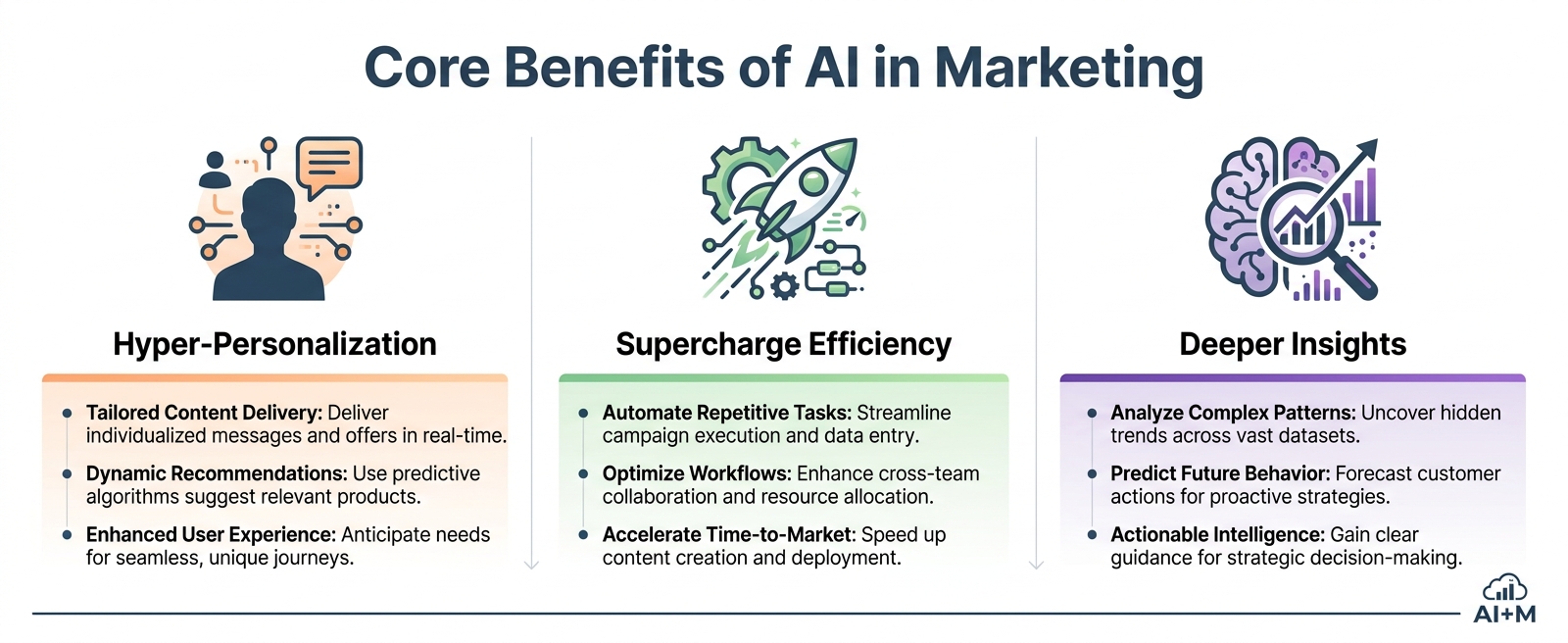
Artificial intelligence is no longer a futuristic concept; it's a critical tool for modern marketers seeking a competitive edge. By integrating AI, marketing teams can achieve unprecedented levels of personalization, efficiency, and data-driven decision-making. Here's a breakdown of the core benefits.
1. Hyper-Personalization at Scale
AI's greatest strength lies in its ability to understand and act on vast amounts of customer data. It analyzes browsing history, past purchases, and user behavior to deliver highly personalized content, product recommendations, and offers. This moves beyond simple name-based emails to truly one-to-one marketing.
According to a report from McKinsey, companies that excel at personalization generate 40% more revenue from those activities than average players. This proves that making customers feel understood directly translates to sales.
2. Supercharge Team Efficiency
Marketers often get bogged down by repetitive tasks like data entry, scheduling social media, and generating performance reports. AI marketing automation tools automate these workflows, freeing up your team to focus on strategic thinking and creative execution.
This automation isn't about replacing marketers; it's about empowering them. When AI handles the mundane, human creativity can be applied to brand-building and innovative campaign development. As noted by HubSpot's State of AI Report, a significant number of marketers report that AI saves them time and helps them create higher-quality content.
3. Deeper Insights and Predictive Analytics
AI algorithms can sift through your marketing data to uncover hidden patterns and trends that a human analyst might miss. This leads to smarter, faster decisions. Instead of guessing which campaign will perform best, you can use predictive analytics to forecast outcomes, identify at-risk customers, and optimize your budget for maximum ROI.
For instance, predictive models can help prevent customer churn by flagging users who are likely to leave, allowing you to proactively engage them with targeted retention offers. This turns data into a powerful tool for protecting and growing your customer base.
The Top AI Marketing Tools by Category
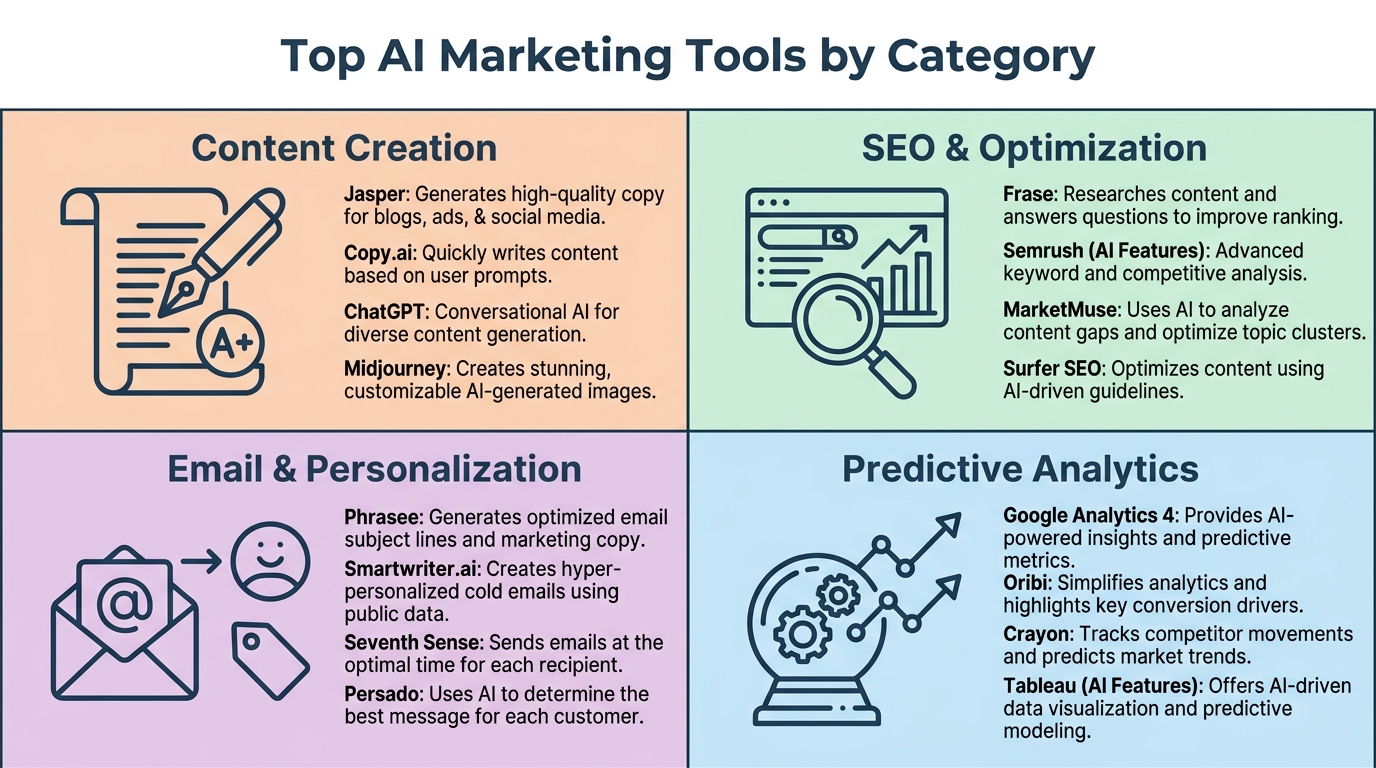
The daily use of artificial intelligence in marketing is soaring. A report highlighted by Dataslayer shows that 60% of marketers now use AI tools every day. With so many professionals relying on them, finding the right one for your specific needs is more important than ever.
To help you navigate this crowded space, we've organized tools by their main function, like content creation or SEO. While many platforms are multi-functional, we're focusing on their primary strength to keep things simple. Our guide on choosing the right tool can also help your evaluation.
AI Tools for Content Creation & Copywriting
One of the biggest uses for AI in marketing is content creation. These tools are fantastic for overcoming writer's block and generating a first draft quickly. Instead of staring at a blank page, you can get ideas flowing in seconds. This helps your team move from brainstorming to a finished piece much faster.
AI also makes it easy to create many versions of copy for testing. Think of writing ten different headlines for an ad or five unique social media posts for a campaign. An AI tool can generate these variations instantly, allowing you to A/B test messages and see what connects best with your audience. This saves a huge amount of time.
For long-form content like blog posts and case studies, a tool like Jasper can be very powerful. It offers numerous templates and can even learn your specific brand voice. This ensures consistency across different pieces of content and helps maintain your company's unique style.
If your team focuses more on short-form copy for ads or social media, a platform like Copy.ai is an excellent choice. It's known for being very user-friendly and has a freemium model. This makes it an accessible starting point for businesses wanting to explore AI copywriting without a big initial investment.
It's important to remember that these tools are helpers, not replacements. They accelerate the drafting process, but your team's expertise is still needed for fact-checking, editing, and adding a strategic human touch. They handle the basic work so your creators can focus on high-level thinking.
This idea is echoed by top industry leaders. In a conversation with Marketers That Matter, Mall of America CMO Jill Renslow explained it well. She said, "AI has added new layers to how we work, but it hasn't changed what we value most: expertise, intuition and creativity."
AI Tools for SEO & Content Optimization
AI marketing tools also help content get found on search engines like Google. These SEO platforms analyze data to show you how to improve your articles. They take the guesswork out of ranking higher, giving you a clear path for better online visibility.
A great example is a tool like Surfer SEO. It acts like a live coach while you write. Its content editor gives a real-time score based on how well your article matches top-ranking pages. This helps you include the right words and structure for success.
The scores are not just for show. In fact, a study from Surfer found a positive connection between higher content scores and better search rankings. This data-driven approach is what makes these tools so valuable for SEO professionals.
Other tools take a wider view. A platform like MarketMuse, for instance, looks at your entire website's content strategy. Instead of focusing on just one article, it helps you plan topic clusters to build authority on a broad subject over time.
MarketMuse is designed to find content gaps you might not see. It shows what topics competitors cover that you've missed. This allows you to create a complete content library that answers every question your audience has.
The main idea is moving beyond targeting single keywords. Modern SEO is about building topical authority, which means proving to search engines that you are an expert in a specific area. AI tools make this easier by analyzing what a complete answer looks like.
These platforms help you align with Google's quality standards like E-E-A-T. As noted in analysis from BrightEdge, AI can help scale the creation of expert-level content. The tools give data-backed suggestions to make your articles more thorough and trustworthy, which is key for long-term success.
AI Tools for Email Marketing & Personalization
Email marketing gets a big boost from artificial intelligence. Instead of sending the same message to everyone, AI helps create emails that feel personal. These tools can write catchy subject lines, suggest the best content, and even find the perfect time to send. This leads to much better engagement.
For example, a tool like Phrasee focuses on language. It uses AI to write email subject lines and ad copy that fit your brand's unique voice. The goal is to generate messages that get more opens and clicks, taking the guesswork out of copywriting for big campaigns.
And the data shows it works. According to a case study detailing its work with eBay, the platform's AI-generated copy led to a 16% average lift in open rates. This demonstrates how optimizing language can directly improve key performance metrics for email marketing.
Other platforms handle content curation automatically. A tool like Rasa.io creates a completely unique newsletter for every single subscriber. It pulls articles and information based on what each person has shown interest in before. This makes every email relevant.
This level of personalization is powerful. It stops subscribers from tuning out irrelevant messages and keeps them engaged with your brand. When people receive content that is valuable to them, they are much more likely to become loyal readers. It helps build a stronger relationship with your audience.
Real-World Example: eBay
eBay partnered with Phrasee, an AI tool for email copywriting, and achieved a 16% average lift in open rates using AI-generated subject lines. When combining optimized subject lines with AI-powered email body copy, the results improved further, demonstrating how AI-driven language optimization directly translates to measurable engagement improvements and higher ROI on email campaigns.
Questions to Ask Before Choosing Your First AI Marketing Tool
- What is the single biggest, most time-consuming or repetitive task your team faces right now?
- Does this tool integrate with the platforms you already use (CRM, email, analytics, ad platforms)?
- Can the vendor show a live demo using data similar to what your company works with, not just a generic example?
- How much technical expertise does your team need to set up, configure, and maintain this tool?
- What happens to your data—is it kept private, or used to train the AI model?
- What specific metrics does this tool track, and can the vendor share case studies or benchmarks showing ROI?
- What level of support, training, and onboarding does the vendor provide to help your team get up to speed?
- What is the total cost of ownership over the first year, including implementation, training, and ongoing fees?
Understanding JSON Schema: The Blueprint for Your Data
In the world of web development and data exchange, JSON (JavaScript Object Notation) has become the de facto standard. Its human-readable format and lightweight nature make it ideal for APIs, configuration files, and more. However, as applications grow in complexity, so does the data they handle. How can you ensure that the JSON data you receive is structured correctly, and that the data you send is valid?
This is where JSON Schema comes in.
What Exactly is JSON Schema?
Think of JSON Schema as a contract or a blueprint for your JSON data. It is a vocabulary that allows you to annotate and validate JSON documents. With a schema, you can define:
- Data Types: Specify whether a value should be a string, number, boolean, array, or object.
- Required Properties: Define which fields must be present in an object.
- Data Formats: Validate if a string conforms to a known format like a date-time, email, or URI.
- Value Constraints: Set rules like a number's minimum or maximum value, or a string's required pattern (using regular expressions).
By creating a schema, you establish a clear, machine-readable definition of your data structure. This allows you to automatically validate data, generate forms, and create documentation, leading to more robust and reliable applications.
A Practical Example
Imagine you are building a user registration system. You expect to receive a JSON object with user details. Here's how you could define its structure with JSON Schema:
json{ "$schema": "http://json-schema.org/draft-07/schema#", "title": "User", "description": "A user in the system", "type": "object", "properties": { "id": { "description": "The unique identifier for a user", "type": "integer" }, "username": { "description": "The user's unique username", "type": "string", "minLength": 3 }, "email": { "description": "The user's email address", "type": "string", "format": "email" } }, "required": ["username", "email"] }
This schema tells any consuming application that a valid User object must have a username (string, at least 3 characters long) and an email (a string in the email format). The id is optional but if present, must be an integer. Any data that doesn't meet these criteria can be automatically rejected, preventing bad data from entering your system.
Beyond the List: Building an Integrated AI Marketing Stack

Choosing individual AI marketing tools is a great start. But the real power comes from making them work together. This is called building an integrated marketing stack. It's a collection of complementary tools that share data and automate tasks.
When your AI tools are connected, they create a single, unified view of your marketing. Information flows freely between your SEO platform, content creator, and email system. This prevents important data from getting trapped in separate programs, which avoids duplicated work and confusion.
Imagine this simple workflow. An AI-powered SEO tool finds a keyword opportunity. This automatically prompts an AI writer to create a first draft for a blog post. Once you approve it, an AI social media tool schedules posts to promote the new article.
Many modern tools are designed to connect with each other using built-in, or native, integrations. But what happens if they don't? That's where workflow automation platforms come in. They act like a bridge to connect your favorite apps.
For instance, platforms like Zapier let you build custom connections. As Zapier highlights on its AI page, you can link thousands of different apps to create automated AI workflows. This can be done without writing a single line of code, making it accessible to any marketer.
The goal is to create a system where your tools talk to each other seamlessly. This turns disconnected actions into a smooth process. It saves your team huge amounts of time and frees them up to focus on strategy instead of manual tasks.
Measuring the ROI of Your AI Marketing Investment

Buying an AI tool is an investment, so you need to know if it's paying off. It's important to look beyond simple numbers like clicks or likes. These vanity metrics don't always connect to real business results, so they don't show the full picture of your success.
Focus on business outcomes like your Cost Per Acquisition (CPA) and Customer Lifetime Value (CLV). You can calculate your return on investment (ROI) with a simple formula: (Value Gained - Cost of Tool) / Cost of Tool. An ROI worksheet from Product School can help you organize these numbers.
So what is "Value Gained"? It can be time your team saves, which you can measure in dollars. For example, if a tool saves 10 hours of work a month, multiply that by an hourly rate. It can also include the value of new leads the tool helps you generate.
To measure any improvement accurately, you need a starting point. Before you start with a new AI tool, track your current metrics for a month to set a baseline. Later, you can compare new results to this baseline to see the actual impact the tool had on your goals.
Knowing your numbers from the start helps you prove the tool's worth to your leadership team. If you're not sure what to track, begin by measuring the right marketing KPIs.
Your Next Step in AI-Powered Marketing
AI marketing tools are powerful partners for your team, not replacements. They handle routine work, freeing up your people to focus on strategy and creative ideas. This is about working smarter and letting your team apply their unique skills where it matters most.
This makes AI a core part of your strategy. As noted by Campaign US, AI can become a partner that transforms how you work. Using these tools helps you stay competitive and effective in a fast-moving industry.
So, where do you begin? Find one major pain point in your team's daily workflow. Pick a tool from this guide that solves it, and sign up for a free trial. This small step is the best way to see the impact firsthand.
The artificial intelligence landscape will always be evolving. The key is to stay curious and be willing to adapt. Embracing change and experimentation will ensure your marketing remains strong and effective for years to come.

Frequently Asked Questions
What is the best AI tool for marketing?
There's no single "best" tool—the ideal choice depends entirely on your specific business needs and pain points. For long-form content creation, Jasper and Copy.ai are strong options; for SEO optimization, Surfer SEO is highly regarded; and for small businesses, all-in-one platforms like HubSpot with built-in AI features offer a cost-effective starting point. The key is to identify your biggest marketing challenge first, then select a tool designed to solve it.
Are there free AI marketing tools?
Yes, many powerful AI tools offer free versions or extended trials. HubSpot provides a comprehensive suite of free tools with AI capabilities, while Copy.ai has a free tier with monthly credit limits. ChatGPT also offers a robust free version that works well for brainstorming, initial drafts, and copywriting tasks. Free AI marketing tools are excellent for testing whether an AI solution fits your workflow before committing financially.
How do I use AI for marketing?
Start by identifying one repetitive or time-consuming task in your workflow—whether that's writing social media posts, optimizing blog content, or scheduling campaigns. Pick an AI tool designed to solve that specific problem and test it with a free trial or freemium plan. Learn how to use it effectively, measure the results, and then gradually expand to other areas of your marketing. The goal is to augment your existing process, not overhaul it overnight.
Does Google have an AI marketing tool?
Yes, Google has extensively integrated AI into its marketing and advertising platforms. Google Analytics 4 (GA4) uses AI for predictive audiences and automated insights; Performance Max campaigns in Google Ads are almost entirely AI-driven, automatically optimizing bids, creative elements, and targeting across Google's entire network. These tools are built directly into platforms most marketers already use.
How can small businesses afford AI marketing tools?
Small businesses should focus on tools with strong free tiers or affordable starter plans and prioritize solutions that directly drive revenue or save significant time, making the ROI easier to justify. Bundled AI features within platforms you already use—like a CRM or email provider—can offer excellent value without adding costs. Many platforms also offer discounts for nonprofits, startups, or annual commitments, so it's worth asking about special pricing.
What is the difference between AI and machine learning in marketing?
Artificial Intelligence (AI) is the broad concept of making machines smart and capable of performing tasks. Machine Learning (ML) is a subset of AI where machines learn patterns from data without explicit programming. In marketing, an AI tool might draft an email (a smart automated task), while ML is the underlying engine that analyzes past open rates to determine the optimal send time (learning from historical data). Most modern marketing tools use both concepts together.
How do I deal with AI content detection and penalties?
Google's focus is on rewarding high-quality, helpful content regardless of how it's produced. Always have a human expert review and edit any AI-generated draft, adding original insights, real experience, and E-E-A-T elements (Expertise, Experience, Authoritativeness, Trustworthiness). Pure, unedited AI content often lacks nuance and strategic depth, making it more likely to underperform or be flagged as unhelpful. The human touch is what transforms AI output into valuable marketing content.
What skills do marketers need to use AI effectively?
Modern marketers need to develop "prompt engineering" skills—learning how to ask AI tools the right questions to get better results. Critical thinking is equally important to evaluate AI output objectively. Data literacy becomes more valuable, as you'll need to understand the data fueling the AI and interpret its recommendations. Above all, strategic thinking is key; use AI to handle tactical execution while you focus on the bigger-picture marketing strategy and decisions.