
Published on: May 14, 2026 | Time to read: 20 min
A post-event email sequence turns attendee connections into lasting customer relationships through strategic follow-up. This automated series bridges the critical gap where 80% of event leads are typically lost, capturing attendee enthusiasm while memories are fresh and guiding prospects through a journey of value that significantly boosts ROI.
Key Takeaways
- Post-event email sequences are crucial for ROI, as 80% of event-generated leads are never followed up on, leaving significant opportunity untapped.
- Strategic sequencing should include an immediate thank you (24 hours), value sharing (days 3-5), educational content (weeks 1-2), and a soft offer (weeks 2-3).
- Personalization beyond first names can increase conversion rates by 202% and click-through rates by 41% compared to generic emails.
- Advanced segmentation by engagement level, interests shown, and persona/role dramatically improves email relevance and response rates.
- Email metrics to track include open rates (industry average ~40%), click-through rates (~3%), conversion rates, and unsubscribe rates.
- A multi-channel approach combining email with LinkedIn, paid ads, and SMS can deliver a 24% higher ROI than single-channel efforts.
Table of Contents
- The Anatomy of a High-Impact Post-Event Email
- Your Blueprint: Post-Event Email Templates & Timeline
- Advanced Segmentation: A Game-Changer for Personalization
- Measuring Your Success: Key Metrics for Your Sequence
- Beyond the Inbox: Integrating Emails with a Multi-Channel Strategy
What Is a Post-Event Email Sequence (And Why Is It Crucial for ROI)?
A post-event email sequence is a series of planned, automated messages sent to attendees after an event ends. Its main job is to keep the conversation going, share value, and turn warm event leads into lasting customer relationships. This process is key to boosting your return on investment (ROI) and is an essential component of any comprehensive B2B event marketing strategy.
The biggest mistake you can make is ending the conversation when the event does. Incredibly, some reports show that as many as 80% of event-generated leads are never followed up on. This leaves a huge opportunity on the table. A well-planned sequence bridges this gap, making sure your investment doesn't go to waste.
Events create a powerful connection with your audience. In fact, a brand trust report by Freeman reveals that 85% of attendees feel more inclined to make a purchase after attending an event. A follow-up sequence helps you capture this positive energy. It turns good feelings into real business results before the memory of your event fades.
One email is rarely enough. Think of it as a journey, not a single destination. Did you know that statistics from sales experts show about 80% of sales require at least five follow-up attempts? A sequence automates these touchpoints. It keeps your brand top of mind without you doing it all manually.
The return on this effort is clear and measurable. For example, by using an event-driven email strategy, the company William Hill achieved an impressive 125% ROI. This shows how automated follow-ups can directly lead to higher conversion rates and revenue. It's not just about being polite; it's about being profitable.
The Anatomy of a High-Impact Post-Event Email
A great post-event email isn't just one thing. It's a combination of smart, simple parts working together. Each element, from the subject line to the final link, has a specific job. When you get these pieces right, you create a message that people want to open, read, and act on. Let's break down what makes these emails so effective.
Your subject line is the gatekeeper. It determines if your email gets opened or ignored. Try A/B testing different options to see what works. For instance, you could compare a simple "Thanks for joining [Event Name]" with a benefit-focused "Your [Event Name] resources are here." This helps you learn what your audience prefers.
A personalized greeting is a good start, but true impact comes from going deeper. Mention a session they attended or an interest they shared. Data on personalization reveals that this effort pays off. For example, customized calls-to-action can boost conversion rates by over 200%.
Keep your email body short and easy to scan. Your attendees are busy. Get straight to the point by reminding them of a key event moment. Then, clearly explain the value you are providing in the email, like a video replay or a special offer.
Every email should have one clear call-to-action (CTA). Giving too many options causes confusion and inaction. Make your CTA button stand out and use action-oriented words. Not including this "ask" is a huge missed opportunity, as marketing experts highlighted by the Content Marketing Institute point out.
Your CTA should align perfectly with your goal. If you want attendees to see a presentation, use "Watch the Replay." To generate sales leads, try "Book a 15-Minute Demo." For sharing resources, "Download the Full Slide Deck" is direct and effective. Always make the benefit clear.
Your Blueprint: Post-Event Email Templates & Timeline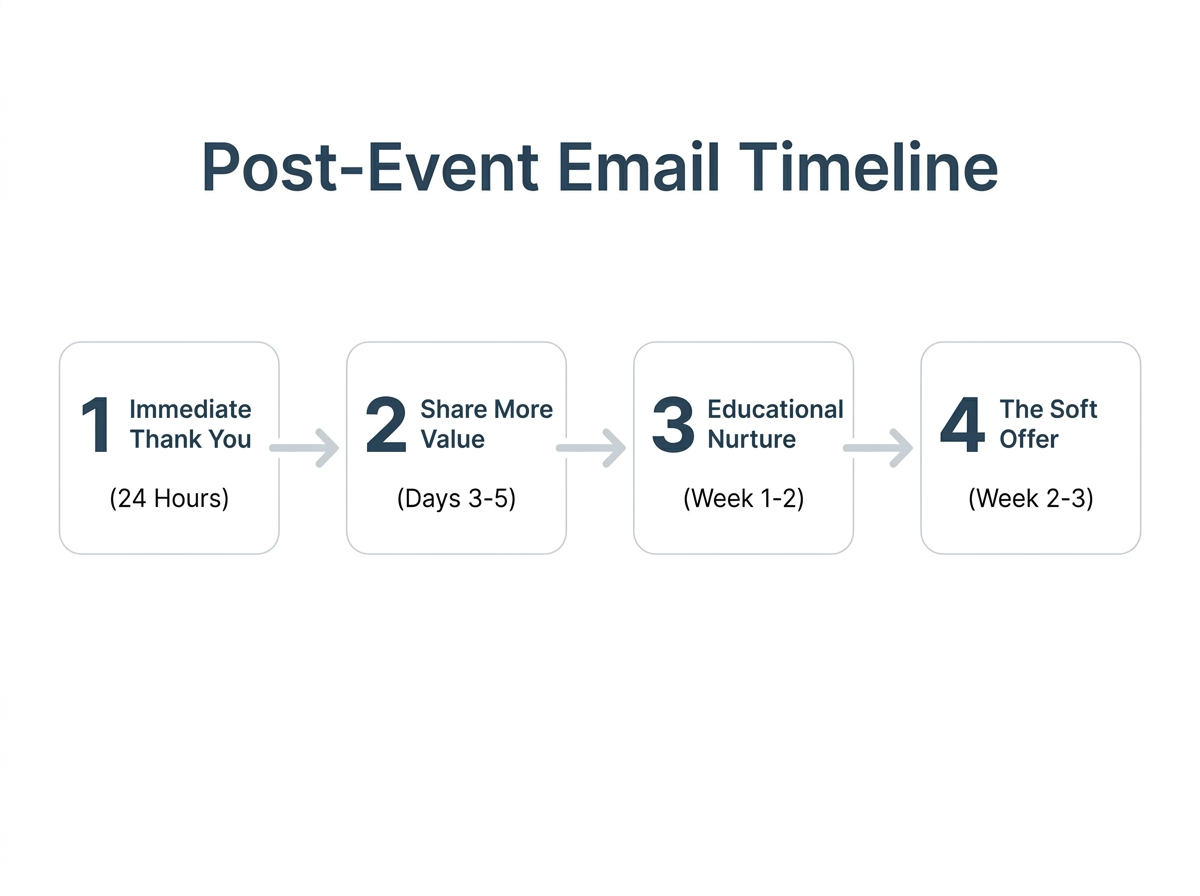
A successful follow-up strategy isn't random. It is a carefully planned journey. This blueprint maps out a four-step email sequence with a clear timeline and purpose for each message. It will help you engage both the people who showed up and those who couldn't make it.
Having a consistent brand voice is important. But tailoring the message to different groups is what drives results. Let's look at a timeline that works, and consider how AI email automation can enhance personalization and efficiency throughout this process.
Email 1: The Immediate Thank You (Within 24 Hours)
Your first email should land within 24 hours of the event. The goal is to say thank you and deliver a quick, valuable piece of content while the event is still fresh in their minds. Sending a survey now is also smart, as The Events Calendar suggests attendees are most likely to give feedback right away.
For Attendees:- Subject: Thanks for coming to [Event Name]!
- Body: Thank them for their time. Remind them of a highlight. Offer a quick resource, like the main slide deck or a link to a key speaker's profile. Keep it short, friendly, and appreciative.
- Subject: Sorry we missed you at [Event Name]!
- Body: Let them know they were missed. Briefly mention what the event was about. Offer the same key resource you sent attendees so they don't feel left out. This gesture shows you value their interest.
Email 2: Share More Value (Day 3-5)
After the initial thank you, wait a couple of days. This email goes deeper by offering more substantial resources. Think about a library of session recordings, a collection of curated articles, or an exclusive interview. This builds on the initial positive connection.
This is also a great time to think beyond just email. A multi-channel approach can make a big difference. In fact, some analysis shows that multi-channel campaigns can achieve a 24% higher ROI compared to single-channel efforts.
For Attendees:- Subject: Your [Event Name] resource library is here!
- Body: Guide them to a page with all the event recordings, slides, and related content. This positions you as a helpful resource and keeps them engaged with your brand's expertise.
- Subject: Here's what you missed at [Event Name]
- Body: Give them access to the same resource library. Frame it as a chance to catch up on the valuable insights they missed. This nurtures their initial interest and keeps them in your marketing funnel.
Email 3: The Educational Nurture (Week 1-2)
Now it is time to nurture the relationship without directly selling. Send an email that provides education on a topic related to your event. This could be a detailed blog post, a case study, or a guide. The goal is to demonstrate your expertise and build trust with your audience.
Personalizing this message based on attendee interests can be very powerful. Segmenting your email lists is a proven strategy that pays off. According to email marketing statistics highlighted by Stripo, segmented and personalized campaigns are responsible for generating 58% of all company revenue.
For Attendees:- Subject: Did you enjoy the [Specific Session] topic?
- Body: If you know which sessions they attended, send content related to that topic. For example, \"Since you attended the session on AI in marketing, we thought you'd love this deep-dive article.\"
- Subject: A little something to help you with [Event Theme]
- Body: Send a more general piece of high-value content that aligns with the overall theme of your event. This keeps the conversation going and provides value, building goodwill for future interactions.
Email 4: The Soft Offer (Week 2-3)
After providing consistent value, you have earned the right to make an ask. This final email in the sequence should contain a soft call-to-action (CTA). It's not a hard sell. Instead, it guides them to the next logical step in their journey with your brand.
This step is crucial for turning warm leads into potential customers. As marketing agency Artisan recommends, a follow-up sequence should build toward a clear CTA, like downloading content or booking a meeting.
For Attendees:- Subject: Ready to take the next step?
- Body: Invite them to a related webinar, offer a one-on-one consultation, or provide a link to request a personalized demo. Connect the offer directly to the knowledge they gained at the event.
- Subject: Your chance to dive deeper into [Event Topic]
- Body: Offer them a similar next step. Since they missed the event, an invitation to a future webinar or a product demo can be a great way to finally connect and show them what your brand can do.
Email 1: The Immediate 'Thank You & Recap' (Within 24 Hours)
The clock starts ticking the moment your event ends. Your first follow-up should land in inboxes within 24 hours to capitalize on fresh energy and memories. The goal is to express gratitude and reinforce your event's value with an immediate resource before the day's distractions take over.
For attendees, your message is a warm thank you. The subject can be a simple "Thanks for coming to [Event Name]!" In the email, reference a high point and provide a link to a resource like the main slides. This proves you value their time and gives them a reason to stay connected. As industry guides from Meetings & Incentives note, this rapid engagement is key.
The approach for no-shows is a little different. A subject like "We missed you at [Event Name]!" works well. Briefly mention a highlight to create a sense of missed value, then offer the same recording or slides. This gesture keeps them included and nurtures their original interest in your brand.
Email 2: The 'Feedback & Community' Nudge (Day 3)
Around day three, it's time for your second email. The main goal here is to collect feedback and build a sense of community. This helps you understand what attendees loved and what you can improve for your next event. It also shows them that their opinions matter to you.
Ask for their honest thoughts on the event experience. You can also encourage them to connect with each other. Invite them to share their biggest takeaway on social media using your event hashtag. This keeps the conversation going and extends your event's reach.
Offering a small incentive can boost your survey response rate. Think about a drawing for a gift card or a small discount on a future purchase. To get the best results, guidance from event data experts confirms that sending surveys quickly is key.
Make your call-to-action direct and simple. Use phrases like, "Take our 2-minute survey" or "Share your thoughts on LinkedIn." This clarity makes it easy for attendees to engage and gives you the valuable insights you need.
Questions to Ask Before Creating Your Post-Event Sequence
- What was the primary goal of your event, and how can your email sequence support it?
- Which segments of attendees showed the highest engagement during the event?
- What specific content or resources would provide immediate value to different attendee segments?
- How will you measure success for this follow-up sequence?
- What's the next logical step you want attendees to take in their journey with your brand?
- How much personalization can you realistically implement based on your event data?
- Which channels besides email would your audience be receptive to for follow-up?
- What timing makes sense for your audience considering their professional roles and time zones?
- Do you have consent for all communication methods you plan to use (especially for SMS)?
- How will you handle follow-up with no-shows differently than with active participants?
Advanced Segmentation: A Game-Changer for Personalization
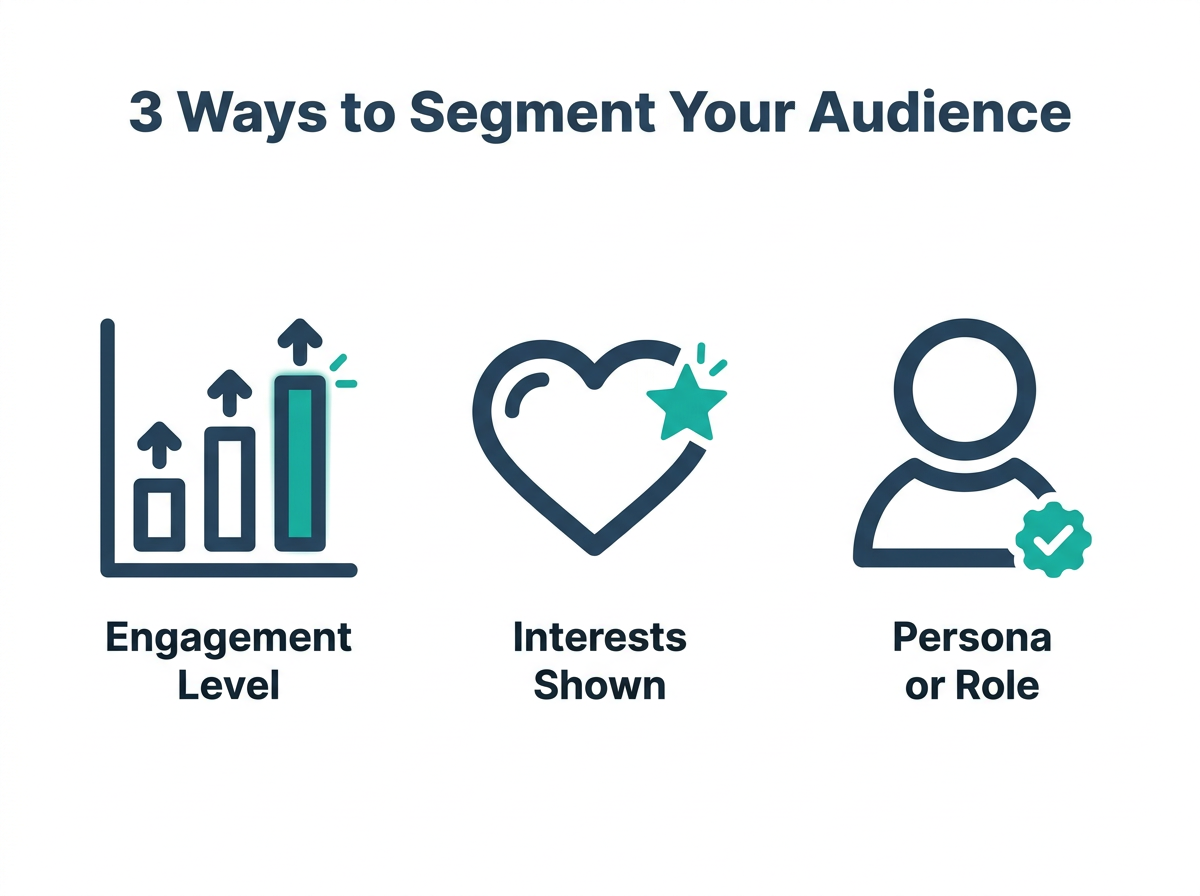
Sending the same email to every attendee is a huge missed opportunity. Advanced segmentation is how you fix that. It means grouping your audience based on their actions and interests. This lets you move from generic messages to conversations that feel personal and relevant, making your follow-ups much more effective.
There are several smart ways to segment your post-event email list. Each one helps you tailor your message so it connects better.
Segment by Engagement Level
A simple way to start is by looking at engagement. You can create separate lists for people who attended the live event, those who only watched the replay, and even those who registered but didn't come. Each group has a different experience, so they need a different message.
Segment by Interests Shown
Next, get more specific by segmenting based on interests. What sessions did they join? What topics did they engage with in polls? Some event platforms can even track specific actions like how much of a replay someone watched. This data tells you exactly what kind of content they want to see from you next.
Segment by Persona or Role
You can also group people by their role. Is the attendee an existing customer, a hot sales prospect, or a business partner? Expert guides on email marketing highlight how sorting by job role or industry makes your follow-up content more valuable. This ensures your message always fits the recipient.
Let's imagine your event had a special track for software developers. With segmentation, you can send a follow-up email only to that group. This message could include a link to a technical deep dive or the speaker's code repository. It's content they actually want.
Meanwhile, attendees from the sales track get a different email with a case study and an invitation to book a demo. This targeted approach feels more helpful and less like spam. It shows you were paying attention to what each person cared about during the event.
Some tools can go even further. For instance, predictive analytics can help create cohorts of attendees whose recent behavior makes them likely to become customers. By focusing your efforts on these high-intent groups, you make your follow-up process smarter and more efficient, driving better results for your business.
Measuring Your Success: Key Metrics for Your Sequence
Once your emails are sent, how do you know if they worked? Tracking key numbers, known as metrics, is the only way to measure success. This data shows how your audience responded and helps you make smarter decisions for your next event. Understanding these metrics is essential for any comprehensive marketing automation strategy.
Start with two main metrics: open rate and click-through rate (CTR). Open rate shows who looked at your email. CTR shows who clicked a link inside. A good subject line gets opens, while compelling content gets clicks.
So what are good numbers? While goals change, averages offer a guide. For instance, GetResponse's 2024 email benchmarks report found an average open rate near 40% and a click-through rate over 3%.
Also check conversion and unsubscribe rates. The conversion rate measures how many people completed your goal, like booking a demo. A high unsubscribe rate can mean your message missed the mark or was sent to the wrong group.
These numbers tell a story. High opens but low clicks suggest a great subject line but weak email content. Dig deeper by checking video watch times or survey completion rates. These details paint a fuller picture of real engagement.
Context is also important. Post-event emails often perform well because they are expected. This is similar to welcome emails, which data analysis from beehiiv highlights can achieve open rates over 47%. Timely, relevant messages get noticed.
Remember that your industry matters. For instance, email marketing benchmarks compiled by Selzy show that nonprofits often get more engagement than marketing firms. Always compare your performance against similar businesses for a fair assessment.
Beyond the Inbox: Integrating Emails with a Multi-Channel Strategy

Email is the foundation of your follow-up, but it should not be the only tool you use. Your attendees are active on many different platforms. A multi-channel strategy reinforces your message by reaching them where they already spend their time. This approach ensures your communication feels natural and not confined to just an inbox.
Think about your most engaged attendees. These are the people who open your emails and click your links. This level of interest is a strong signal that they want to hear more from you. You can use this signal to create a more personal connection on professional networks like LinkedIn.
You can even automate this process. Tools like Zapier can trigger a connection request or a personal message on LinkedIn right after someone clicks a key link in your email. This simple, timely action can move the conversation from a broadcast to a valuable one-on-one relationship.
Another powerful strategy is using paid ads to stay visible. Most ad platforms, including Facebook and LinkedIn, let you create custom audiences. You can upload your event attendee list to show targeted ads specifically to them. This keeps your brand front and center long after the event ends.
Make sure your ads mirror the message in your email sequence. If your email is about downloading a new case study, your ad should promote the same content. This creates a consistent experience across all channels. It reminds attendees of the value you offered and reinforces your key points.
Sometimes you need to send a message that gets seen right away. This is where SMS, or text messaging, comes in. Texts have a sense of urgency that emails often lack. They are perfect for time-sensitive information or can't-miss reminders that you want people to see immediately.
For example, you could send a text alert saying, "Last chance to get the recordings!" This can drive immediate action. Just be sure to use SMS sparingly. Reserve it for your most important messages to avoid overwhelming your audience. It works best when it feels special and important.
But a word of caution is needed. Using SMS for marketing comes with strict rules. You must get clear permission before sending any promotional texts. In fact, TCPA compliance guidelines from ActiveProspect stress the need for express written consent from each person. This protects both your audience and your business.
Real-World Example: William Hill
William Hill demonstrated the power of event-driven email marketing with automated follow-up sequences, achieving an impressive 125% ROI based on normal client acquisition costs. Their campaign featured a 2.5x higher conversion rate compared to standard approaches, with initial emails reaching a 9.4% arrival rate and follow-ups generating 5.4% clickthrough rates. This success shows how combining personalized emails with automated sequences directly translates to measurable revenue.
Turn One-Time Attendees into Lifelong Fans
Your event doesn't end when the last attendee leaves. That's when the work of building relationships begins. A smart post-event email sequence is no longer optional. It's how you turn temporary interest into lasting connections and prove the value of your event.
The strategy is simple. Start immediately with a thank you message packed with value. Personalize your communication by segmenting your audience based on their behavior. This shows you were listening and makes your brand feel more human and trustworthy.
Next, measure everything. Watch your metrics to see what's working and use that data to improve. Remember to think beyond the inbox. Integrating emails with social media or targeted ads creates a seamless experience that keeps your brand top of mind.
That list of attendees is a huge opportunity. It holds future customers, potential partners, and vocal brand advocates. With a thoughtful follow-up plan, you can unlock that potential. You can build a community that supports your business long after the event is over.
Don't let that opportunity fade. Take what you've learned and outline your first "thank you" email right now. A simple, helpful message is the first step toward turning one-time attendees into lifelong fans.
Frequently Asked Questions
How many emails should be in a post-event sequence?
A typical post-event sequence consists of 3 to 5 emails sent over one to two weeks. This provides enough touchpoints to deliver value and drive action without overwhelming your audience. Fewer than 3 emails may not be sufficient to nurture a lead properly, while more than 5 can lead to fatigue and increased unsubscribes.
What should the first post-event email say?
The first email, sent within 24 hours of your event, should primarily be a thank you message. It should acknowledge the attendee's time, reiterate one major takeaway from the event, and provide a direct link to essential resources like the event recording or presentation slides. Keep it short, friendly, and focused on immediate value.
When is the best time to send a post-event email?
The first email should be sent as soon as possible, ideally within a few hours but no later than 24 hours after the event ends. Subsequent emails should be spaced out every 2-3 days to stay top-of-mind without being intrusive. For optimal open rates, weekday mornings between 8-11 AM, particularly Tuesday through Thursday, tend to perform best.
How do you follow up with people who registered but didn't attend?
Create a separate segment for 'no-shows' and send them a modified version of your first email with a subject line like 'Sorry we missed you at [Event Name]'. Frame it as a value-add by providing the recording and slides so they can still benefit from the content they were initially interested in. Continue to include them in your sequence with appropriate messaging adjustments.
Should my post-event emails come from a person or a generic company address?
For a more personal touch that drives higher engagement, send emails from a real person's name and address (e.g., 'Jane Doe at Company' <jane.doe@company.com>), such as the event host or a key speaker. This feels more like a one-to-one conversation than an email from a generic 'marketing@' address and typically generates better response rates.</jane.doe@company.com>
How can I use AI to write my post-event email sequence?
AI writing tools can be a great starting point for drafting your emails. You can provide them with the event context, your goals for each email, and key information (like speaker names and resource links), and ask for a draft. Always review and edit the AI-generated content to ensure it matches your brand voice and adds a human touch that resonates with your specific audience.