
Published on: May 13, 2026 | Time to read: 36 min
SEO GEO & AEO optimization targets customers in specific geographic areas, helping businesses appear in local searches and Google Maps. With 'near me' searches growing 250% and 46% of all Google searches having local intent, this strategy is essential for businesses with physical locations or service areas looking to capture ready-to-buy local customers.
Key Takeaways
- Local SEO captures 46% of all Google searches and 'near me' searches have grown 250% in two years, making geographic targeting critical for visibility
- Google Business Profile optimization is the single most important tool—complete profiles with reviews and engagement features dominate local map pack results
- NAP consistency (Name, Address, Phone) across all online directories is a foundational trust signal that improves local rankings significantly
- Dedicated local landing pages for each service area or city convert 6× better than generic pages when properly optimized with local keywords and schema
- Citations, backlinks from community involvement, and local authority building are essential ranking factors that signal legitimacy to search engines
- Combining organic local SEO with paid geo-fencing strategies creates a powerful dual approach that captures existing demand and generates new leads
- AI-powered hyper-local content creation and precise geo-grid rank tracking enable businesses to scale local strategies across multiple service areas
Table of Contents
- What is SEO Geo Optimization (And Why It Matters)
- Foundational Steps: Local Keyword Research and Analysis
- Implementing Local Business Schema Markup
- On-Page SEO for Hyper-Local Targeting
- Mastering Google Business Profile to Dominate the Map Pack
- Building Local Authority: Citations and Link Building
- Unique Differentiator: Amplifying Results with Paid Geo-Fencing
- Unique Differentiator: AI-Powered Hyper-Local Content Strategy
- Measuring Success: Tracking Your Geo-Targeting ROI
- Conclusion: Your Action Plan for Local Search Dominance
SEO Geo-optimization is the process of fine-tuning your online presence to attract customers in specific geographic areas. By focusing on local signals, businesses can show up in 'near me' searches and on local maps, connecting directly with people nearby who are ready to buy. This strategy is perfect for companies looking to dominate their local market.
What is SEO Geo Optimization (And Why It Matters)
Think of the difference between national and local marketing. While broad SEO casts a wide net across the country, geo-optimization targets a specific city, neighborhood, or service area. This tactic helps you appear when local customers are looking for businesses just like yours, putting you right in front of them at the perfect moment.
This targeted approach is more important than ever because of how people search. For instance, a recent report on 2024 SEO statistics reveals 'near me' searches on Google have grown by 250% over the last two years. This shows a massive shift in how consumers find products and services in their area.
This isn't a small trend. In fact, a huge portion of all online searches has a local focus. According to data compiled by SOCI.ai, 46% of all Google searches are for local information. If your business isn't visible locally, you're missing out on a massive audience that's actively looking to engage.
By targeting customers geographically, you connect your brand with people who are ready to make a purchase. It ensures your message reaches the audience most likely to become paying customers. For any business with a physical location or a defined service area, this strategy is key to growth and staying competitive.
Questions to Ask Before You Start Your Local SEO Strategy
- Do you have a fully optimized Google Business Profile with complete NAP information, categories, and recent updates?
- Are your business name, address, and phone number (NAP) consistent across all online directories and your website?
- Which specific cities, neighborhoods, or service areas do you want to target, and do you have dedicated landing pages for each?
- How many reviews does your business have on Google, and are you actively asking satisfied customers to leave feedback?
- Have you implemented local business schema markup on your website to help search engines understand your location and services?
- What local citations and backlinks do you currently have, and are you involved in your local community or chamber of commerce?
- Are you tracking your local rankings with a geo-grid rank tracker, or only monitoring citywide visibility?
- Could combining organic local SEO with paid geo-fencing campaigns help you reach more ready-to-buy customers in your target areas?
Demystifying The Cloud: A Beginner's Guide to Cloud Computing
In the digital age, you've almost certainly heard the term "the cloud." We save photos to the cloud, stream movies from the cloud, and use applications that run on the cloud. But what exactly is this nebulous concept? In this article, we'll break down the basics of cloud computing.
What is Cloud Computing?
At its core, cloud computing means accessing and storing data and programs over the internet instead of on your computer's hard drive. The "cloud" is just a metaphor for the internet. It refers to a vast network of remote servers, hosted on the internet, that are used to store, manage, and process data.
Think of it like electricity. When you turn on a light, you don't need to own your own power plant. You simply plug into a grid provided by a utility company. Similarly, with cloud computing, you can plug into a massive infrastructure of computing resources without having to build and maintain it yourself.
Key Service Models
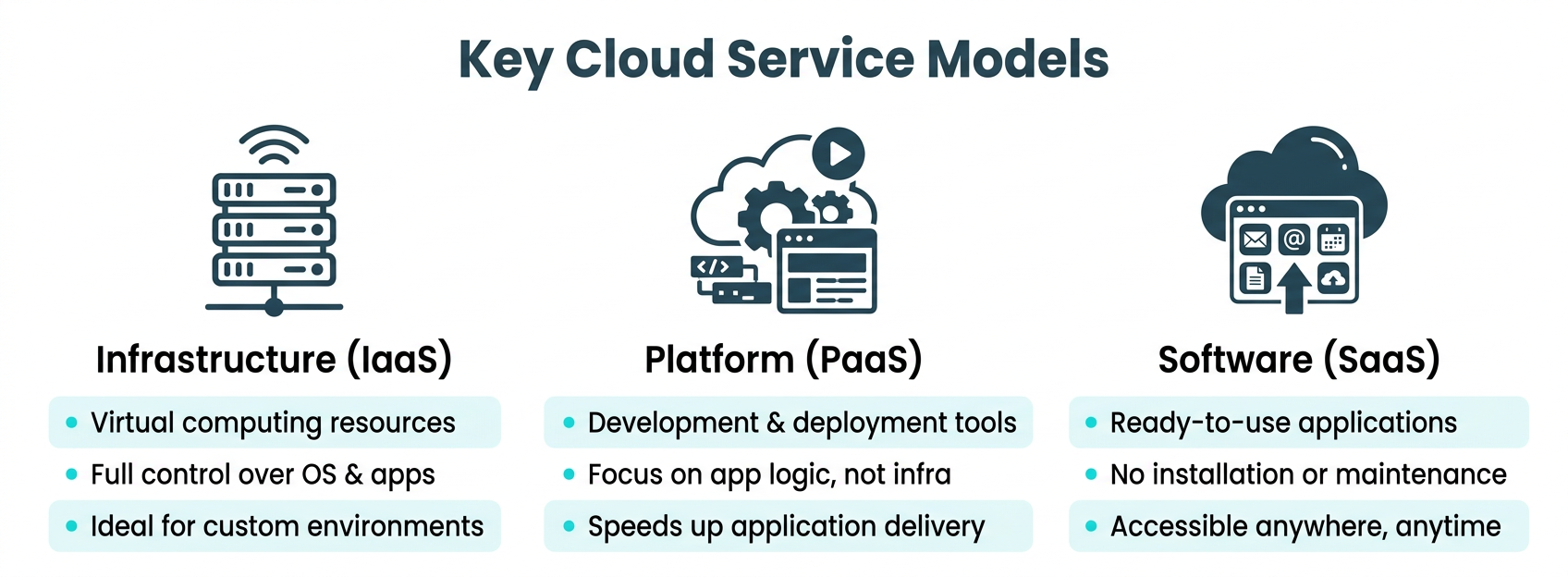
Cloud computing services are typically offered in three main categories:
Infrastructure as a Service (IaaS): This is the most basic category. It provides you with virtualized computing resources over the internet, such as servers, storage, and networking. Examples: Amazon Web Services (AWS) EC2, Google Compute Engine.* Platform as a Service (PaaS): PaaS provides a platform allowing customers to develop, run, and manage applications without the complexity of building and maintaining the infrastructure typically associated with developing and launching an app. Examples: Heroku, Google App Engine.* Software as a Service (SaaS): This is the most common model. It delivers software applications over the internet, on a subscription basis. You don't need to install or run applications on your own computers. Examples: Google Workspace, Salesforce, Dropbox.*By leveraging the power of the cloud, individuals and businesses can gain flexibility, efficiency, and scale like never before. It's not just a buzzword; it's a fundamental shift in how we build and use technology.
On-Page SEO for Hyper-Local Targeting
Optimizing your website for local searches starts with on-page SEO. This means tweaking your site's content to send strong location signals to Google. Think of it as decorating your online storefront with signs that say "We serve your neighborhood!" It tells both search engines and customers that you are the right choice for their local needs.
Start with the basics: your title tags, meta descriptions, and headers. These are the first things Google reads. Simply adding your city or neighborhood to them works wonders. For example, a title like "Expert Plumbing Services in Brooklyn" is much more powerful for local search than just "Expert Plumbing Services."
These simple changes have a big impact. On-page signals like keywords in your titles and relevant website content are critical for ranking. In fact, a survey of local SEO experts by BrightLocal identifies them as one of the top factors for appearing in Google's local map pack. This shows how much Google values content that matches a user's local intent.
Beyond the tags, you need to create geo-specific content. This could mean building dedicated service pages for each location you cover. Instead of a single "services" page, have one for "roof repair in Denver" and another for "roof repair in Boulder." This tells Google exactly where you operate and what you do there.
This strategy is especially powerful for businesses with multiple locations. Each storefront or service area should have its own unique landing page. This page should feature the specific address, phone number, hours, and testimonials from local customers. It creates a highly relevant experience for users in that area.
Don't underestimate the power of these pages. A well-built local page is designed to convert visitors into customers. According to analysis on high-converting local pages, they can generate significantly more leads than generic, non-localized pages. It's about showing up and being relevant.
For larger organizations, managing these pages can be a challenge. B2B companies using a marketing system like The Zulu Method can scale this process, creating hundreds of optimized local pages efficiently. This ensures every market has a strong, targeted presence online, driving growth across all service areas.
Unlocking Data Consistency with JSON Schema
In today's data-driven world, APIs and microservices constantly exchange information. The reliability of these systems hinges on the consistency and predictability of the data they handle. Without a clear contract, data formats can drift, leading to brittle integrations, unexpected bugs, and wasted developer hours. This is the exact problem that JSON Schema is designed to solve.
JSON Schema is a powerful vocabulary that allows you to annotate and validate JSON documents. It acts as a blueprint, defining the expected structure, data types, and constraints for your JSON data. Think of it as a formal, machine-readable contract that your data must adhere to.
Adopting JSON Schema offers several significant advantages:
- Automated Validation: You can programmatically validate JSON payloads against a schema, ensuring that any data entering your system is correctly formatted. This catches errors early and prevents bad data from corrupting your application state.
- Clear Documentation: A schema serves as unambiguous, always-up-to-date documentation for your data structures. This makes it far easier for developers to understand and correctly use your APIs.
- Improved Developer Experience: Modern IDEs and tools can leverage JSON schemas to provide intelligent code completion, hints, and real-time validation, significantly boosting developer productivity.
- Code Generation: You can use schemas to automatically generate boilerplate code for data models in various programming languages, reducing manual effort and potential for error.
By integrating JSON Schema into your development workflow, you create a more robust, predictable, and maintainable system. It's a foundational practice for building scalable and reliable applications that rely on JSON data exchange.
Mastering Google Business Profile to Dominate the Map Pack
Your Google Business Profile (GBP) is the single most important tool for local SEO. It is your digital storefront on Google Search and Maps. A fully optimized profile is your ticket to appearing in the coveted "Map Pack," the block of three local businesses shown for most local searches. This puts you directly in front of customers who are looking to buy now.
Getting the basics right is step one. This means filling out every single section of your profile. Start with your business name, address, and phone number (NAP), ensuring they are identical everywhere online. Select the most accurate primary category for your business, as this tells Google what you do. Then, add secondary categories to cover all your services.
A complete and accurate GBP sends strong trust signals to Google. According to expert advice on ranking in Google's map feature, elements like your business category and a correctly placed map pin are foundational. Don't just set it and forget it. A well-maintained profile shows Google your business is active and reliable.
Reviews are pure gold for local businesses. Encourage your happy customers to leave reviews, and make it a habit to respond to every single one. Thanking people for positive feedback and professionally addressing negative comments shows potential customers that you care about their experience. This builds trust and social proof.
To truly stand out, use GBP's more advanced features. Many businesses ignore Google Posts and the Q&A section. Some marketing experts feel these are some of the most powerful underutilized tools in local SEO. Use Posts to share updates, offers, and news. Answering questions in the Q&A section helps you control your business narrative and provide valuable information upfront.
Finally, connect your optimized GBP to your website. Link from your profile to dedicated local landing pages that are built to convert visitors. As outlined in guides on creating effective local service pages, these pages should expand on the services mentioned in your GBP. This creates a seamless and relevant user journey from search to sale.
You can measure the impact of your efforts by using a rank tracker. To see how your visibility changes across a city or neighborhood, you'll need a tool with geo-specific tracking. These specialized local rank tracking tools show exactly where you are ranking on the map, helping you fine-tune your strategy.
For large B2B companies, managing profiles for multiple service areas can be complex. A marketing system like The Zulu Method helps scale these efforts. It allows businesses to maintain consistent, fully optimized Google Business Profiles across hundreds of locations, ensuring every market is positioned to dominate the local map pack.
Building Local Authority: Citations and Link Building
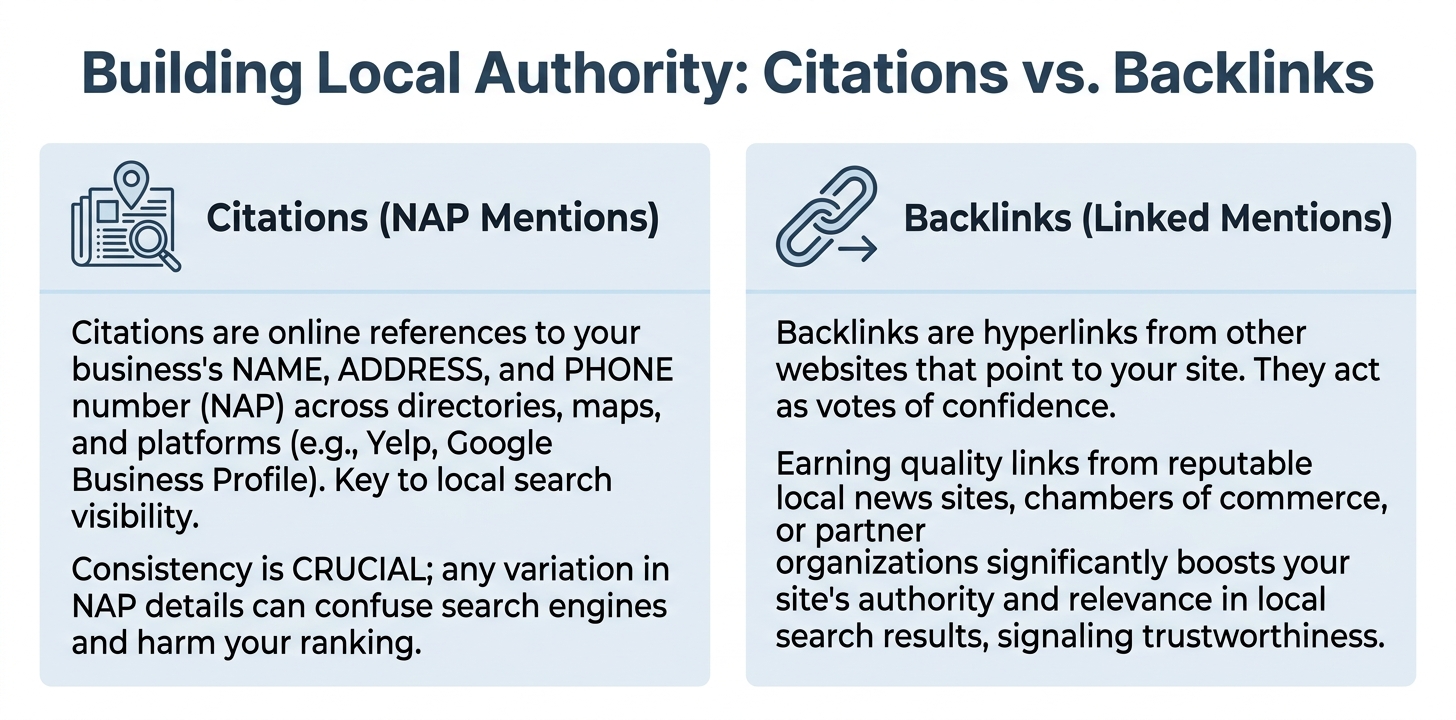
Think of your online presence like a local reputation. To become the go-to business in town, you need other sources to vouch for you. In local SEO, this is done through citations and backlinks. These act as votes of confidence that tell Google you are a legitimate and prominent player in a specific geographic area.
Everything starts with your NAP, which stands for Name, Address, and Phone number. This is your business's digital fingerprint. The most important rule is to ensure your NAP is 100% consistent everywhere it appears online. Even a small difference, like using "St." instead of "Street," can confuse search engines.
This consistency is not just a minor detail; it's a major trust signal. In fact, a data-driven case study on local search rankings found that businesses with a consistent NAP are significantly more likely to show up in the local map pack section. Google rewards businesses it can easily verify and trust.
A citation is any online mention of your business's NAP. You can build citations by getting listed in major directories like Yelp and the Yellow Pages. You should also find niche directories specific to your industry or city. The goal is to build a large and consistent footprint across many relevant websites.
Beyond citations, earning local backlinks is the next step. While a citation is just a mention, a backlink is a clickable link from another website to yours. These are more powerful because they pass authority and drive referral traffic. You want to earn links from other well-respected local websites.
One great strategy is to get involved in your community. Sponsoring a local kids' sports team, a charity run, or a town festival often results in a link from their website's sponsor page. This shows both Google and local residents that you are an active part of the community.
Another powerful tip is to create useful local content. This could be a guide to the best parks in your city or a calendar of local events. Other local bloggers, news outlets, or organizations might link to your helpful resource. For large B2B companies, a system like The Zulu Method can help scale this content creation across hundreds of service areas.
Finally, a simple but effective tactic is to join your local Chamber of Commerce. Membership nearly always comes with a listing in their directory, which includes a valuable backlink from a highly trusted and geographically relevant website. It's an easy win for building local authority.
Unique Differentiator: Amplifying Results with Paid Geo-Fencing
While SEO helps you get found by people already searching, you can also proactively reach local customers. Geo-fencing is a paid advertising tactic that lets you do just that. It allows you to draw a virtual boundary around a specific location, like an office building, a stadium, or a competitor's storefront. You can then show targeted ads to anyone with a smartphone inside that virtual fence.
Think of local SEO and geo-fencing as a powerful team. Your SEO work captures existing demand from customers who are searching for you. Geo-fencing helps create new demand by putting your message in front of a relevant audience before they even think to search. Combining them means you are both capturing and creating leads in your target service areas.
Here's a simple example. A restaurant can set up a geo-fence around a nearby office park. During lunchtime, they can run ads showing their daily specials to everyone in that building. The ad could link to a locally optimized menu page. This drives foot traffic by reaching hungry professionals at the perfect moment.
This combined approach gets real results. When businesses coordinate their organic and paid location strategies, the lift can be huge. In fact, a case study aligning organic and paid search goals saw a 375% improvement in conversion rates. This shows how paid ads and SEO can work together to boost performance.
This strategy isn't just for restaurants. For B2B companies, a marketing system like The Zulu Method can manage these sophisticated campaigns at scale. Targeting decision makers at a conference or an industrial park becomes much simpler. It turns a broad advertising strategy into a precise, high-impact marketing effort across all your key locations.
Unique Differentiator: AI-Powered Hyper-Local Content Strategy
Artificial intelligence is your secret weapon for creating content that connects with local customers. Instead of generic posts, use AI tools like ChatGPT to craft articles tailored to specific neighborhoods. This helps you sound like a local expert, not just another business on the internet.
Imagine creating posts about local news, high school sports, or charity events. AI can help brainstorm these hyper-local topics in minutes. This makes your content relevant to the people in your service area. It helps your brand feel like an authentic part of the community.
You can guide the AI with instructions, called prompts, to get better results. As some guides for using AI in real estate show, a simple prompt can turn a general tool into a local idea engine. You can ask for neighborhood-specific topics that speak directly to customer concerns.
AI is also great for analyzing competitors. Ask it to review a local competitor's website and identify content gaps. It can show you what topics they are missing. This gives you a clear roadmap for creating unique articles that will stand out and attract local search traffic.
AI can even help tailor your website's experience. You can personalize what visitors see based on their location. As experts on the future of local search highlight, this creates a more relevant journey for each user, which can improve engagement and conversions.
For large B2B companies, managing this across many markets is a big job. A marketing system like The Zulu Method helps streamline these efforts. It allows businesses to implement a sophisticated, AI-powered local content marketing plan for hundreds of different service areas.
Measuring Success: Tracking Your Geo-Targeting ROI
How do you know your local SEO efforts are successful? You must measure your results. Tracking key metrics proves your return on investment (ROI). It reveals what is working, so you can do more of it, and what isn't, so you can adjust your strategy.
Start with where you show up. Track your rank in local search results and on Google Maps. Also, watch your Google Business Profile insights. Metrics like phone calls, requests for directions, and clicks are direct proof that local customers are engaging with your profile.
To check your rank across a city, use specialized tools. According to guides on the best local rank trackers, platforms with geo-grids offer the most accurate view of your visibility. They show how you appear block by block, giving you a truer sense of performance.
Next, use Google Analytics 4 to see where your website visitors are from. You can segment traffic by a specific city or region. This confirms your SEO work is attracting an audience from your target areas, not somewhere else entirely. It connects your efforts to real website traffic.
As Google's official documentation outlines, you can easily create these user segments. For B2B firms using The Zulu Method, this data is scaled across hundreds of markets. It provides a clear, consolidated view of campaign performance across all locations.Real-World Example: Local Falcon's Competitive Edge
Local Falcon demonstrates the power of geo-specific rank tracking by providing visual heatmaps and competitive overlays that show ranking variations down to neighborhoods. Agencies using Local Falcon can identify hyperlocal ranking patterns across city blocks, revealing opportunities competitors miss. This granular intelligence helps businesses adjust strategies for maximum visibility in high-value areas, driving both organic traffic and customer conversions at the neighborhood level.
Conclusion: Your Action Plan for Local Search Dominance

Winning in local search does not have to be difficult. We have covered the key strategies to get your business seen by customers right in your neighborhood. It all comes down to building a strong foundation. You then consistently tell Google where you are and what you do. Be the best answer for local searches.
Your journey to local dominance rests on a few key pillars. It starts with local keywords and on-page SEO for your website. Next, you build visibility with a perfect Google Business Profile and local links. Finally, you can amplify your results with smart tactics like paid geo-fencing and AI-powered content.
Ready to get started? Here is a simple action plan to begin winning in your local market today.
- Optimize Your GBP: Fill out every single section of your Google Business Profile. This is your most important tool.
- Fix Your NAP: Check that your Name, Address, and Phone number are identical everywhere on the web.
- Build Local Pages: Create a unique webpage for each city or neighborhood you serve.
- Ask for Reviews: Encourage happy customers to leave feedback on your Google profile and respond to them.
- Find Local Links: Join your chamber of commerce or sponsor a local event to earn valuable backlinks.
Investing in a geo-targeted SEO strategy is a powerful way to get consistent leads. For larger B2B companies, systems like The Zulu Method can help scale these efforts across many markets. But for any business, the path to local growth starts with these simple, focused steps.
SEO Geo-optimization is the process of fine-tuning your online presence to attract customers in specific geographic areas. By focusing on local signals, businesses can show up in 'near me' searches and on local maps, connecting directly with people nearby who are ready to buy. This strategy is perfect for companies looking to dominate their local market.
What is SEO Geo Optimization (And Why It Matters)
Think of the difference between national and local marketing. While broad SEO casts a wide net across the country, geo-optimization targets a specific city, neighborhood, or service area. This tactic helps you appear when local customers are looking for businesses just like yours, putting you right in front of them at the perfect moment.
This targeted approach is more important than ever because of how people search. For instance, a recent report on 2024 SEO statistics reveals 'near me' searches on Google have grown by 250% over the last two years. This shows a massive shift in how consumers find products and services in their area.
This isn't a small trend. In fact, a huge portion of all online searches has a local focus. According to data compiled by SOCI.ai, 46% of all Google searches are for local information. If your business isn't visible locally, you're missing out on a massive audience that's actively looking to engage.
By targeting customers geographically, you connect your brand with people who are ready to make a purchase. It ensures your message reaches the audience most likely to become paying customers. For any business with a physical location or a defined service area, this strategy is key to growth and staying competitive.
Foundational Steps: Local Keyword Research and Analysis
Effective local SEO starts with understanding what your customers are actually typing into Google. Instead of targeting a broad term like "roofing services," you need to think locally. The goal is to find phrases like "roof repair in Austin" or "emergency plumber near me." This simple shift in focus helps you connect with people who are actively searching for your services in your specific area.
But how do you find these hyper-local keywords? You don't have to guess. There are many tools available that show you what terms people are searching for. They also tell you how many people search for them each month. This data helps you pick the keywords that will bring the most valuable traffic to your website.
You don't even have to spend money to get started. Great options exist that offer powerful features for free. According to a roundup of free keyword research tools by Ahrefs, you can find location-specific search volume, competition levels, and long-tail keyword ideas. This helps you build a solid foundation for your local content strategy without a big budget.
Once you have your list of target keywords, the next step is to see who is already ranking for them. A quick Google search will show you the top local competitors. Look at their websites and Google Business Profiles. What are they doing well? What content are they creating? This analysis reveals what it will take to outrank them.
For larger businesses with many service areas, this process can feel repetitive. Managing keyword research and competitor analysis across dozens or hundreds of locations is a huge task. Systems like The Zulu Method help B2B companies automate and scale their local keyword strategy, ensuring every market is effectively targeted.
Foundational Steps: Local Keyword Research and Analysis
Effective local SEO starts with understanding what your customers are actually typing into Google. Instead of targeting a broad term like "roofing services," you need to think locally. The goal is to find phrases like "roof repair in Austin" or "emergency plumber near me." This simple shift in focus helps you connect with people who are actively searching for your services in your specific area.
But how do you find these hyper-local keywords? You do not have to guess. There are many tools available that show you what terms people are searching for. They also tell you how many people search for them each month. This data helps you pick the keywords that will bring the most valuable traffic to your website.
Great options exist that offer powerful features for free. In fact, a roundup of the best keyword research tools by Zapier shows how you can find location-specific search volume, competition levels, and new ideas. This helps you build a solid foundation for your local content strategy without a big budget.
Once you have your list of target keywords, the next step is to see who is already ranking for them. A quick Google search will show you the top local competitors. Look at their websites and Google Business Profiles. What are they doing well? What kind of content are they creating? This analysis reveals what it will take to outrank them.
For larger businesses with many service areas, this process can feel repetitive. Managing keyword research and competitor analysis across dozens or hundreds of locations is a huge task. Systems like The Zulu Method help B2B companies automate and scale their local keyword strategy, ensuring every market is effectively targeted.
Implementing Local Business Schema Markup
Think of Schema markup as a secret language for search engines. It is a piece of code you add to your website that translates your content for Google. While visitors do not see it, this code clearly labels important details. It tells Google things like your business name, address, phone number, and opening hours.
This special code helps your business stand out in search results. When Google understands your information perfectly, it might show it in special formats called rich snippets. This could mean displaying your star rating or hours directly under your search listing. It makes your business more visible and appealing to potential customers.
Giving search engines clear data is a key part of building trust. A trustworthy presentation is vital for persuading users to take the next step. As experts in conversion optimization at CXL explain, removing uncertainty for the visitor is a big part of getting them to convert. Schema markup helps do just that by providing clear, upfront information.
Here is a simple idea of what the code can look like for a local plumbing business:
json{ "@context": "https://schema.org", "@type": "Plumber", "name": "Reliable Plumbing Co.", "address": { "@type": "PostalAddress", "streetAddress": "123 Main St", "addressLocality": "Austin", "addressRegion": "TX", "postalCode": "78701" }, "telephone": "+1-512-555-0123" }
You do not need to be a coding expert to use this. Many free tools online can generate this code for you. You just fill out a form with your business details. For B2B companies with numerous locations, a system like The Zulu Method can manage and deploy this schema at scale. This ensures every local page is perfectly optimized.
Mastering Google Business Profile to Dominate the Map Pack
Your Google Business Profile (GBP) is the single most important tool for local SEO. It is your digital storefront on Google Search and Maps. A fully optimized profile is your ticket to appearing in the coveted "Map Pack," the block of three local businesses shown for most local searches. This puts you directly in front of customers who are looking to buy now.
Getting the basics right is step one. This means filling out every single section of your profile. Start with your business name, address, and phone number (NAP), ensuring they are identical everywhere online. Select the most accurate primary category for your business, as this tells Google what you do. Then, add secondary categories for everything else you offer.
A complete and accurate profile sends strong trust signals to Google. According to tips for Google Maps optimization, details like verifying your business and using accurate categories are foundational to earning visibility. Don't just set it and forget it. An active profile shows Google your business is active and reliable.
Reviews are pure gold for local businesses. Encourage your happy customers to leave reviews, and make it a habit to respond to every single one. Thanking people for positive feedback and professionally addressing negative comments shows potential customers that you care about their experience. This builds trust and social proof.
Go beyond the basics with features many businesses ignore. Some marketing experts feel that Google Posts and the Q&A section are powerful yet underutilized tools in local SEO. Use Posts to share updates and specials. Answering questions in the Q&A section helps you control your business narrative and provide information upfront.
Connect your optimized GBP to your website. Link from your profile to dedicated local landing pages built to convert. As highlighted in showcases of high-converting landing pages, a clear value proposition and focused design are vital. This creates a seamless journey from search to sale.
Measure the impact of your work with a rank tracker. To see how visibility changes across a city, you'll need a specific tool. According to reviews of local SEO rank trackers, platforms using geo-grids offer the most accurate view. They show your map ranking from different points, helping you fine-tune your strategy.
For large B2B companies, managing profiles for multiple service areas can be complex. A marketing system like The Zulu Method helps scale these efforts. It allows businesses to maintain consistent, fully optimized Google Business Profiles across hundreds of locations, ensuring every market is positioned to dominate the local map pack.
Building Local Authority: Citations and Link Building
Think of your online presence like a local reputation. To become the go-to business in town, you need other sources to vouch for you. In local SEO, this is done through citations and backlinks. These act as votes of confidence that tell Google you are a legitimate and prominent player in a specific geographic area.
Everything starts with your NAP, which stands for Name, Address, and Phone number. This is your business's digital fingerprint. The most important rule is to ensure your NAP is 100% consistent everywhere it appears online. Even a small difference, like using 'St.' instead of 'Street,' can confuse search engines.
This consistency is not just a minor detail; it's a foundational trust signal. As local SEO experts at Local SEO Guide explain, having consistent business information is a critical part of a successful strategy. Google rewards businesses it can easily verify and trust with better visibility in local search results.
A citation is any online mention of your business's NAP. You can build them by getting listed in major directories like Yelp and the Yellow Pages. You should also find niche directories specific to your industry or city. The goal is to build a large and consistent footprint across many relevant websites.
Beyond citations, earning local backlinks is the next step. While a citation is just a mention, a backlink is a clickable link from another website to yours. These are more powerful because they pass authority and drive referral traffic. You want to earn links from other well-respected local websites, like news outlets or community blogs.
One great strategy is to get involved in your community. Sponsoring a local sports team or joining the Chamber of Commerce often results in a valuable backlink from their website. You can also create useful local content, like an event calendar, that other local bloggers might link to.
These actions show both Google and residents that you are an active part of the community. For large B2B companies, a system like The Zulu Method can help scale this content creation and outreach across hundreds of service areas, building authority everywhere you operate.
Unique Differentiator: Amplifying Results with Paid Geo-Fencing
While SEO helps you get found by people already searching, you can also reach local customers proactively. Geo-fencing is a paid ad tactic that lets you do this. It works by drawing a virtual boundary around a location, like a stadium or a competitor's store. You can then show targeted ads to anyone with a smartphone inside that fence.
Think of local SEO and geo-fencing as a powerful team. SEO captures existing demand from people searching for your services. Geo-fencing creates new demand by putting your message in front of a relevant audience before they even think to search. Combining them means you are both capturing and creating leads in your target areas.
Here's a simple example. A restaurant sets up a geo-fence around a nearby office park. During lunch, they can run ads showing their daily specials to everyone in that building. The ad could link to a locally optimized menu page. This drives foot traffic by reaching hungry professionals at the perfect time.
This combined approach gets real results. In fact, analysis on geofencing marketing from Predikdata shows it can drive a 20% increase in store traffic. When businesses coordinate their paid and organic local strategies, the lift can be huge. This shows how the two methods work together to boost performance.
This strategy is not just for restaurants. For B2B companies, a marketing system like The Zulu Method can manage these campaigns at scale. Targeting decision makers at a conference or an industrial park becomes much simpler. It turns a broad ad strategy into a precise, high-impact marketing effort across all your key locations.
Unique Differentiator: AI-Powered Hyper-Local Content Strategy
Artificial intelligence is your secret weapon for creating content that connects with local customers. Instead of generic posts, use AI tools like ChatGPT to craft articles tailored to specific neighborhoods. This helps you sound like a local expert, not just another business on the internet.
Imagine creating posts about local news, high school sports, or charity events. AI can help brainstorm these hyper-local topics in minutes. This makes your content relevant to your service area. As guides for real estate agents show, it helps your brand feel like an authentic part of the community.
AI is also great for analyzing competitors. You can ask it to review a local competitor's website and identify content gaps. It can show you what topics they are missing. This gives you a clear roadmap for creating unique articles that will stand out and attract local search traffic.
AI can even help tailor your website's experience for each visitor. The way people search is changing, with more conversational questions. Analysis on how AI is impacting local search highlights this shift. Personalizing content for a user's location creates a more relevant journey, which can improve engagement.
For large B2B companies, managing this across many markets is a big job. A marketing system like The Zulu Method helps streamline these efforts. It allows businesses to implement a sophisticated, AI-powered local content plan for hundreds of different service areas, ensuring a consistent and authentic local voice everywhere.
Measuring Success: Tracking Your Geo-Targeting ROI
How do you know if your local SEO is actually working? You must measure the results. Tracking key metrics proves your return on investment (ROI). It shows what's working and what is not. Start by watching your rank, Google Business Profile insights like clicks and calls, and where your traffic comes from.
To track your local rank accurately, you need a specialized tool. A standard tracker is not enough. Tools that use a geo-grid show your position from multiple points inside a single ZIP code. This gives you a true map of your visibility across a service area.
This level of detail is a must for businesses with many locations. As guidance from GMB Mantra highlights, grid-based map tracking is key for seeing performance in different service areas. It shows where you are winning and where you need to improve.
Next, use Google Analytics 4 to confirm your SEO work is attracting a local audience. You can create segments to filter traffic by city or region. For B2B firms using a system like The Zulu Method, this data can be scaled across hundreds of markets, providing a clear view of performance.
Your Action Plan for Local Search Dominance
Winning in local search does not have to be difficult. We have covered the key strategies to get your business seen by customers right in your neighborhood. It all comes down to building a strong foundation. You then consistently tell Google where you are and what you do. Be the best answer for local searches.
Your journey to local dominance rests on a few key pillars. It starts with local keywords and on-page SEO for your website. Next, you build visibility with a perfect Google Business Profile and local links. Finally, you can amplify your results with smart tactics like paid geo-fencing and AI-powered content.
Ready to get started? Here is a simple action plan to begin winning in your local market today.
- Optimize Your GBP: Fill out every single section of your Google Business Profile. This is your most important tool.
- Fix Your NAP: Check that your Name, Address, and Phone number are identical everywhere on the web.
- Build Local Pages: Create a unique webpage for each city or neighborhood you serve.
- Ask for Reviews: Encourage happy customers to leave feedback on your Google profile and respond to them.
- Find Local Links: Join your chamber of commerce or sponsor a local event to earn valuable backlinks.
Investing in a geo-targeted SEO strategy is a powerful way to get consistent leads. For larger B2B companies, systems like The Zulu Method can help scale these efforts across many markets. But for any business, the path to local growth starts with these simple, focused steps.
Frequently Asked Questions
What is the difference between local SEO and geo-targeting?
Local SEO is the broader strategy for optimizing any business with a physical location to appear in local search results. Geo-targeting is a more specific tactic within local SEO where you target particular neighborhoods or service areas. For example, a plumber with one location uses local SEO to rank in their city, while a service-area business might use geo-targeting to focus on multiple cities where they don't have physical offices.
How do I target multiple cities with SEO?
Avoid stuffing keywords into a single page, as this dilutes relevance for each location. Instead, create unique, high-quality landing pages for each target city with location-specific content, customer testimonials from that area, and schema markup including the city name and address. Each page should have its own dedicated URL structure (e.g., yoursite.com/austin/roof-repair) to help search engines understand you serve different geographic areas.
How long does it take for local SEO to show results?
You can expect minor results like improved Google Business Profile rankings within 1-3 months of starting your optimization efforts. However, significant and stable organic ranking improvements typically take 6-12 months of consistent effort. The timeline depends on competition level, how complete your optimization is, and the authority of your domain.
How does voice search affect geo-targeted SEO?
Voice searches tend to be more conversational and question-based, such as "what's the best pizza near me open now?" This increases the importance of including an FAQ section on your website and using natural, long-tail keywords in your content. Optimizing for voice search intent helps you capture these specific, local queries that often have high purchase intent.
Can I do geo-targeted SEO without a physical address?
Yes, this is called Service Area Business (SAB) optimization. You can set up a Google Business Profile with a service area instead of a physical address, then create dedicated city pages for each location you serve. The key is to acquire reviews and citations from customers in those target service areas to build credibility and rankings for each location.
FAQs continued
What are the best free tools for local keyword research?
Local Falcon's Local Keyword Tool, Semrush Keyword Magic Tool (10 free searches per day), and WordStream Free Keyword Tool are excellent options. These provide location-specific keywords with search volume and competition data without requiring a subscription, making them ideal for businesses starting their local SEO journey.