Hannon Brett | Published on: June 4, 2026 | Time to read: 23 min | Last Updated on: June 4, 2026
What Is Content Marketing (And Why Does It Matter)?
Content marketing is a strategic approach to marketing that focuses on creating and sharing valuable, relevant, and consistent content. The goal isn't to pitch a product directly. It's to attract a clearly defined audience, build trust over time, and ultimately drive profitable customer action.
Content Marketing vs. Traditional Advertising
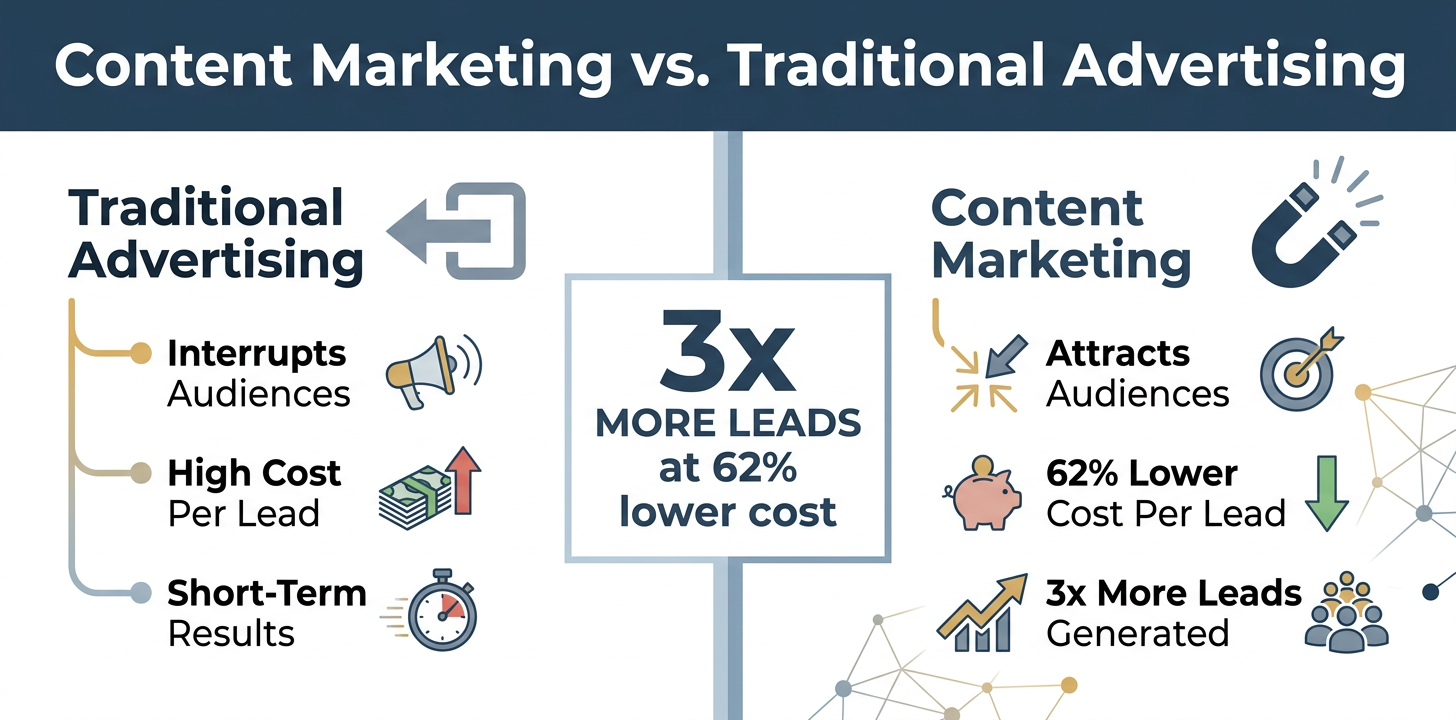
Traditional advertising pushes messages at people. Think TV commercials, banner ads, and cold calls. Content marketing works the opposite way. It pulls people in by giving them something genuinely useful, like a how-to guide, a helpful video, or an informative blog post.
This pull approach builds relationships instead of interrupting them. And that matters because today's buyers do a lot of research before they ever talk to a salesperson.
Why It Actually Works
The numbers back this up. Content marketing generates 3x more leads than outbound marketing at 62% lower cost per lead. That's not a small difference. That's a fundamentally better use of your marketing budget.
And companies that document their content strategy see 33% higher ROI compared to those without one. Yet 63% of businesses still don't have a documented strategy in place.
The Core Purpose
At its heart, content marketing is about being helpful before asking for anything in return. You create content that solves real problems for real people. Over time, that builds trust. And trust is what turns readers into customers.
If you want to see how content fits into a bigger picture, check out our guide to digital marketing strategy to understand how all the pieces connect.
The Tangible Business Benefits of a Strong Content Marketing Strategy
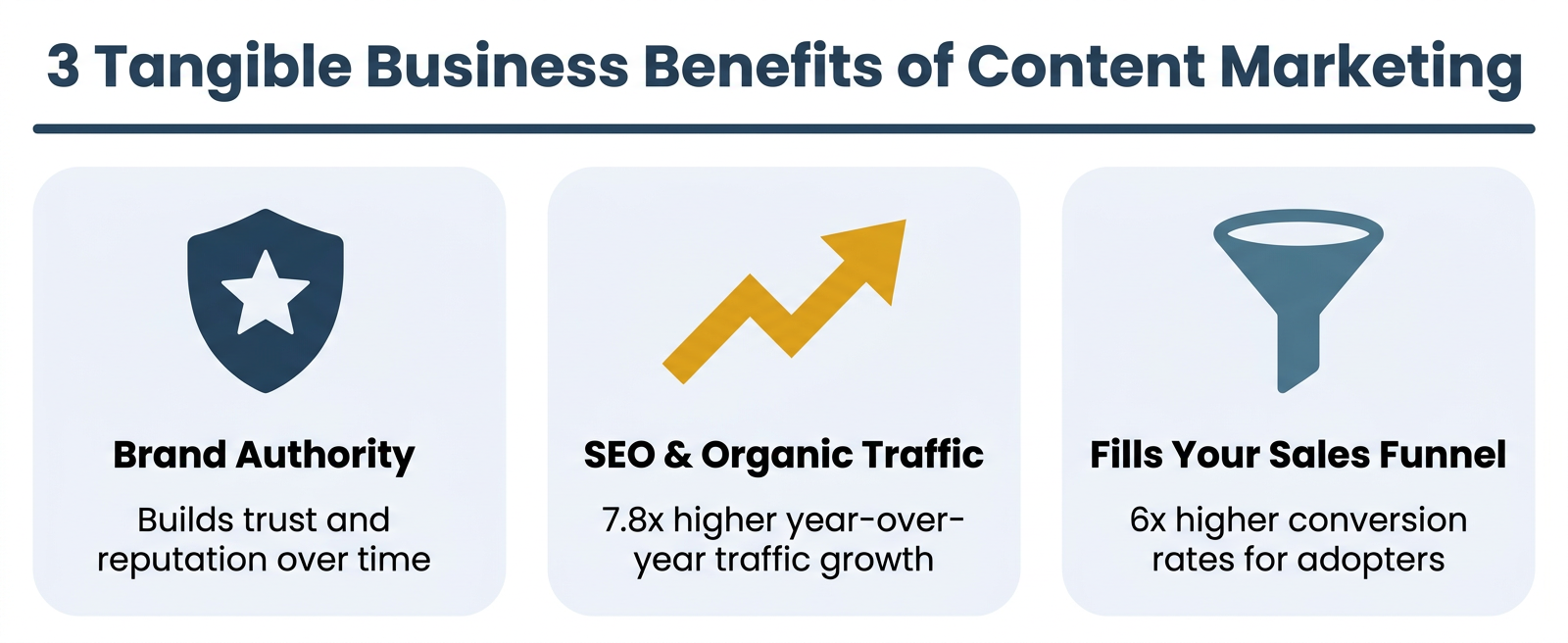
A solid content marketing strategy doesn't just look good on paper. It delivers real, measurable results across your entire business. From how people find you online to how many of them actually buy from you, the impact shows up in ways you can track and grow.
It Builds Brand Authority Over Time
When you consistently publish expert content, something important happens. People start to see your brand as a trusted resource in your space. They come back. They share your stuff. They recommend you.
This kind of authority doesn't come from one blog post. It builds up gradually as your content answers real questions and solves real problems. Over time, that reputation becomes one of your most valuable business assets.
It Powers Your SEO and Organic Traffic
Search engines reward websites that publish helpful, high-quality content. Every article you write is a chance to rank for a keyword your ideal customer is already searching for.
And the traffic compounds. Unlike paid ads that stop the moment you stop spending, a well-written piece of content can attract visitors for months or even years. Content leaders see 7.8x higher year-over-year website traffic growth compared to brands that don't prioritize content. That's a massive edge.
It Fills Your Sales Funnel
Content isn't just for awareness. Done right, it actively generates leads and nudges people toward a purchase.
Gated content like ebooks or webinars collects contact info from interested readers. Well-placed calls to action within articles guide people to the next step. And educational content helps potential buyers feel confident enough to convert.
According to research from the Content Marketing Institute, 58% of B2B marketers report that content marketing has directly increased their sales and revenue. That's a majority of businesses seeing bottom-line results.
Content marketing also produces 6x higher conversion rates for adopters compared to non-adopters. So the companies investing in strategy aren't just getting more traffic. They're turning more of that traffic into actual customers.
How to Build a Winning Content Marketing Strategy in 7 Steps
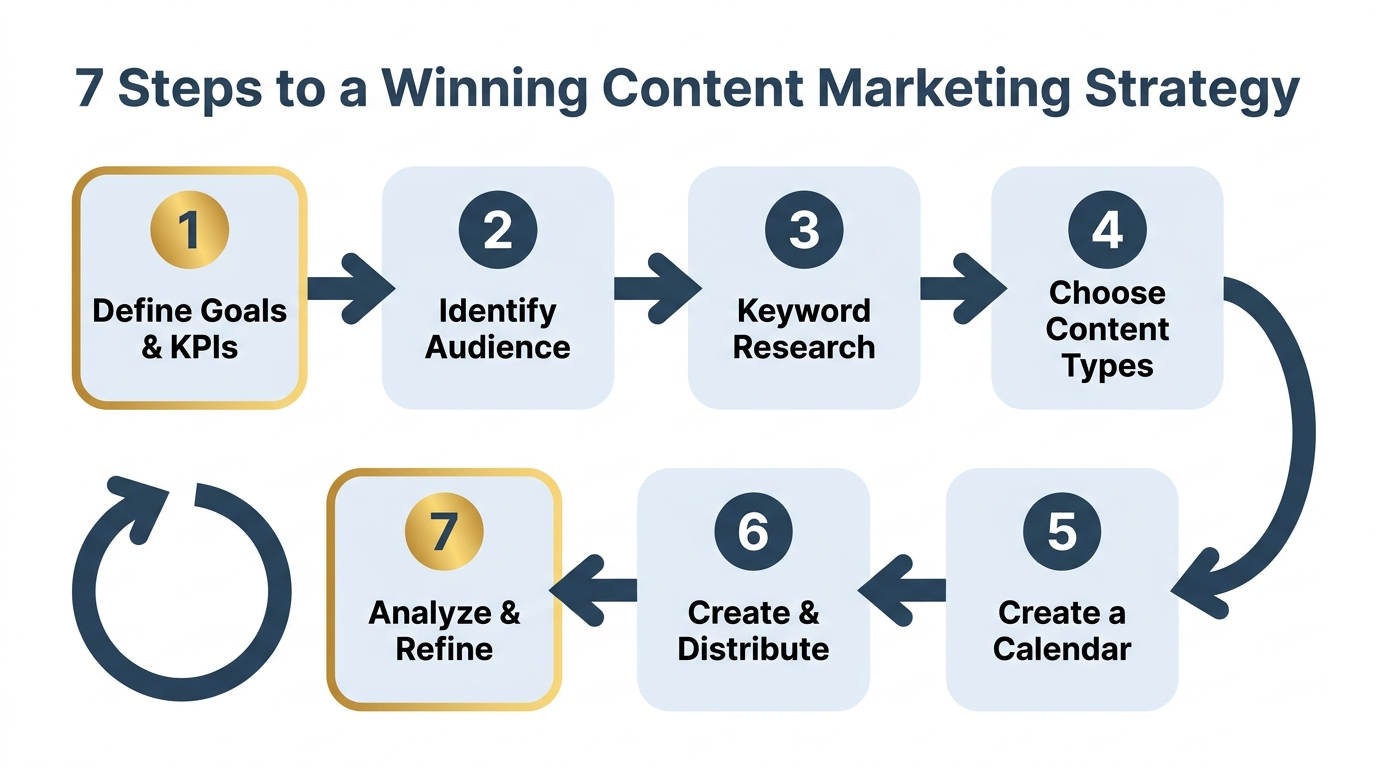
Success with content marketing doesn't happen by accident. It takes a documented strategy, not just random acts of content creation. Businesses that plan their content approach see far better results than those that publish without direction.
Here's the truth: most companies wing it. They write a few blog posts, post on social media here and there, and wonder why nothing sticks. A real strategy changes that.
According to research from Databox, having a documented content strategy directly correlates with hitting marketing goals more consistently. Yet most businesses still don't have one written down.
Here are the 7 steps we'll walk through:
- Define your goals and audience
- Audit your existing content
- Research keywords and topics
- Plan your content calendar
- Create and publish consistently
- Distribute across the right channels
- Measure results and adjust
One more thing to keep in mind: this isn't a one-and-done process. Your strategy should be reviewed at least every quarter. Markets shift, audience needs change, and what worked six months ago might need a refresh. Treat your strategy as a living document, not a finished project.
Step 1: Define Your Goals & KPIs
Before you write a single word of content, you need to know what you're trying to achieve. Without clear goals, you're just creating content and hoping something sticks. That's not a strategy. That's guesswork.
The best way to set content goals is to use the SMART framework. That stands for Specific, Measurable, Achievable, Relevant, and Time-bound. A SMART goal gives you something concrete to work toward and a way to know if you've actually hit it.
What SMART Goals Look Like in Practice
Vague goals like "get more traffic" don't help you make decisions. SMART goals do. Here are a few real examples:
- Increase organic website traffic by 20% within 90 days
- Generate 50 marketing qualified leads (MQLs) per month by Q3
- Improve keyword rankings for a target topic cluster within 60 days
- Reduce cost per lead by 15% over the next two quarters
Notice how each one is specific and has a deadline. That's what makes them actionable.
Connect Goals to the Right KPIs
Once your goals are set, you need KPIs to track them. KPIs are the metrics that tell you if you're moving in the right direction.
Here's a quick breakdown of common goals and their matching KPIs:
| Content Goal | Key KPI to Track |
|---|---|
| Increase brand awareness | Unique monthly visitors |
| Generate more leads | Conversion rate, MQLs |
| Improve SEO performance | Keyword rankings, organic sessions |
| Boost engagement | Time on page, scroll depth |
| Drive revenue | Cost per lead, sales attributed to content |
Tracking the right KPIs matters more than tracking everything. Focus on the two or three numbers that directly connect to your goal. According to research from genesysgrowth.com, teams that tie content efforts to measurable business outcomes consistently see stronger results than those that don't.
Start simple. Pick one goal. Match it to one or two KPIs. Then build from there as your strategy matures.
Step 2: Identify Your Target Audience
Knowing your goals is just the first piece. The next step is figuring out exactly who you're creating content for. Without a clear picture of your audience, even great content can miss the mark entirely.
This is where buyer personas come in. A buyer persona is a detailed profile of your ideal customer. It goes beyond basic demographics like age or job title. It digs into what problems they're dealing with, what motivates their decisions, and what questions they're asking online.
Build Personas Using Real Data
Don't guess at who your audience is. Use real sources to find out. A few good places to start:
- Customer interviews: Talk directly to your best existing customers. Ask what challenges brought them to you and what content they find helpful.
- Surveys: Use short online surveys to gather feedback from your email list or website visitors.
- Analytics tools: Google Analytics shows you who's visiting your site, what they're reading, and how long they stay. Social media insights reveal demographics and engagement patterns.
The goal is to build personas grounded in evidence, not assumptions.
Map Pain Points to Content Topics
Once you know your audience, you can connect their pain points directly to content ideas. If your ideal customer struggles with managing their time, a guide on productivity tools speaks directly to them.
This mapping process keeps your content relevant and useful. And useful content is what drives real results. Want to go deeper on this? Check out our complete guide to creating buyer personas for a step-by-step walkthrough.
Step 3: Conduct Keyword & Topic Research
Once you know your audience, you need to figure out what they're actually searching for online. That's where keyword and topic research comes in. It's how you make sure your content shows up when the right people go looking for answers.
Start With Topic Clusters and Pillar Pages
The smartest way to build search authority is through topic clusters. The idea is simple: you create one big, comprehensive article (called a pillar page) on a broad topic. Then you write several shorter articles on related subtopics, and link them all back to the pillar.
This structure tells search engines that your site covers a topic in depth. And that depth builds what's called topical authority. Sites with topical authority tend to rank higher and more consistently than sites with scattered, unrelated content.
How to Find the Right Keywords
Here's a basic process that works well for most businesses:
- Pick a seed keyword: Start with a broad term your audience would search. For example, "content marketing" or "email newsletters."
- Use a research tool: Tools like Ahrefs Keyword Generator or Semrush's Keyword Magic Tool help you find variations, related questions, and search volumes. Both offer free options to get started.
- Check search intent: Look at whether a keyword is informational (people want to learn), transactional (people want to buy), or navigational (people want to find a specific site). Match your content type to the intent.
Run a Content Gap Analysis
A content gap analysis helps you find topics your competitors already rank for that you don't cover yet. It also uncovers underserved topics where competition is low but search demand exists.
You can do this with tools like Ahrefs or Semrush by comparing your site's keyword rankings against a competitor's. The gaps you find become your next content opportunities. For a visual walkthrough, this short explainer on content gap analysis walks through the process using real tools in under two minutes.
This step alone can unlock a whole pipeline of content ideas you'd never have thought of on your own.
Step 4: Choose Your Content Types & Channels
Not all content formats work equally well for every business. Once you know your audience and your keywords, the next step is picking the right formats and the right places to share them.
Common Content Formats to Consider
There are plenty of formats to choose from. Here are the most common ones:
- Blog posts: Great for SEO, education, and driving organic traffic
- Videos: High engagement and easy to share across multiple platforms
- Podcasts: Perfect for audiences who prefer learning on the go
- Ebooks and guides: Useful for lead generation through gated downloads
- Case studies: Build trust by showing real results with real customers
- Infographics: Turn complex data into easy-to-digest visuals
- Social media content: Short, shareable posts that keep your brand top of mind
You don't need to use all of these at once. Start with one or two formats that match your strengths and resources.
Pick Formats Based on Fit, Not Trends
The best format is the one your audience actually wants. A detailed how-to guide works great for a technical B2B audience. Short videos work better for younger consumer audiences.
Topic suitability matters too. Some subjects are easier to explain visually. Others need long-form writing to do them justice. And always factor in your available time and budget. A podcast sounds great until you realize it needs consistent recording, editing, and hosting.
Match Channels to Where Your Audience Actually Is
Choosing the right channel is just as important as choosing the right format. Publishing great content in the wrong place means nobody sees it.
According to Deloitte's 2025 Digital Media Trends report, audience media consumption habits vary significantly by age and platform preference. Younger audiences lean toward short-form video on platforms like YouTube and TikTok. Professional B2B audiences are far more active on LinkedIn.
Here's a quick reference guide:
| Audience Type | Best Channels |
|---|---|
| B2B professionals | LinkedIn, company blog, email |
| General consumers | YouTube, Instagram, Facebook |
| Technical audiences | Blog, GitHub, niche forums |
| Local customers | Google Business, Facebook, local blog |
| Podcast listeners | Spotify, Apple Podcasts |
Start with one or two channels where your audience is already active. Do those well before expanding.
Step 5: Create a Content Calendar
A content calendar is a planning tool that maps out what content you'll publish, when you'll publish it, and where it will go. It keeps your team organized and makes consistency much easier to maintain.
Without one, content creation tends to become reactive. You end up scrambling for ideas at the last minute or publishing in bursts followed by long stretches of silence.
What to Include in Your Calendar
A good content calendar tracks more than just publish dates. Here are the key fields to include:
- Publish date: When the content goes live
- Topic and title: What the piece covers
- Target keyword: The primary search term it targets
- Author: Who is responsible for creating it
- Status: Draft, in review, scheduled, or published
- Distribution channels: Where it will be shared after publishing
These fields give you a full picture of your pipeline at a glance.
Tools to Manage Your Calendar
You don't need fancy software to start. A simple spreadsheet works fine. HubSpot offers a free editorial calendar template in both Google Sheets and Excel formats that you can grab and customize today.
As your team grows, dedicated tools like Asana, Trello, or CoSchedule add features like task assignments, workflow automation, and team notifications. Start simple, then upgrade when you need to.
Step 6: Execute: Create & Distribute Content
Once your calendar is ready, it's time to actually make and share content. This step is where your strategy becomes real work.
A simple creation workflow helps keep things moving without chaos. Start with an outline, then write a draft, edit it carefully, add any visuals or design elements, and finally publish. This process keeps quality consistent no matter who on your team is doing the writing.
Distribution Is Half the Battle
Creating great content is only part of the job. Getting it in front of people is just as important. Many teams put all their energy into creation and almost none into distribution. That's a mistake.
Here are the key distribution tactics to use after every publish:
- SEO: Optimize every piece so search engines can find and rank it
- Email marketing: Send new content directly to your subscriber list
- Social media: Share across the platforms where your audience hangs out
- Outreach: Let partners, collaborators, or industry sites know when you publish something worth sharing
Get More Mileage Through Repurposing
Repurposing means taking one piece of content and turning it into several. A single blog post can become an infographic, a short video, a LinkedIn post, and a few social media snippets.
This approach stretches your effort further without starting from scratch each time. According to research from Taboola's content marketing hub, repurposing content across multiple formats is one of the most effective ways to expand reach without increasing your content production budget.
Work smarter, not just harder.
Step 7: Analyze, Measure, and Refine
Content marketing is a long game. You won't see massive results overnight, and that's completely normal. Most businesses start seeing significant ROI within 3 to 6 months, with stronger compounding results appearing at the one-year mark and beyond, according to data from First Page Sage's content marketing ROI research.
But only if you're paying attention to what's working.
Set Up a Simple Tracking Dashboard
Go back to the KPIs you defined in Step 1. Those are the only numbers that matter right now. Set up a simple dashboard in Google Analytics or a tool like Google Looker Studio to track them weekly.
You don't need to monitor every metric. Focus on the two or three that connect directly to your goal. Check them on a consistent schedule so you spot trends early.
Use Data to Make Smarter Decisions
Once you have data coming in, use it to guide your next moves. Ask three questions:
- What's working? Double down on those topics, formats, and channels. Create more like it.
- What's underperforming? Update thin or outdated content before deleting it. A refresh often works better than starting over.
- What's missing? Look for keyword gaps or audience questions your content hasn't answered yet. Those become your next content opportunities.
This review cycle keeps your strategy fresh and connected to real results. Treat it as a regular habit, not a once-a-year task.
Key Questions to Ask Before Starting Your Content Strategy
- Do we have one clear, documented goal for content marketing with specific metrics (not just 'get more traffic')? If not, which KPI directly ties to our business revenue?
- Who is our ideal customer, and what specific problems are they searching for online right now that our content could solve?
- Do we have the internal capacity to execute a content strategy, or should we start with freelancers and one in-house strategist?
- Which content format (blog, video, podcast, ebook) matches both our audience's preferences and our team's ability to produce it consistently?
- How will we measure success after 90 days, and who owns the responsibility for tracking and adjusting our strategy quarterly?
- Are we prepared to commit to content marketing for at least 3-6 months before expecting significant ROI, or do we need quick wins through other channels?
Scaling with Smarts: Integrating AI into Your Content Workflow [UNIQUE SECTION]
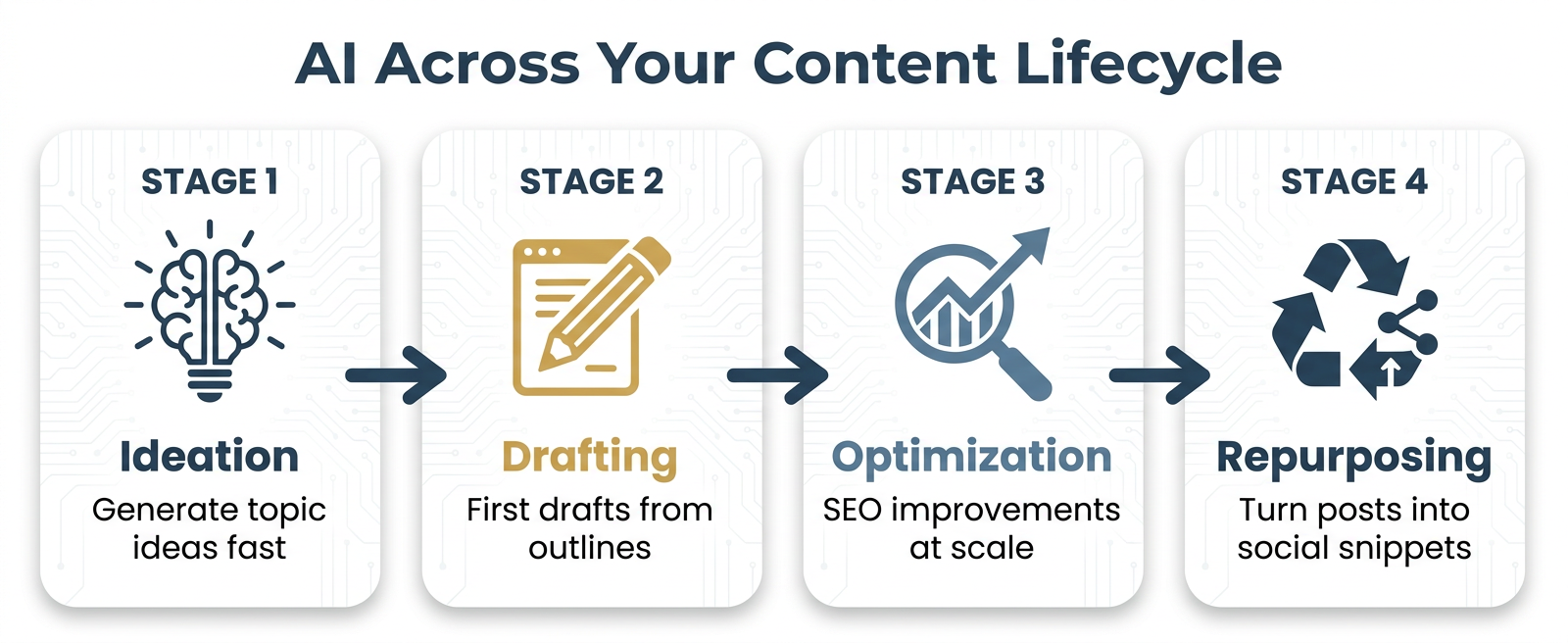
AI isn't here to replace your content team. It's here to make them faster, sharper, and more productive. Think of it as a tireless assistant that handles the repetitive parts of content creation so your team can focus on strategy, creativity, and the human touches that actually connect with readers.
Here's how AI fits into each stage of your content lifecycle:
Ideation: Generate Better Topic Ideas, Faster
Brainstorming content angles can eat up hours every week. AI tools like ChatGPT can generate dozens of topic ideas in seconds when you give it context about your audience and goals. It's a great starting point, not a final answer.
You still bring the judgment. AI brings the volume.
Drafting: Turn Outlines Into First Drafts
Tools like Jasper and Copy.ai can take a topic outline and generate a working first draft quickly. These drafts need human editing, fact-checking, and a genuine voice layered in. But they slash the blank-page problem and speed up your publishing cadence.
Global media agency Croud integrated AI workflows into their content operations and achieved 4 to 5x productivity improvements without adding headcount. That's a real-world example of what smart AI adoption looks like.
Optimization: Make Every Piece Work Harder
Once a draft exists, AI-powered tools like SurferSEO analyze your content against top-ranking competitors and suggest improvements for keyword usage, structure, and readability. This makes SEO optimization faster and more precise than doing it manually.
Summarization: Repurpose Content for Social
AI can quickly condense a long blog post into punchy social media captions, email subject lines, or short video scripts. This supports the repurposing workflow from Step 6 without requiring hours of extra writing.
Want to explore the best tools for this? Check out our guide to top AI marketing tools for a full breakdown by use case and budget.
Real-World Example: Croud's AI-Powered Content Workflow
Croud, a global media agency, integrated custom AI workflows into its content and data processes using Google Cloud's Vertex AI. They automated high-frequency tasks like email sentiment analysis, complex data analysis, coding assistance, and supplier-specific media operations. The result: 4-5x productivity improvements without adding headcount. The creative team handled significantly more work, demonstrating that AI augmentation—not replacement—delivers measurable ROI through labor efficiency and faster content cycles. This model shows how smart AI integration lets teams focus on strategy and creativity while AI handles repetitive work.
Building Your Content Dream Team: Roles and Responsibilities [UNIQUE SECTION]

So who actually does all this content work? That's one of the most common questions businesses ask when they start taking content marketing seriously. The answer depends on your size and budget. But every content operation, big or small, needs a few core functions covered.
The Core Roles You Need
Here's a quick breakdown of the key players and what they do:
- Content Strategist: Decides the what and why. They set goals, define the audience, plan topic clusters, and make sure everything ties back to business results.
- Content Creator/Writer: Handles the how. They research, write, and produce the actual content pieces. This is often the biggest time investment.
- Editor: Keeps quality high. They review drafts for accuracy, tone, clarity, and consistency before anything goes live.
- SEO Specialist: Makes content findable. They handle keyword research, on-page optimization, and track search performance over time.
In a small business, one person often wears two or three of these hats. That's completely fine to start. Just make sure none of the functions get skipped entirely.
Which Team Structure Fits Your Business?
There's no single right answer here. Each model has real trade-offs:
| Team Model | Best For | Key Trade-offs |
|---|---|---|
| Fully in-house | Established brands needing deep voice control | High fixed costs, slower to scale |
| Freelancers | Small teams, variable content needs | Flexible and affordable, but needs strong management |
| Content agency | Businesses wanting a full team fast | Broad expertise, but less brand immersion |
According to research from AMWorld Group comparing agency vs. in-house models, agencies offer immediate access to diverse specialists and scalability. But in-house teams tend to win on brand voice authenticity and cross-department collaboration over time.
The smartest move for most growing businesses? Start with one strong in-house strategist and fill gaps with trusted freelancers. Then scale from there as results build.
Start Building Your Content Engine
You've covered a lot of ground in this guide. From understanding what content marketing actually is, to building a seven-step strategy, to scaling with AI and the right team, every piece connects to one bigger idea: content marketing works when you commit to it.
The businesses that win aren't the ones with the biggest budgets. They're the ones that stay consistent, keep their audience at the center of every decision, and genuinely focus on providing value at every step.
As marketing thought leader Jeff Bullas puts it: "Successful content marketing demands a long-game mindset. Keep going, as there is no other way." That's the mindset that separates brands that grow from brands that stall.
So here's your one actionable step for today: go back to Step 1 of this guide and document one clear, measurable goal for your content marketing efforts over the next quarter. Just one. Write it down. That single act puts you ahead of the majority of businesses still operating without a plan.
Start there. Build momentum. The rest will follow.

A: HubSpot is a classic example. They offer free tools like their 'Website Grader' and a massive library of blogs, ebooks, and courses on marketing and sales. This valuable content attracts their ideal customers (businesses needing marketing help) and establishes them as an authority, naturally leading users to consider their paid software.
Q: How do you start content marketing with no budget?A: Start small and focused. Use free tools like Google Trends and AnswerThePublic for research. Focus on one content type (like a blog) and one distribution channel (like LinkedIn or SEO). Prioritize creating high-quality, in-depth content on a niche topic to build authority—consistency matters more than volume when starting out.
Q: What are the 4 main types of content?A: While many types exist, they often fall into four categories: Written (blogs, ebooks, whitepapers), Video (tutorials, webinars, brand stories), Audio (podcasts), and Visual (infographics, charts, social media graphics). A good strategy typically uses a mix of these formats based on your audience and resources.
Q: How can marketing agencies use content marketing to get clients?A: Agencies should publish detailed case studies of client successes, write blog posts solving specific marketing challenges their target clients face, and create lead magnets like 'The Agency's Guide to Local SEO' to capture leads from potential clients. This approach proves expertise while building trust.
Q: How will AI change the future of content marketing jobs?A: AI will shift jobs from pure creation to strategy and editing. Roles will focus on prompt engineering to guide AI for better first drafts, high-level strategy and audience research, and fact-checking with human insight added to AI-assisted content. The emphasis will shift to creative direction rather than manual writing.