
Hannon Brett | Published on: June 8, 2026 | Time to read: 22 min | Last Updated on: June 8, 2026
What Are AI Native Marketing Services?
AI native marketing services are marketing programs built from the ground up with AI at their core. They're not tools added to an existing workflow. Instead, AI handles the decisions, the targeting, the content, and the optimization all at once. Think of it as a fully integrated marketing operating system, not a set of separate software features.
AI Native vs. Traditional vs. AI-Assisted
There's a real difference between these three approaches, and it matters a lot for your results.
Traditional digital marketing relies on humans doing most of the work: analyzing data manually, writing briefs, adjusting budgets, and reviewing performance weekly or monthly. It's slow and often reactive.AI-assisted marketing takes that same traditional setup and adds AI features on top. Think of AI writing tools bolted onto an old email platform, or a predictive scoring widget added to a legacy CRM. The foundation hasn't changed. The AI is just a helper.AI native marketing services are different at the architecture level. AI isn't a feature here. It's the engine. Audience segmentation, creative generation, budget allocation, and performance feedback loops all run through AI systems by design, not by addition.Built From the Ground Up
When a marketing service is truly AI native, it impacts every layer of how work gets done. Audience segments are built dynamically, not uploaded from a spreadsheet. Ad creative is generated and tested automatically. Budget flows toward what's working in real time, not after a monthly review meeting.
This design shift means better speed, tighter feedback loops, and more consistent personalization across every channel.
From Reactive to Predictive
One of the biggest changes AI native services bring is the shift from reactive analysis to predictive, automated execution. Traditional teams look at what happened last week. AI native systems look at what's likely to happen next and act on it before the opportunity passes.
According to the 2024 State of Marketing AI Report, 51% of marketing teams were already piloting or scaling AI in 2024. That's up from 42% the year before. The category is moving fast.
As one industry analysis puts it, the AI native agency is no longer a future category. It's here now, and the gap between AI native and AI assisted is widening every quarter. Teams that treat AI as an add-on will keep falling behind teams that built their marketing around it from the start.
"AI-Native" vs. "AI-Assisted": A Critical Distinction
Not every agency that says "AI" actually means the same thing. There's a real and important gap between using AI tools inside a traditional workflow and building your entire marketing operation around AI from the start. Getting this distinction wrong can cost you time, budget, and competitive ground.
AI-Assisted: Sharper Tools, Same Kitchen
AI-assisted marketing means a human-led team picks up AI tools to work faster. A strategist might use a writing tool to draft ad copy. A designer might generate image variations with an AI image tool. A media buyer might use a predictive feature inside their ad platform.
But here's the thing: the strategy is still human-driven. The workflow is still the old workflow. The AI is helping people do their jobs more quickly. It doesn't change how decisions get made or how the system adapts over time.
Think of it like giving a chef a sharper knife. The chef is still doing all the thinking. The knife just makes the cutting faster.
AI-Native: A Fully Automated Kitchen
AI-native marketing is built differently from the ground up. Instead of humans running a workflow with AI tools plugged in, the AI system itself analyzes incoming data, generates strategic recommendations, and automates execution across channels simultaneously.
Using the same analogy: an AI-native setup is like giving that chef a fully automated kitchen. The kitchen monitors what ingredients are available, learns what diners prefer, suggests recipes based on both, and adjusts the cooking process in real time. The chef still sets the goal. But the system handles the orchestration.
According to ActiveCampaign's breakdown of AI-native marketing, true AI-native platforms don't just assist humans. They are built so AI handles decisioning, adaptation, and optimization as core functions rather than add-on features.
Why the Gap Matters Strategically
This isn't just a technical distinction. It's a strategic one. When AI is only assisting, your output speed improves but your decision quality still depends on human bandwidth and judgment.
When AI is native to the system, feedback loops close faster. Audience segments update automatically. Budget shifts toward what's working without waiting for a weekly review meeting. Personalization scales without adding headcount.
Research from Forrester on generative AI points to how AI technologies that generate content and recommendations from existing data are changing what's possible in marketing execution. But that potential is only fully unlocked when AI is embedded in the architecture, not bolted on top of legacy tools.
A Quick Side-by-Side
| Factor | AI-Assisted | AI-Native |
|---|---|---|
| Strategy ownership | Human-led | AI-informed, human-approved |
| Workflow structure | Traditional with AI features | Built around AI from day one |
| Decision speed | Weekly or manual reviews | Real-time or near real-time |
| Personalization scale | Limited by team capacity | Scales automatically |
| Optimization loops | Reactive | Predictive and continuous |
The takeaway is simple. If you're evaluating ai native marketing services, ask the agency one direct question: is AI doing the work, or is it helping people do the work? The answer tells you almost everything about what you're actually buying.
The Strategic Advantages of AI Native Marketing
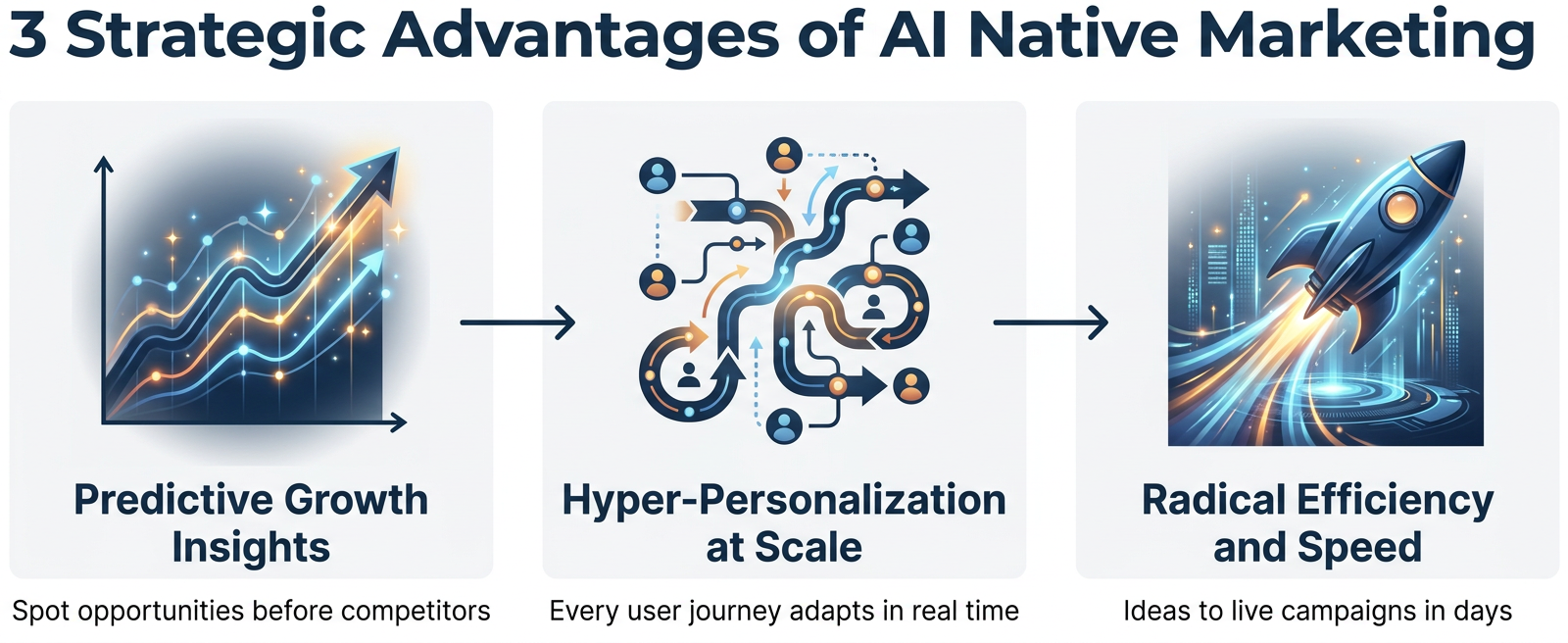
AI native marketing services give businesses a real competitive edge by moving from slow, reactive processes to fast, predictive ones. The core advantages come down to three things: smarter growth insights, deeper personalization, and dramatically faster execution.
Benefit 1: Predictive Growth Insights
Most marketing teams spend their time looking backward. They pull last month's numbers, figure out what worked, and adjust. That cycle takes weeks. By then, the opportunity may already be gone.
AI native marketing flips that model. Instead of analyzing past performance after the fact, these systems scan patterns in real time and flag high-value audience segments before competitors even notice them. The system predicts where demand is heading, not just where it's been.
This matters a lot in crowded markets. Getting to the right audience first, with the right message, is often the difference between winning and chasing. Predictive insights make that possible without requiring a team of analysts.
For context on how quickly this shift is happening: according to Patagon AI's 2024 marketing AI roundup, 56% of marketers said their company is now taking an active role in implementing and using AI. Teams not building predictive capability into their strategy are already falling behind.
Benefit 2: Hyper-Personalization at Scale
Personalization used to mean using someone's first name in an email subject line. That's table stakes now, and it doesn't move the needle.
True hyper-personalization means the entire user journey changes based on behavior. The offer someone sees, the content on a landing page, the follow-up sequence in email, all of it shifts in real time depending on what that person actually does. Not what segment they were dropped into last quarter.
This kind of dynamic personalization was impossible to do at scale without AI. There are simply too many variables for a human team to manage across thousands or millions of users.
And the payoff is significant. Research consistently shows that personalization delivers 5 to 8 times return on marketing spend, with 89% of marketers reporting a positive ROI from personalization efforts. AI native systems make those numbers achievable for companies that aren't running massive in-house data science teams.
Benefit 3: Radical Efficiency and Speed
Setting up a campaign the traditional way takes time. Strategy, briefs, creative, approvals, launch, then wait for data. The whole cycle can stretch across weeks.
AI marketing automation compresses that timeline significantly. Campaign structures get built automatically. A/B tests run and resolve without a human having to check in daily. Budget allocation shifts toward what's performing, in real time, not after a weekly review.The practical result is that teams can go from idea to live campaign in days instead of weeks. And they can run more experiments at once, which means faster learning and better results over time.
This isn't just about saving hours. It's about competitive speed. In fast-moving markets, the team that can test, learn, and adapt fastest wins. AI native infrastructure makes that kind of pace sustainable without burning out the team behind it.
Real-World Predictive Analytics Case Study
An e-commerce brand implemented predictive analytics to score website visitors based on browsing behavior and past purchase history. Marketing then used these scores to trigger targeted offers and real-time product recommendations for high-intent users. This AI-driven targeting produced an 18% lift in conversion rate and a 22% drop in cost per acquisition (CPA). The result demonstrates how predictive analytics embedded in an AI-native system can directly improve marketing efficiency and bottom-line performance without requiring a large in-house data science team.
Core Components of an AI Native Marketing Service Offering
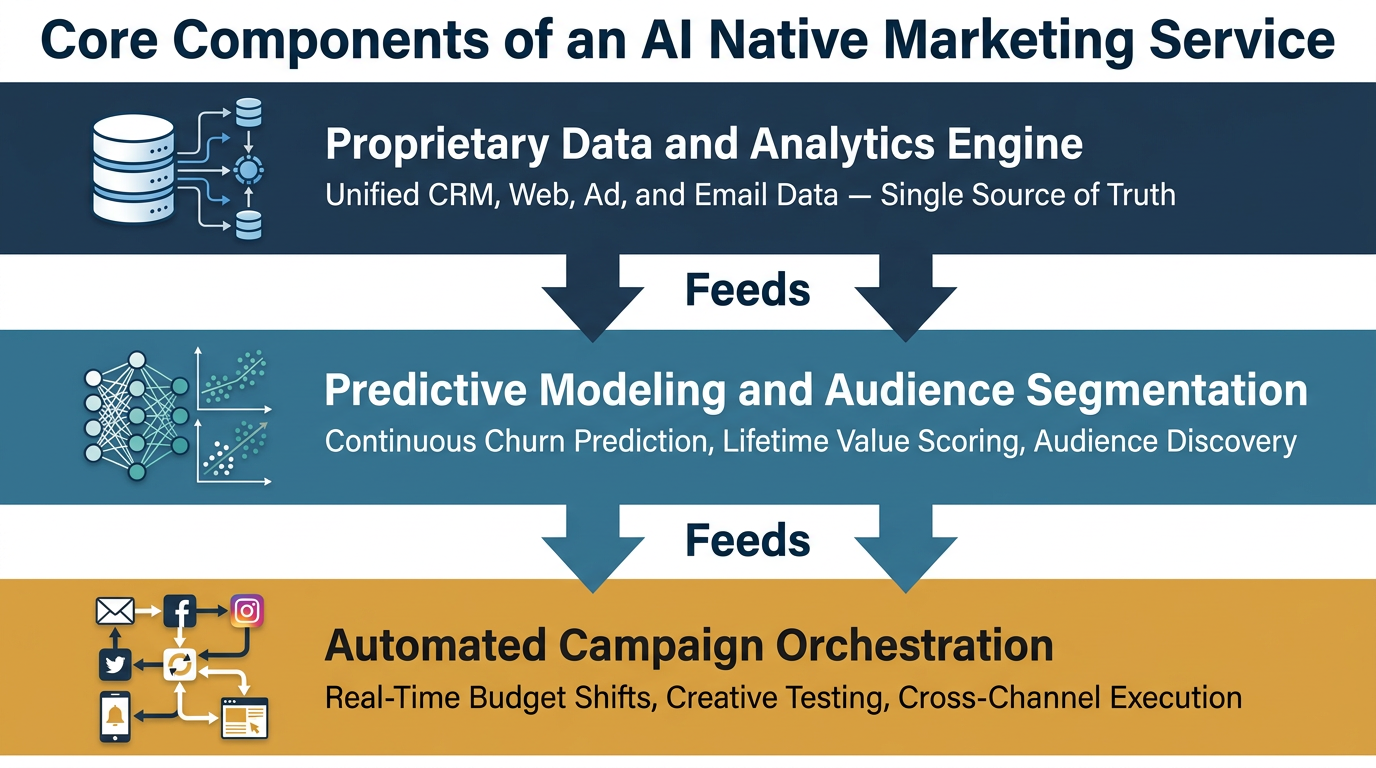
An AI native marketing service is built on three core systems working together: a unified data engine, predictive modeling, and automated campaign orchestration. Each layer feeds the next. Without all three, you don't have an AI native service. You have an AI-assisted one.
Proprietary Data and Analytics Engine
Everything in an AI native setup starts with data. Specifically, it starts with clean, unified data from every source your customer touches: your CRM, your website, your ad accounts, your email platform, and more.
Most traditional marketing stacks store this data in silos. Your ad data lives in one tool. Your email data lives in another. Your CRM is somewhere else entirely. Nobody has a full picture of what any one customer has done or needs next.
A proprietary data engine solves that. It pulls all of those sources into a single, centralized platform. The result is one consistent view of each customer across every channel. Marketers and analysts call this a "single source of truth."
Why does this matter so much? Because AI models are only as good as the data they run on. If the data is fragmented or inconsistent, the predictions and automations built on top of it will be wrong. Garbage in, garbage out.
With clean, unified data, the AI can actually learn. It can spot patterns across channels. It can connect a paid ad click to an email open to a purchase three weeks later. That full picture is what makes real personalization and prediction possible.
Predictive Modeling and Audience Segmentation
Once the data is unified, the next layer is prediction. This is where AI native services start to look very different from traditional or even AI-assisted approaches.
Predictive models use historical behavior and real-time signals to forecast what's likely to happen next. Which customers are about to churn? Which leads have the highest lifetime value potential? Which audience segments are growing but haven't been targeted yet?
These are questions that traditional teams answer slowly, if at all. A human analyst might build a churn model once per quarter. An AI native system runs that model continuously.
Research from GrowthStats on predictive analytics in marketing highlights how companies using predictive scoring consistently outperform those relying on manual segmentation. In one documented e-commerce case, predictive scoring drove an 18% lift in conversion rate and a 22% drop in cost per acquisition. Those aren't marginal gains.
The other major advantage here is audience discovery. Instead of only targeting audiences you already know about, AI models can surface new high-potential clusters based on behavioral similarity. You find customers you didn't know to look for.
Automated Workflow and Campaign Orchestration
The third component is where the strategy turns into action. And in an AI native service, a lot of that action happens without someone manually clicking buttons.
Automated campaign orchestration means the system can launch campaigns, monitor performance, shift budget toward what's working, pause what isn't, and test creative variations. All of this happens across multiple channels at once: paid search, social, email, display, and more.
This isn't the same as setting up a basic email automation sequence. True orchestration means the system responds to live performance data. If a campaign is underperforming on one channel, it shifts resources. If a new audience segment is converting at a higher rate, it adjusts targeting.
According to Splunk's breakdown of AI-native architecture, AI-native systems are designed so that AI handles decisioning and adaptation as core operating functions, not as optional add-ons. That's exactly what good campaign orchestration looks like in practice.
The practical result is that campaigns can go live faster and optimize themselves continuously. Teams spend less time managing execution and more time setting strategy, reviewing results, and making high-level decisions.
Together, these three components create a marketing system that learns from its own data, predicts what customers need, and acts on those predictions at scale. That's what separates a genuine AI native marketing service from a platform that just uses the word "AI" in its pitch deck.
How to Choose the Right AI Native Marketing Partner
Choosing the right AI native marketing partner comes down to three things: what their technology actually does, what results they've proven, and whether they understand your business well enough to act as a real strategic partner. Ask the wrong questions and you'll end up paying for rebranded traditional services with an AI label slapped on top.
Scrutinize the 'Proprietary AI' Claim
Almost every agency today says they use AI. Very few can show you a system that actually does what they claim. Before signing anything, ask for a live demo of their platform.
Watch closely for what the system does on its own versus what a human does manually. A genuine AI native setup will show you automated audience segmentation, real-time budget optimization, and creative testing running without someone clicking buttons. If what you see is a familiar third-party tool with a custom dashboard on top, that's a wrapper, not a platform.
This matters because AI washing is a real and growing problem. Common red flags include vague claims like "AI-powered" with no specifics, inability to explain the underlying model, and deliverables that look like standard outsourced work. If they can't clearly explain what the AI does, what it doesn't do, and where humans stay involved, that's your answer.
Evaluate Strategic Expertise, Not Just Tool Fluency
The best AI marketing agencies don't just operate a platform. They act as strategic consultants who understand your business model, your audience, and the competitive dynamics of your market.
Ask them: "How would you approach customer acquisition for a business like ours?" Their answer tells you whether they're thinking strategically or just looking for a campaign to plug into their system.
According to a practical guide on questions to ask before hiring an AI marketing agency, the best agencies can clearly explain not just what they'll do, but why it's the right approach for your specific situation. Generic answers are a red flag.
A true partner will also be honest about fit. If they're not asking questions about your goals, your data, and your existing stack, they're selling you a product rather than solving your problem.
A Quick Evaluation Checklist
| Criteria | What to Look For | Red Flag |
|---|---|---|
| AI platform | Live demo with real automation | Thin wrapper over public APIs |
| KPI Focus | Revenue, CAC, CLV results | Vanity metrics only |
| Strategic depth | Business model understanding | Generic pitch for any client |
| Transparency | Clear explanation of AI role | Vague "proprietary" claims |
| Data handling | Defined governance and privacy | Evasive on data questions |
Take your time with this evaluation. The right AI native marketing partner will welcome hard questions. The wrong one will answer every question with a polished slide deck and no real specifics.
Critical Questions to Ask Before Selecting an AI Native Marketing Partner
- Can you demonstrate a live platform showing real automation in audience segmentation, budget optimization, and creative testing—or is this a wrapper over third-party tools?
- What specific revenue, CAC, or CLV improvements have you driven for clients similar to our business, and can you quantify the lift with hard numbers?
- How would you approach customer acquisition and retention for a business with our specific model, and what assumptions are you making about our market?
- Where do humans stay involved in your process, and where does AI make autonomous decisions—and how do you measure the AI's actual contribution to results?
- What is your data governance model, and how do you handle privacy, security, and our proprietary customer information?
- What would make you tell us we're not a good fit for your services?
- How long does it typically take to see measurable improvements, and what baseline metrics should we establish before launch?
- Will you accept an outcome-linked fee structure tied to revenue lift or CAC reduction, or is pricing purely based on platform usage or hours?
- How do you stay current with AI model improvements, and how often will the underlying system update without disrupting our live campaigns?
- Can you clearly explain what your AI actually does, what it cannot do, and where you see limitations compared to your own internal capabilities?
Measuring ROI from Your AI Native Marketing Investment
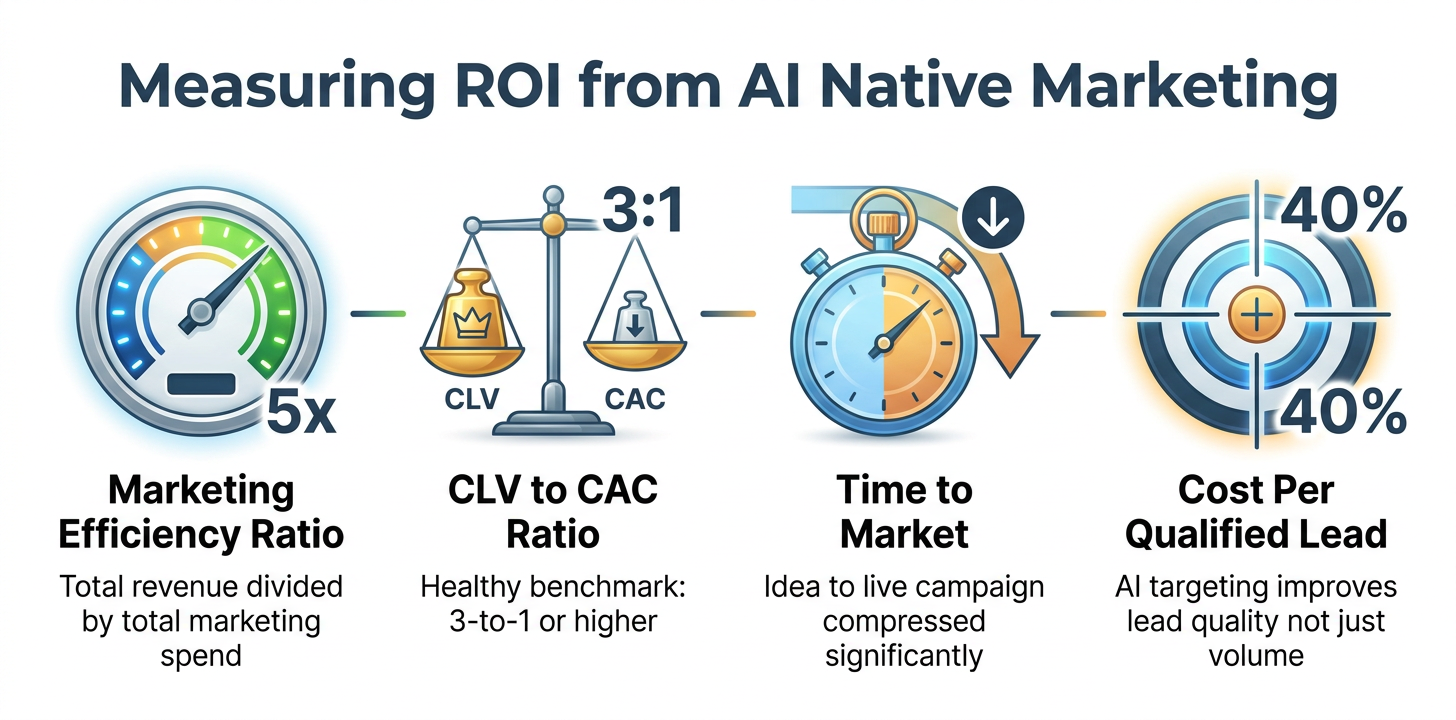
Measuring ROI from AI native marketing services means going beyond simple ad spend returns. The real picture shows up in efficiency ratios, customer lifetime value, and operational speed. Without the right metrics and a clear starting baseline, you cannot tell if the AI is actually working.
Move Beyond ROAS to Holistic Metrics
Return on Ad Spend tells you how much revenue a campaign generated per dollar spent. That is useful, but it is a narrow view. It misses a lot of the value that AI native systems actually deliver.
Two better measures to track are the Marketing Efficiency Ratio and your CLV to CAC ratio. MER looks at total revenue divided by total marketing spend across all channels. It gives you a full-picture view instead of isolating one campaign.
The CLV to CAC ratio compares how much a customer is worth over time against what it cost to acquire them. A healthy ratio sits at 3 to 1 or higher. Falling below that signals a real problem with acquisition economics.
When AI native marketing is working well, you should see that ratio improve over time. The AI gets better at finding the right customers, which lowers acquisition cost while retaining more of the right buyers.
Track Operational KPIs That Show the Real Impact
Some of the most telling indicators are not financial at all. They are operational. These metrics show where the AI is actually changing how work gets done.
Here are three to track from day one. First, time to market for new campaigns. How long does it take from idea to live campaign? AI native systems should compress this significantly compared to your pre-AI baseline. Second, cost per qualified lead. Not just cost per lead, but cost per qualified lead. AI targeting should improve lead quality, not just volume. Third, predictive model accuracy. If your AI native partner uses forecasting models, track how often those predictions hold up. Improving accuracy over time is a sign the system is learning.
A useful approach recommends tracking metrics at three layers: campaign level including ROAS and CPA, pipeline level including lead-to-opportunity rates, and business outcome level including revenue lift and retention. Together, these tell a complete story.
Establish a Baseline Before You Start
This step sounds simple. But it is the one most teams skip, and it makes everything else harder.
Before any AI native system goes live, record your current numbers. That means your average cost per acquisition, your campaign launch timelines, your lead quality rates, and your CLV to CAC ratio. Cover at least one full business cycle so seasonal swings do not skew the comparison.
Without that baseline, you have no way to prove improvement. You will have numbers after implementation, but no context for whether those numbers are better, worse, or just different.
The standard ROI formula applies here: net benefits divided by total costs, multiplied by 100. But net benefits needs to include both hard returns like revenue and cost savings and soft returns like hours saved and faster turnaround times. Do not forget to count the full cost of the AI system either, including setup, data integration, and ongoing management.
Get the baseline right first. Everything else in your measurement model builds on it.
Your Next Step in AI Native Marketing
AI native marketing services are not a trend you can wait out. They represent a fundamental shift in how marketing decisions get made, how campaigns get executed, and how businesses grow. The gap between teams that have adopted this approach and those still relying on manual workflows is widening every quarter.
The core message from this guide is straightforward. AI native marketing is a strategic imperative, not a nice-to-have technology upgrade. It delivers predictive growth insights, personalization at real scale, and operational speed that traditional setups simply cannot match.
But the label means nothing without the substance behind it. The right partner has a demonstrable platform, proven business results, and the strategic thinking to apply AI to your specific situation. The wrong partner just uses common AI tools under a polished brand.
So here is your clear next step: go back to the evaluation checklist in this guide and use it. Audit your current marketing capabilities against each criterion. Then use the same checklist to vet any potential AI native marketing partner you speak with.
Ask hard questions. Request live demos. Push for case studies tied to real business outcomes. The right partner will welcome every question. And that's how you know you've found them.
For businesses ready to take the next step, developing a comprehensive AI marketing strategy is essential to maximize the potential of AI native services and ensure alignment with your growth objectives.

AI-native marketing refers to a fully integrated marketing operating system where artificial intelligence is the foundational core, handling audience segmentation, creative generation, budget allocation, and real-time optimization as core functions rather than add-on features. Unlike AI-assisted marketing, which uses standalone AI tools to help with specific tasks, AI-native systems are built from the ground up with AI embedded in the architecture to drive decisioning, adaptation, and optimization across all marketing processes.
What is an AI-driven marketing operating model?An AI-driven marketing operating model is a new structure for marketing teams and processes that centralizes data into an integrated AI platform, automates repetitive tasks like reporting and A/B testing, and empowers human marketers to focus on high-level strategy and creative oversight. The model shifts the team's focus from manual execution to managing and directing an AI system to achieve business goals, with AI handling real-time budget shifts, audience updates, and personalization at scale without waiting for weekly review meetings.
Why choose an AI-native agency for SaaS marketing?SaaS businesses are uniquely positioned to benefit from AI-native marketing due to their data-rich environments including product usage data and subscription metrics. An AI-native agency can leverage this data to build sophisticated predictive models that identify churn risk, flag up-sell opportunities, and precisely target high-value user segments, leading to better unit economics (improved LTV:CAC ratios) and faster growth compared to traditional or AI-assisted approaches.
How do AI native marketing services handle creative tasks like copywriting and design?AI-native services use a hybrid approach where generative AI models produce hundreds of variations of ad copy, email subject lines, and design concepts automatically. The AI system then tests these variants at scale to identify top performers. The human marketer's role evolves to setting creative direction, refining the AI's best outputs, and ensuring brand alignment, rather than manually creating every single asset, enabling faster iteration and more consistent personalization.
Is hiring an AI native marketing agency expensive?While initial investment may be higher than a traditional agency, the focus is on total value and ROI rather than hourly rates. AI-native services drive efficiency by automating tasks that would require significant human hours and more effectively allocating ad spend based on predictive data, often delivering a superior Marketing Efficiency Ratio and higher long-term return on investment that justifies the upfront cost.